Blue Tsunami Sweeps Texas: What 5 Things Could Change for Employers After Midterm Elections?
Texas voters reshaped the state’s political leadership when they elected a slate of Democratic candidates into federal, state, and local offices this Election Day. For Texas employers, the “Blue Tsunami” could bring renewed attention to proposals involving minimum wages, paid leave, workplace heat protections, and noncompete agreements, just to name a few. With the Texas Legislature divided, the election results set the stage for renewed debate over workplace policy. Which proposals will advance? What form might they take? Will they become law? Here are five workplace issues Texas employers should track.
🔵 Selected Scorecard: Where Democrats Won in Texas
Some of the key election wins for Democrats included Gina Hinojosa as governor, Vikki Goodwin as lieutenant governor, Nathan Johnson as attorney general, and James Talarico in the US Senate. Democrats also won in races for state comptroller, land commissioner, agriculture commissioner, and railroad commissioner, not to mention seven statewide judicial elections, including four Texas Supreme Court seats. Democrats also won control of the Texas House of Representatives, but Republicans retained control of the State Senate.
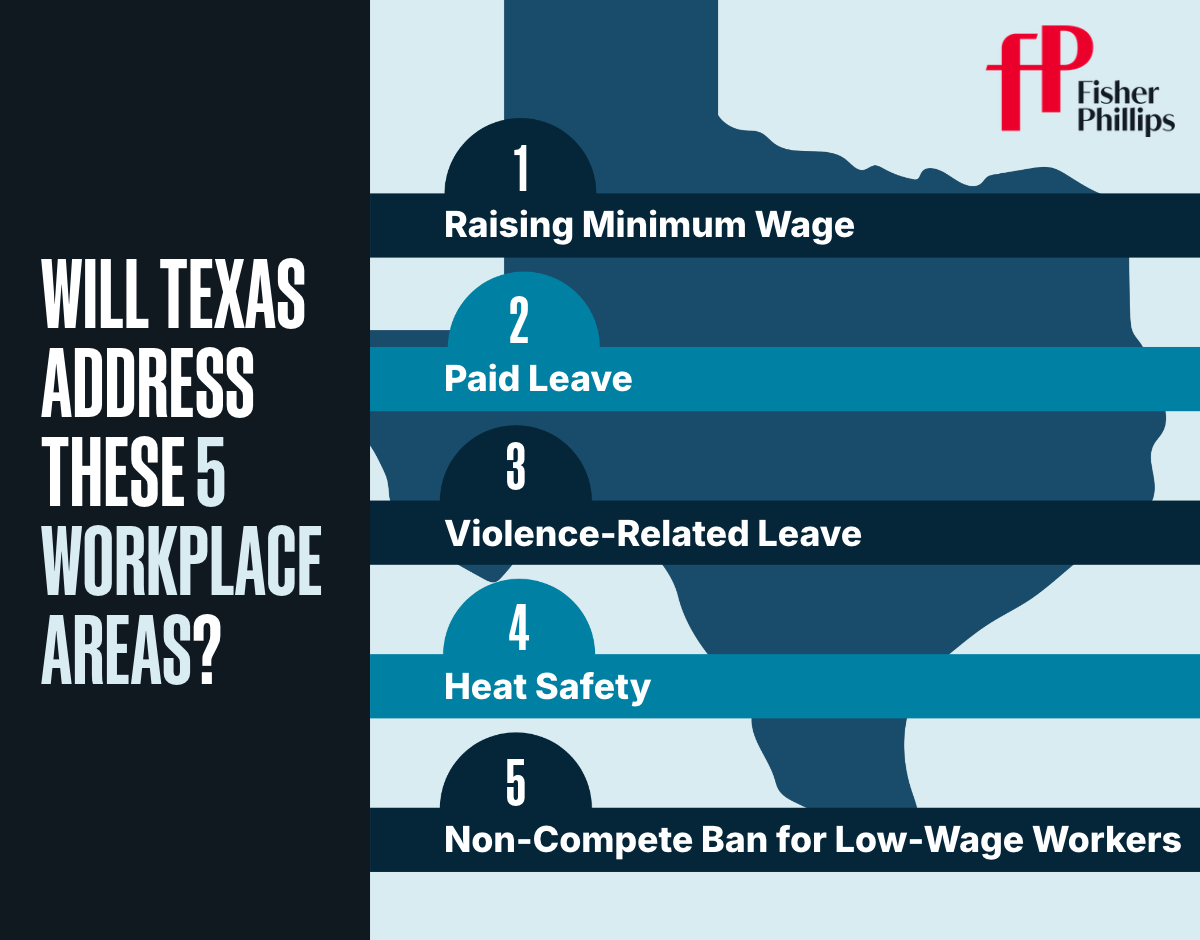
1. Renewed Interest in a Higher Minimum Wage
A higher statewide minimum wage could become a prominent issue in the next legislative session. During his service in the Texas House, Talarico authored H.B. 5297, which proposed increasing the minimum wage to $15 per hour. Goodwin has also publicly supported increasing the minimum wage.
Although they have not yet taken office, at least 13 incoming Texas House members have publicly advocated for a higher minimum wage. Their support suggests that proposals to raise the statewide minimum wage could gain attention in the newly constituted House.
With any new proposal that gets put forward, you should pay as much attention to the details as the proposed hourly rate. Specifically, watch for implementation dates, phased increases, treatment of tipped employees, and any exceptions. You can begin assessing how a higher wage floor could affect your payroll budgets and compensation differences between entry-level employees and more experienced (and even managerial) workers.
2. Paid Family and Medical Leave Proposals Could Resurface
During his service in the Texas House, Talarico authored H.B. 5326, which proposed a statewide paid family and medical leave program. It contemplated participation by employers with at least one employee, employer contributions to a state fund, and partial wage replacement for qualifying employees. Benefits generally would have equaled 67% of an employee’s average wages, subject to statutory minimums and maximums. It also included protections against adverse employment actions based on requesting or using covered leave.
That bill offers one example of an approach lawmakers could consider. We’ll be tracking whether similar legislation will be introduced in 2027, and how it might address coverage, funding, benefits, and coordination with existing leave programs.
3. Potential Consideration of Leave for Employees Experiencing Violence
Lawmakers could also revisit proposals supporting employees experiencing domestic violence, sexual assault, or stalking. Talarico previously authored H.B. 5321, which proposed protected leave and accommodations for qualifying employees. It would have prohibited employers from penalizing covered employees for taking time off to seek protective orders, restraining orders, or other relief related to their safety or their children’s safety.
If the issue returns in 2027, you should track the proposed coverage, permitted reasons for leave, and notice and documentation provisions.
4. Workplace Heat Safety May Receive Further Attention
Workplace heat safety is another subject that could receive legislative attention. Talarico previously authored H.B. 446, which proposed heat illness prevention measures, employee and supervisor training, and protections against retaliation for reporting heat illness or exercising rights under the proposed law. It also contemplated training materials in a language employees understand and addressed heat exposure in industries including construction, agriculture, warehousing, and manufacturing.
If you have employees working in hot environments, you’ll want to follow developments as part of your ongoing workplace safety planning.
5. Lawmakers Could Revisit Noncompetes for Lower-Wage Employees
Noncompete agreements for lower-wage employees could also become a subject of discussion. During her service in the Texas House, Hinojosa authored H.B. 1043, which proposed prohibiting certain private employers from requiring lower-wage employees to enter into noncompete agreements and making covered agreements unenforceable. The proposal used a wage threshold tied to the greater of $15 per hour or the applicable federal minimum wage.
Hinojosa’s prior sponsorship offers insight into her policy interests as the incoming administration develops its legislative agenda. If you use noncompetes, follow the expected developments concerning coverage, treatment of existing agreements, and effective dates.
Divided Government Leaves Outcomes Uncertain
Republicans will retain control of the Texas Senate by at least a 19-12 split, where incoming Lieutenant Governor Vikki Goodwin will preside and cast the deciding vote in the event of a tie. This means that Democrats will need to work with their Republican counterparts to craft bipartisan proposals if they want to advance their agenda.
What Should Texas Employers Do Now?
During this interim period while we wait for Democrats to assume control of so many positions, you should prepare for several possible outcomes:
- Monitor new legislation addressing wages, leave, heat safety, and restrictive covenants. The best way to stay up to speed is to subscribe to Fisher Phillips’ Insight System to get the most up-to-date information.
- Model potential costs associated with wage increases or employer-funded leave programs.
- Inventory relevant policies and agreements so you can efficiently evaluate them as proposals develop.
- Coordinate internally among HR, payroll, operations, finance, and legal teams to identify implementation questions early.
Conclusion
We’ll continue to monitor developments and provide the most up-to-date information directly to your inbox, so make sure you are subscribed to Fisher Phillips’ Insight System. If you have questions, contact your Fisher Phillips attorney, the authors of this Insight, or any attorney in our Texas offices.
Related People