

The Supreme Court will likely rule in favor of President Trump in a critical pending case that should be decided in early 2026, vastly expanding the president’s power to remove members of independent agencies. That’s according to the consensus predictions of our firm’s thought leaders monitoring Trump v. Slaughter, a high-stakes case that centers on challenges to statutory removal protections for members of the Federal Trade Commission (FTC). But whatever the court decides could ultimately have sweeping implications for other independent agencies like the Employment Opportunity Commission (EEOC) and the National Labor Relations Board (NLRB) – not to mention the fundamental structure of the federal government itself. Read on for an analysis of the issues, our specific predictions on how SCOTUS will decide the case, and how a final decision in 2026 could impact employers for years to come.
Quick Background
Earlier this year, President Donald Trump fired two Democratic Commissioners of the Federal Trade Commission (FTC) without articulating a specific cause. After former Commissioner, Rebecca Kelly Slaughter, challenged her termination as unlawful and was reinstated by a federal district court in July, the Trump administration appealed and challenged Slaughter’s statutory removal protections as unconstitutional.
The Supreme Court agreed in September to hear the case and blocked Slaughter’s reinstatement while the lawsuit continues to play out.
Overview of the Issues
At issue in Trump v. Slaughter is a century-old federal law and a 1935 Supreme Court decision:
- The FTC Act establishes the agency’s powers and provides that commissioners may be removed by the president for “inefficiency, neglect of duty, or malfeasance.”
- In Humphrey’s Executor v. United States, SCOTUS upheld the constitutionality of for-cause removal protections in the FTC Act. The unanimous Court at that time said that because FTC commissioners were “charged with duties neither political nor executive, but predominantly quasi-judicial and quasi-legislative,” the power of Congress to establish those protections prevailed over the president’s removal power.
The Supreme Court will soon decide:
- whether the FTC Act’s statutory removal protections violate the separation of powers and, if so, whether Humphrey’s Executor should be overruled; and
- whether a federal court may prevent a person’s removal from public office, either through relief at equity or at law.
For more background on Trump v. Slaughter, check out our prior FP insight.
What’s the Latest?
The Supreme Court heard arguments in Trump v. Slaughter on December 4. Below are some of the highlights.
- Trump’s solicitor general argued that many FTC functions, such as rulemaking, adjudications, and investigations are “quintessentially executive.” He said that Humphrey’s Executor has become a “decaying husk” that tempts Congress to erect a “headless fourth branch insulated from political accountability and democratic control.” Gen. D. John Sauer advocated for no restrictions on the president’s removal powers when it comes to multi-member agencies wielding executive powers, such as – according to Sauer – the FTC or the NLRB. The administration asked the Court to explicitly overrule Humphrey’s Executor and “restore the separation of powers to our government.”
- Slaughter’s lawyer, Amit Agarwal, stressed that “multi-member commissions with members enjoying some kind of removal protection have been part of our story since 1790.” He argued that “if Petitioners are right, all three branches of government have been wrong from the start.” Mr. Agarwal noted that traditional multi-member regulatory commissions have always involved a blend of lawmaking, adjudicatory, and enforcement actions without being deemed executive, as opposed to independent agencies. He also said that Court should not overrule a century of precedent, but should instead leave it to the legislature to find a solution that strikes an appropriate balance.
- Conservative Justices Alito, Barrett, Gorsuch, Kavanaugh, Roberts, and Thomas clearly seemed to agree with the Trump administration that the FTC Act’s removal protections violate the separation of powers. However, some justices expressed concern over how to rule on the matter without addressing other similarly structured agencies (such as the Federal Reserve) or Article I courts (such as the US Tax Court). It was less clear whether the majority was ready to fully overturn Humphrey’s Executor.
- Liberal Justices Jackson, Kagan and Sotomayor, on the other hand, emphasized the power of Congress to structure independent agencies and expressed concerns over the sweeping implications that even a narrow ruling could create. “What this is going to amount to at the end of the day is putting not only all executive power in the President but an incredible amount of legislative/rulemaking power and judging in the President's hands,” Kagan said.
FP SCOTUS Predictions: Court Will Strike Down FTC Removal Protections and Overturn or Narrow Humphrey’s Executor
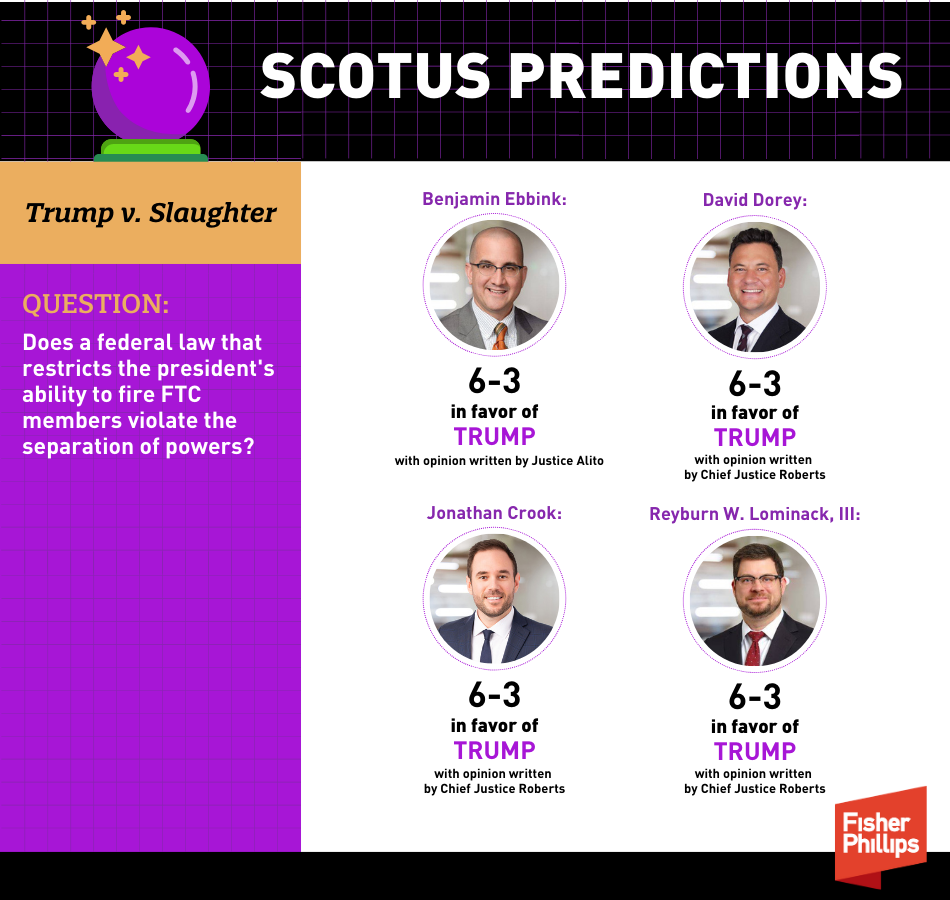
- Jonathan Crook: The Court will hold the statutory removal protection for FTC Commissioners is unconstitutional, and that President Trump therefore legally terminated Commissioner Slaughter. The Court will distinguish, but not overrule, Humphrey’s Executor. The 6-3 decision will be written by Chief Justice Roberts and joined by Justices Thomas, Alito, Gorsuch, Kavanagh, and Barrett.
- Ben Ebbink: The Court will rule in favor of the government in a 6-3 decision authored by Justice Alito. The Court could conceivably rule in favor of the president’s authority by narrowing Humphrey’s Executor – without explicitly overturning it – based on how significantly the FTC has changed since that case was decided in 1935. However, with many similar cases working their way up (including cases involving the NLRB), I think the Court will go ahead with the inevitable and actually overturn Humphrey’s Executor. The oral argument went beyond a discussion of the FTC and focused on broader issues of presidential control over executive branch agencies without Congressional interference, so I think they will go the whole way in overturning Humphrey’s.
- Dave Dorey: The Justices will vote 6-3 in favor of the government and overturning Humphrey’s Executor. The Court will hold that Humphrey’s Executor was an aberration from a long line of precedent holding that the president’s removal authority cannot be restricted in respect to officers exercising executive authority. The framing will be a return to the historical understanding of the separation of powers in which there is not a “fourth branch” of government. How much the opinion engages in line-drawing about future cases involving “unique” government agencies is an open question – we are likely to see the Court say the opinion does not reach unpresented questions about, for example, the Federal Reserve, the Library of Congress, or the Court of Federal Claims. Given how important the issues are here, I think the opinion will be written by Chief Justice Roberts.
- Reyburn Lominack: SCOTUS will issue a 6-3 decision written by Chief Justice Roberts and uphold the president’s firing of Slaughter. The ruling will also lock in Trump’s recent win in the battle over his firing of former NLRB Member Gwynne Wilcox (more on this below).
What’s at Stake For Employers?
If the Supreme Court strikes down the statutory removal protections for FTC members, the FTC would become more politicized, and its enforcement priorities could swing more drastically with each administration. However, it would have very little impact on the FTC in the short term – the five-member agency already has had a Republican majority since the Senate approved Trump-nominated Mark Meador as the newest commissioner in May, and federal law prohibits more than three commissioners from the same political party.
While the FTC may not seem like a major player in workplace law, it has increasingly expanded its reach into employment-related issues, such as non-competes and restrictive covenants, antitrust in the labor market, gig economy and worker classification, and employee data privacy (particularly when artificial intelligence tools are involved). And, of course, consumer protection remains a priority for the agency, which can also impact many businesses (for example, the FTC recently announced a $7.5 million settlement with an educational technology company over its unlawful cancellation practices).
Further, if SCOTUS overrules or chips away at Humphrey’s Executor, it could create ripple effects for other independent agencies such as the NLRB or EEOC, dramatically shifting how these key workplace agencies operate or potentially dismantling them altogether. For example:
- A federal appeals court recently upheld President Trump’s unprecedented firing of former NLRB member Gwynn Wilcox, ruling that the Board’s functions in recent years amounted to meaningful enforcement and policymaking authority beyond the reach of Humphrey’s Executor and into a realm that must be subject to the president’s unfettered removal authority. While the ruling could be appealed, the Supreme Court’s expected decision in Trump v. Slaughter would all but guarantee the Wilcox saga to end in the president’s favor.
- A circuit split is taking shape regarding whether employers can use federal court injunctions to halt NLRB proceedings, and several courts are currently hearing constitutional challenges to the NLRB’s structure. If our SCOTUS predictions are correct, the agency will be in a much weaker position to prevail in these cases.
- In addition, after Trump fired two Democratic members of the EEOC in January, one of them sued the administration. Jocelyn Samuels argued in a July 28 court filing that her removal was unlawful and that protections set by Congress are constitutional under Humphrey’s Executor. This case is still playing out in a district court in DC.
Conclusion
We expect the court to issue an opinion during the first half of 2026. We will continue to monitor developments related to this case and provide an update when SCOTUS issues an opinion, so make sure you subscribe to Fisher Phillips’ Insight System to get the most up-to-date information. If you have questions, contact your Fisher Phillips attorney or the authors of this Insight.
Related People