

House Passes Bill to Reshape First Union Contract Negotiations: What Employers Need to Know About the Faster Labor Contracts Act
A bill that would impose strict timelines and mandatory binding arbitration on first union contract negotiations passed the US House yesterday, marking a pivotal step in what could end up being a sea change in the country’s established labor dynamic. The Faster Labor Contracts Act (FLCA) passed the House by a 230-193 vote on Tuesday, with 20 Republican House members joining 210 Democrats in approving the bill. If it passes the Senate and is signed by the President, it would represent the most sweeping change to the nation’s labor laws in nearly a century. What do you need to know about the bill, its chances of becoming law, and what you should do while we await the final outcome?
Current Framework
The National Labor Relations Act (NLRA) currently imposes no timeline for reaching a first contract, allowing both parties to take the time to hammer out a fair deal. But opponents of the status quo point to data showing workers are forced to wait an average of over 450 days before obtaining a first union contract.
What the Faster Labor Contracts Act Would Do
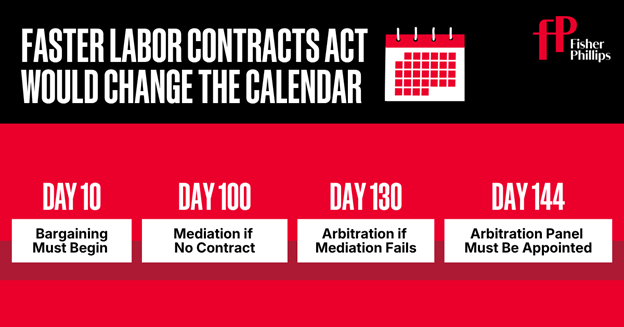
It is hard to understate the potential impact of this legislation. It would amend the NLRA for the first time in over 50 years by imposing a compressed, federally mandated timeline on first-contract negotiations in the private sector. Under this framework, following union certification:
- Day 10: The employer is required to begin bargaining
- Day 100: Federal mediation is triggered if no agreement has been reached
- Day 130: Binding interest arbitration is initiated if mediation fails
- Day 144: An arbitration panel is seated to impose a final contract
This represents a maximum bargaining period of 120 days – 90 days of bargaining followed by 30 days of mediation – before either party can invoke mandatory arbitration. To put that window into context: one researcher found that fewer than 10% of first contracts have historically been achieved within 120 days.
If the parties cannot agree on a neutral third arbitrator, the Federal Mediation and Conciliation Service (FMCS) would step in to designate one. The arbitration panel’s decision would be binding for two years. The panel must weigh factors such as the employer’s financial status and employee living costs.
Why Should Employers Care?
There are numerous reasons why employers should care about the potential of the Faster Labor Contracts Act becoming law.
Would Lead to Unintended Consequences
The FLCA would inject an interest arbitration concept into the private sector framework. With few exceptions (namely in hospitality, cannabis, and Major League Baseball), interest arbitration is largely confined to state-level public sector settings. Our experience shows that interest arbitration has given rise to numerous aberrations in the public sector and arguably been proven to be a failed model in many instances. Notably, when used in the private sector, it is a function of the parties’ agreement, and not a government-imposed mandate.
No Guarantee of Quicker Contracts
While the FLCA limits the time the parties can spend in negotiation, the arbitration timeline itself is unlimited. It could take months or longer to bring uninformed arbitrators up to speed on the circumstances of the situation. The bill also fails to impose strict timetables on the arbitrators themselves, who could conceivably sit on the process for months or even years before issuing an award (that would be limited to two years). During that period, the parties could easily have achieved an agreement on their own (and for a longer period of time).
Would Strip Employers – and Unions – of Rights
If passed, the FLCA would, for the first time ever, take away the rights of employers and unions to decide for themselves what goes into their initial collective bargaining agreements. Instead, a panel of government-appointed arbitrators would take control.
Government-Picked Arbitrators Would Operate With Limited Context
Those arbitrators, parachuting into a dispute they know nothing about, would have limited context about the business, finances, and workforce while making a final decision. For example, they could go so far as to compel the employer to begin participating in an underfunded multi-employer pension plan that carries with it the prospect of substantial withdrawal liability. The new law would direct them to take a host of factors into account (ranging from employer financial status to cost of living), but absent among those factors would be a list of proposals exchanged by the parties themselves. Decisions made without that context could be disastrous for the business and union members alike.
Businesses and Unions Would Have Limited Input
Under the FLCA, employers would forfeit any input into provisions fundamental to the employee relationship, such as wages, medical, retirement and other benefits, and general employment terms. Employees and unions would forfeit any voice in these matters as well, along with the right to participate in ratification votes at the crucial first contract stage (and potentially to strike in support of their position).
Small Businesses Would Bear the Brunt
The small business community, which remains the backbone of job creation, would stand to suffer the most from the FLCA. Unlike large corporations with in-house labor relations teams and deep benches of legal counsel, small employers would face the same 90-day clock with a fraction of the resources. Many would land in arbitration not because they bargained in bad faith, but simply because they couldn’t keep pace. And while a government-imposed contract dictating two years of wages and benefits might be manageable for a Fortune 500 company, it could be an existential threat for a business operating on thin margins. Opportunistic labor organizations could attempt to gain an advantage by delaying the bargaining process itself, leaving the small business with little in the way of immediate recourse.
What’s Next?
While yesterday’s news is significant, the bill still has a ways to go before it becomes law.
-
The bill would need to find 60 votes in the Senate to overcome a filibuster, which is by no means a certainty.
- That chamber’s work will slow over the summer given recess schedules, limiting the amount of time lawmakers have to work on this bill before mid-term elections.
- Some opponents are already lining up potential litigation challenges to the FLCA as being unconstitutional. The theories include arguments that Congress can’t impose contracts on unwilling private parties, the new law would amount to a “taking” from employers without just compensation, and it would violate the non-delegation doctrine by outsourcing government function to private arbitrators.
- If Democrats recapture the House and/or the Senate in the November mid-terms, we could see lawmakers seek to swap out the FLCA for an even more game-changing bill: the Protecting the Right to Organize (PRO) Act, a labor wishlist you can read about here.
What Should You Do?
While there are several steps to go before this bill becomes law, employers shouldn’t wait for it to cross the finish line before taking action. Here’s what we recommend:
1. Contact your representatives. The most effective action you can take right now is to make your voice heard. Reach out to your US Senators to express your concerns. Our FP Gov Team can help facilitate that engagement.
2. Proactively strengthen your employee relations. The best defense against a compressed bargaining timeline is a workforce that doesn’t feel the need to organize in the first place. Review your wages, benefits, communication practices, and management culture now.
3. Assess your union exposure. Take stock of which of your facilities or workforces could be subject to an organizing campaign. If a union were certified tomorrow, would you be prepared to bargain effectively within a 90-day window?
4. Evaluate your bargaining readiness. Understand where your compensation and benefits stand relative to the market. If arbitration became a possibility, an arbitrator would evaluate your financials and employee living costs. You’ll want to enter that process in a strong position, not scrambling to gather data.
5. Audit your first-contract bargaining strategy. If you already have unions in some locations, work with labor counsel to understand how this law would change your approach to any upcoming initial agreements.
Conclusion
We will continue to monitor developments and provide updates as Congress acts. Make sure you are subscribed to Fisher Phillips’ Insight System to get the most up-to-date information direct to your inbox. If you have questions, contact your Fisher Phillips attorney, the authors of this Insight, or any member of our Labor Relations Practice Group or Government Relations Team.
Related People

Regional Managing Partner and Labor Relations Group Co-Chair
emailSend Email
phone813.769.7513




Regional Managing Partner and Vice Chair, Labor Relations Group
emailSend Email
phone617.722.0044