

FP Snapshot on Manufacturing Industry: 3 Key Steps When Using AI to Boost Employee Engagement
Welcome to this edition of the FP Snapshot on Manufacturing Industry, where we take a quick snapshot look at a recent significant workplace law development with an emphasis on how it impacts employers in the manufacturing sector. This edition will cover how manufacturing facilities can harness artificial intelligence to enhance employee engagement and retention. AI will have a particular impact on manufacturers struggling with these workforce challenges, so read on to find out the three key steps you need to take if you go this route.
Snapshot Look at AI-Powered Employee Engagement
As employers continue to face unprecedented workforce challenges – from labor shortages to high turnover rates – many are turning AI solutions to improve employee engagement and satisfaction. Many organizations are deploying AI-powered tools to personalize training programs, predict turnover risks, facilitate better communication between shifts, and create more responsive workplace cultures.
These AI systems analyze employee data, engagement surveys, productivity metrics, and communication patterns to identify disengagement early and recommend targeted interventions. While the potential benefits are significant (reduced turnover costs, improved safety outcomes, higher productivity, etc.), they raise important legal considerations around data privacy, algorithmic bias, and employment decision-making.
For a deeper dive into the risks and best practices when using AI for engagement and retention, you can read our full Insight here: AI Can Help with Employee Engagement and Retention – But What Are the Risks and Best Practices?
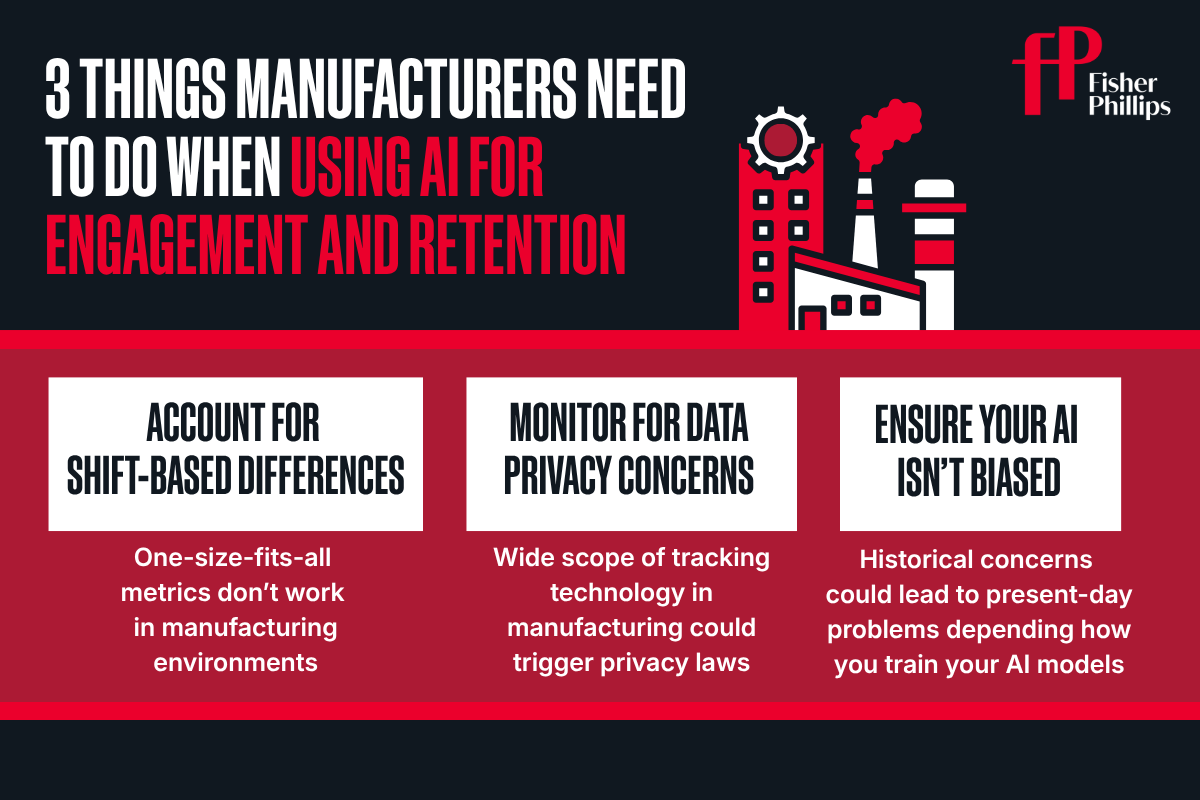
3 Things Manufacturing Employers Need to Do
Manufacturing employers implementing AI-powered engagement tools should understand how these systems uniquely impact their operations and consider the following three steps:
Account for Shift-Based Differences
First, manufacturers should ensure their AI tools are calibrated to recognize shift-specific engagement patterns rather than applying one-size-fits-all metrics developed for traditional office environments. After all, shift-based operations present special challenges.
For example, AI systems monitoring employee sentiment and engagement should account for the fact that employees may have vastly different experiences, communication patterns, and workplace cultures across different shifts. An AI tool that flags a night-shift employee as “disengaged” based on limited participation in company-wide communications might miss the reality that this employee has no opportunity to attend daytime meetings or social events.
Monitor for Data Privacy Concerns
Second, data privacy concerns are heightened in manufacturing settings where AI tools may monitor not just digital communications but also physical behaviors, equipment usage patterns, break-time activities, and safety compliance. If your AI system tracks when employees take breaks, how long they spend in certain areas, or patterns in their machine operation, you’re collecting data that could implicate privacy rights under state laws. And if the system makes inferences about physical or mental health status, it could also potentially implicate HIPAA. Beyond that, multiple states now regulate biometric data and worker surveillance, and others are considering “no robo bosses” or algorithmic management laws.
You should work with legal counsel to ensure your data collection practices comply with applicable privacy laws. You might be required to pair your AI engagement initiatives with compliant notices, consent mechanisms, and processes for handling employee data requests. And you’ll want to implement strong security measures to protect the sensitive employee information you collect.
Ensure Your AI Isn’t Biased
Third, algorithmic bias poses unique risks in manufacturing diversity initiatives. If an AI engagement tool is trained on historical data from your facility, it may perpetuate existing patterns of discrimination or bias. For example, if women or minority employees have historically been underrepresented in certain roles or shifts, an AI system might incorrectly identify different engagement patterns as “disengagement” rather than recognizing systemic barriers to inclusion. Similarly, AI tools that predict flight risk or promotion readiness based on past patterns could disadvantage protected groups and expose manufacturers to discrimination claims.
- You should treat AI‑generated engagement scores and risk flags as considerations that you take into account when making workplace decisions, not as the final word.
- Also, you should regularly audit AI systems for bias, ensure diverse data sets are used in training, and document your efforts to prevent discriminatory outcomes.
- If you are working with AI vendors for these programs, don’t blindly rely on their bias testing. Ask them the right questions about how their tools were developed and trained and conduct your own assessment of the bias testing or audits.
- Negotiate vendor contracts to ensure you have transparency into how the system works and that you can run bias and security audits. You should also ensure the contract properly allocates responsibility for regulatory compliance.
Want More?
We will continue monitoring workplace law developments as they apply to manufacturing employers, so make sure you are subscribed to Fisher Phillips’ Insight System to have the most up-to-date information sent directly to your inbox. If you have questions, contact your Fisher Phillips attorney, the authors of this Insight, or any attorney on our Manufacturing Industry Team.
Related People