

HUD Pulls the Plug on Emotional Support Animal Guidance: 5 Steps for Education Housing Administrators
Federal housing officials just formally stripped emotional support animals of their protected status in housing, a sweeping policy change that will directly affect how college and university housing offices process accommodation requests from students with disabilities. On May 22, the US Department of Housing and Urban Development issued an enforcement memo permanently rescinding prior guidance on emotional support animals in housing, effectively ending nearly two decades of federal protection for those who rely on ESAs. The memo eliminates the presumption that landlords and housing providers must accommodate untrained ESAs, replaces it with the much stricter ADA standard for trained service animals, and takes effect immediately. Here is what happened, what it means for your campus, and what you should do now.
What HUD Did
FHEO Assistant Secretary Craig Trainor signed the memo on May 22, effective immediately. It permanently cancels both of HUD’s prior guidance documents on assistance animals in housing: one issued in 2013 (FHEO-2013-01) and the updated version from 2020 (FHEO-2020-01). Together, those documents told housing providers they had to treat ESAs as assistance animals rather than pets, could not charge pet fees, and could only request limited documentation.
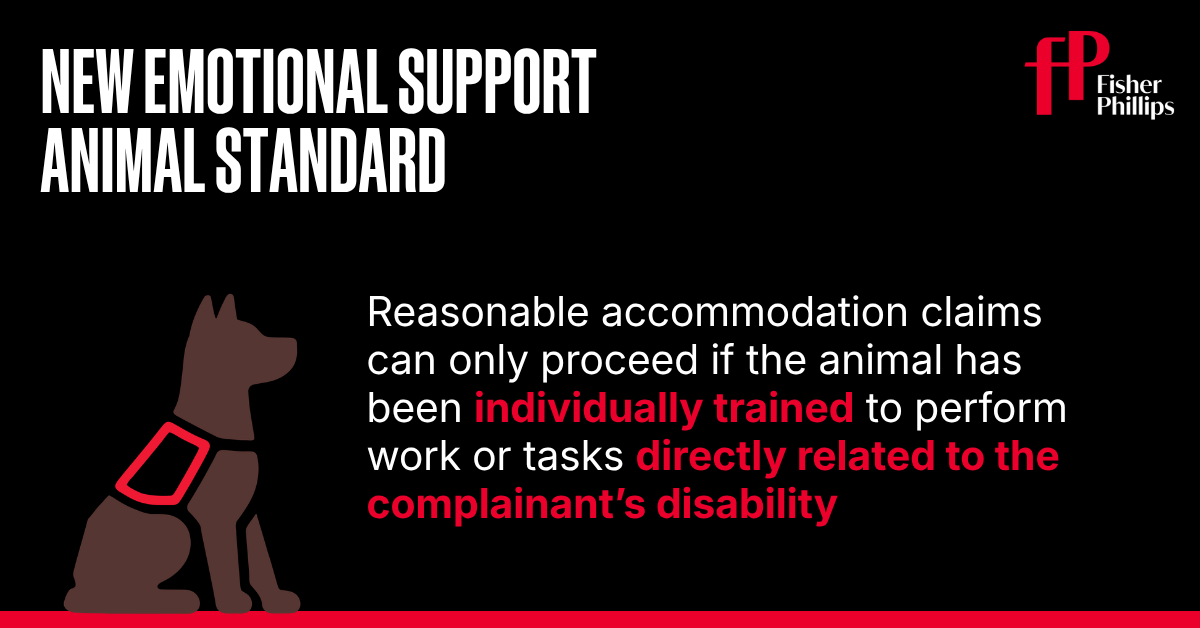
Going forward, FHEO will find reasonable cause for failure to provide a reasonable accommodation involving the waiver of a pet policy only where the animal has been individually trained to perform work or tasks directly related to the complainant’s disability. That is the ADA’s definition of a service animal, which is a much higher bar than an untrained ESA has historically needed to clear.
HUD said it was making this change because the 2020 guidance failed to provide greater clarity on the supposed distinction between pets and emotional support animals, which had caused problems at the agency. Over 20% of FHEO’s fair housing complaints had come to revolve around untrained ESAs, a caseload HUD characterized as unsustainable.
What Hasn’t Changed
Higher education administrators should tread carefully before changing any policies, as several critical elements of the law have not changed.
- First, the Fair Housing Act itself has not been amended. This memo withdraws prior HUD guidance, but it does not by itself rewrite the Fair Housing Act or state laws. It simply alters how HUD will treat complaints and guidance going forward.
- Second, the memo is explicitly limited to animal accommodation complaints under the Fair Housing Act. Complaints filed under Section 504 of the Rehabilitation Act and the ADA are not affected. State laws and complaints filed under state laws are also not affected. For campus housing offices, this is particularly significant. Campus housing at public universities is subject to Section 504, and many states have their own fair housing laws that go beyond federal protections. Your obligations under those frameworks remain unchanged.
- Third, nothing in the enforcement guidance affects the rights of parties to seek redress through a private action in court. Students whose ESA requests are denied can still sue, and private litigation does not require a prior HUD finding. The removal of HUD enforcement does not eliminate legal exposure for housing providers who deny legitimate accommodation requests.
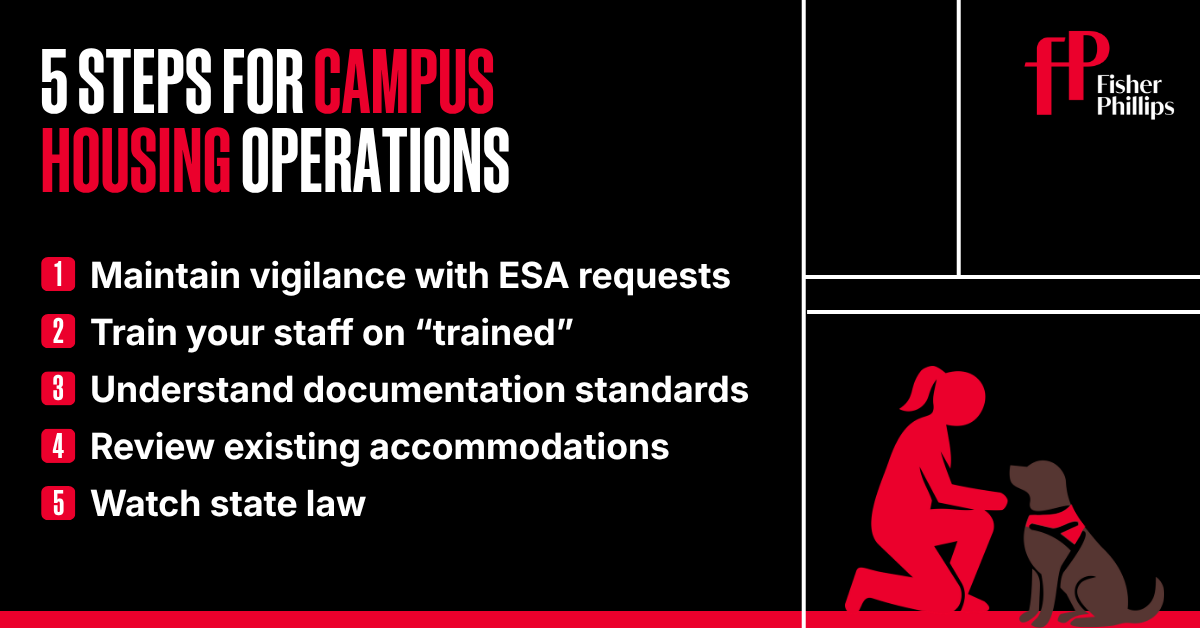
What Campus Housing Operations Should Do
Here are five practical steps that higher education housing administrators can take in light of this memo:
1. Maintain vigilance with ESA requests. Don’t treat this memo as a green light to categorically deny ESA requests. As noted above, the Fair Housing Act remains the law. Automatically denying all ESA requests is still off limits, and disability discrimination is still illegal. Any student with a genuine disability and a legitimate need for an animal is still entitled to an individualized interactive process, regardless of whether the animal is trained.
2. Train your staff on what “trained” actually means under the new standard. There is no requirement that training be done by a professional organization or certified trainer. Owner training can be sufficient under the new policy, as it is under the ADA. A student claiming their dog is individually trained to interrupt a panic attack or perform a specific psychiatric task may well meet the standard even without formal credentials. Your reviewers need to understand this distinction to avoid denying requests that are actually valid under the new framework.
3. Make sure you understand the documentation process. Now that HUD’s 2020 guidance is rescinded, you have more flexibility on what documentation you can and cannot request. Requiring documentation from a licensed healthcare provider who has an actual treatment relationship with the student (not an online letter mill) is now a defensible standard. You can also feel more confident rejecting obvious fraud, including online certificates and generic letters from providers with no therapeutic relationship.
4. Review existing approved accommodations. If a student’s ESA has already been approved as a reasonable accommodation, that approval stands. Your institution would have to take affirmative steps to revoke it, which could raise its own legal issues. The bigger concern is new requests, transfers to different campus housing, or students returning next year who need to renew an accommodation.
5. Watch your state law. Many states (like California, New York, Illinois, and others) have their own fair housing statutes that independently protect ESAs. Those laws are unaffected by this memo. If your institution operates in a state with stronger protections, the federal rollback provides no cover.
What’s Next?
HUD has indicated it intends to engage in notice and comment rulemaking regarding animal-related reasonable accommodations, with the aim of harmonizing its regulations with those of the ADA. That process will take time and will likely produce a clearer and more restrictive permanent standard. You’ll want to monitor the situation closely, as it will eventually replace the current guidance vacuum. The best ways to stay up to speed is to subscribe to Fisher Phillips’ Insight System so you can get the most up-to-date information directly to your inbox.
Conclusion
To stay up to date on legal developments in this space, reach out to your Fisher Phillips attorney, the authors of this Insight, or any member of our Higher Education Team with any questions. We will continue to monitor the legal landscape and will provide updates as warranted, so make sure you are subscribed to Fisher Phillips’ Insight System to get the most up-to-date information directly to your inbox.
Related People

Regional Managing Partner and Vice Chair, Labor Relations Group
emailSend Email
phone617.722.0044