

EU Overhauls AI Act Just Before Key Deadline: What Should Businesses Do With The Extra Time?
With a critical compliance deadline just months away, European Union lawmakers and member states reached a provisional agreement on 7 May to significantly overhaul the EU AI Act, changes that promise relief for the business community. The revisions will push back enforcement of high-risk AI rules by 16 months, strip overlapping requirements that created duplicate compliance burdens for manufacturers, and extend regulatory relief to a broader array of smaller businesses. Importantly, for employers using AI to hire, monitor, or manage workers in the EU, this means the compliance deadline for high-risk AI systems used in employment decisions just moved from August 2026 to December 2027. What do companies doing business in the EU need to know?
📢 Check out our primer on the EU AI Act here: The 7 Things You Need to Know About the EU’s AI Act.
Employment Rules Delayed Until Late 2027
The European Parliament and Council of the EU reached the provisional agreement to reform the EU AI Act as part of a broader “Digital Omnibus on AI” simplification package. The deal was driven by mounting pressure from industry groups and member states – particularly Germany – that warned the original compliance framework was becoming unworkable, especially for manufacturers facing duplicative requirements across multiple EU laws.
The biggest change for employers pushes back enforcement of rules covering high-risk AI systems in areas such as employment, biometrics, critical infrastructure, education, migration, and border control until December 2, 2027 – a 16-month delay from the previous August 2, 2026, deadline. For AI systems that qualify as regulated products or safety components, the deadline is extended to August 2, 2028.
Bias Detection and Special Category Data
The reform clarifies that organizations may process special category data (e.g., race, health, or sexual orientation) where strictly necessary for bias detection and correction in in both high-risk and non-high-risk AI systems, expanding the legal basis to cover providers and deployers. Safeguards like pseudonymization and access controls remain mandatory, and the strict necessity standard stays intact.
Five More Changes Businesses Should Know About
Beyond the deadline extension, the agreement makes several other notable adjustments:
- Industrial and product-embedded AI gets relief. The deal clarifies that machinery products only need to comply with sectoral safety rules rather than both the EU AI Act and sectoral rules. The European Commission will also be able to limit the EU AI Act’s application in other sectors (including medical devices, toys, and connected cars) where existing sectoral law already contains similar AI-specific requirements.
- Definition of “safety component” gets tightened. The agreement clarifies the term “safety component,” meaning AI systems that only assist users or optimize performance will not automatically face high-risk obligations under the AI Act if their failure or malfunction does not create health or safety risks.
- SME relief extended to small mid-caps. The deal extends some regulatory exemptions that were previously provided to Small and Medium-sized Enterprises (SMEs) to small mid-cap companies as well.
- AI-generated content transparency deadline adjusted. The application of watermarking obligations on AI-generated content has been delayed until December 2, 2026, so companies using generative AI tools to produce content have a few extra months to implement labeling solutions.
- High-risk database registration reinstated. Notably, the update brings back the obligation for providers to register AI systems in the EU’s high-risk systems database, including for providers that believe their systems qualify for an exemption from the high-risk classification.
One New Prohibition to Know About
The provisional agreement adds a new prohibition on AI systems that create child sexual abuse material or that depict, without that person’s consent, the intimate parts of an identifiable person or an identifiable person engaged in sexually explicit activities. Compliance with this prohibition begins December 2, 2026.
What’s Next
The European Parliament and the Council must now formally adopt the provisional agreement, with formal adoption expected before the current August 2 deadline when the current rules on high-risk AI systems would otherwise become applicable. Upon adoption, the amendments will be published in the EU’s Official Journal and enter into force three days later.
What Do Businesses Need to Do?
Keep in mind that this deal doesn’t change the AI Act’s fundamental architecture. High-risk AI in employment and other sensitive categories is still regulated, and transparency obligations are still coming. But it does give companies more time, reduce overlap for industrial and product-embedded AI, and narrow the definitional scope so fewer systems get swept in inadvertently. Use the extended timeline to:
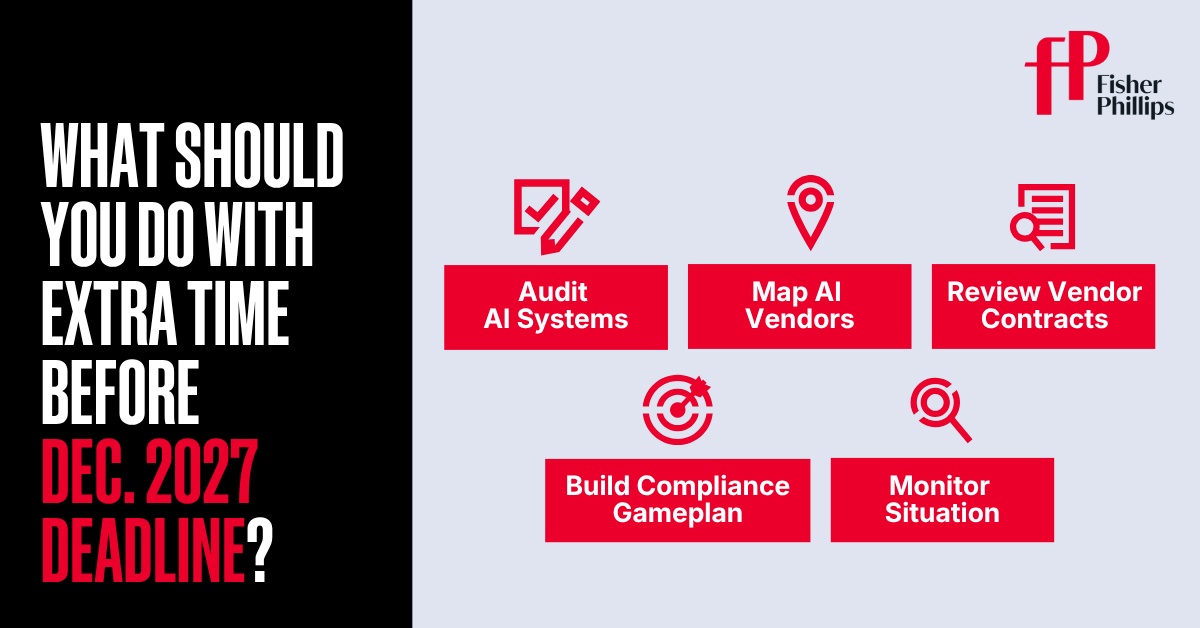
- Audit your AI systems to identify which ones fall under the high-risk framework, paying particular attention to tools used in hiring, performance evaluation, workforce monitoring, and termination decisions;
- Map your AI vendors and determine whether they are providers or deployers under the Act, since your compliance obligations differ significantly depending on your role;
- Review contracts with AI vendors to confirm they will meet their own obligations under the Act before the new deadlines arrive;
- Begin building a compliance gameplan now, even with the extended timeline -- because December 2027 will arrive faster than you think; and
- Monitor the formal adoption process expected before August 2, since the amendments don’t take effect until published in the EU’s Official Journal. The best way to track developments is to ensure you are subscribed to Fisher Phillips’ Insight System to gather the most up-to-date information directly to your inbox.
Conclusion
If you have questions, contact your Fisher Phillips attorney, the author of this Insight, or any attorney in our AI, Data, and Analytics Practice Group or our International Practice Group. Make sure you subscribe to Fisher Phillips’ Insight System to gather the most up-to-date information on AI and the workplace.
Related People


Co-Chair International Practice Group, Regional Managing Partner - Tokyo
emailSend Email
phone+81-3-6892-5595