

Employer Guide to the Aging Workforce: 4 Key Compliance Considerations
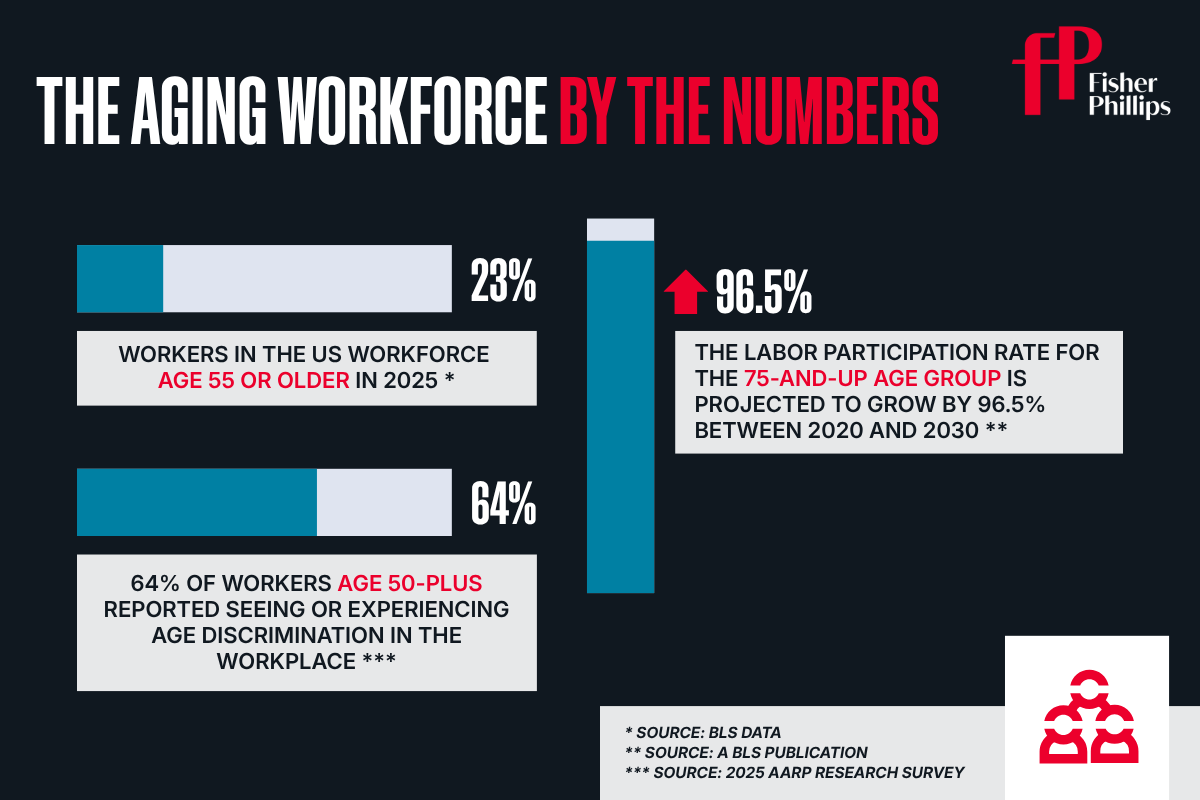
Workers 55 and older now make up nearly a quarter of the US workforce and represent the labor force’s fastest growing age group. Further, while the Bureau of Labor Statistics projects that the overall labor force participation rate will slightly decline between 2020 and 2030, the rate for those in the 75-and-up age group is expected to grow by 96.5% during this same decade. What does an aging workforce mean for employers? This Insight will cover four key workplace law considerations as employees continue working later into their lives.
4 Key Compliance Considerations for Employers
1. Age Discrimination Risks
An aging workforce heightens the importance of careful compliance with age discrimination laws. This is especially true in light of a recent AARP Research survey of workers age 50-plus, which showed that:
- 22% of respondents felt they were being pushed out of work because of their age; and
- 64% reported seeing or experiencing age discrimination in the workplace.
The federal Age Discrimination in Employment Act (ADEA) generally protects employees and applicants age 40 or older and applies to employers with 20 or more employees. The ADEA prohibits age-based discrimination with respect to any term or condition of employment, including hiring, firing, compensation, layoffs, promotions, and benefits. Some state and local laws add additional protections based on age. An aging workforce means more employees who are protected by the ADEA, and employers should be cautious to ensure they are compliant with those protections.
Subtle forms of age discrimination are not uncommon, including jokes about different generations and assumptions that older employees are less tech savvy or resistant to change, that they may be close to retirement, have “only a few good years left,” or will struggle to “keep up.”
Employers should be mindful of additional provisions for release agreements that include a release of claims of age discrimination and special considerations should be taken when planning reductions in force to avoid disproportionately impacting older workers.
Practical Takeaway: Employers should take proactive compliance efforts to avoid violating the ADEA (or state/local laws) and limit exposure to age-based discrimination claims. Job interviews and hiring decisions can be a primary source of age discrimination, so make sure to train your hiring managers and update job postings or descriptions as needed to combat potential age bias. If you receive a complaint, you should follow up quickly and document any steps taken to decrease potential litigation and foster a more positive and productive workplace. If you plan to offer a severance agreement to an employee over the age of 40, you should consult legal counsel to ensure your agreement covers the necessary provisions.
2. Disability Discrimination Exposure
Under the Americans with Disabilities Act (ADA) or applicable state laws, older employees may be more likely to qualify for reasonable accommodations and protections from disability discrimination. The ADA prohibits discrimination when an employee has a disability and can apply even when an employee is regarded as having a disability.
Employment decisions based on actual or perceived physical slowing, memory concerns, diminished mental capacity or other impairments attributed to the aging process of an older employee can therefore potentially create exposure under both the ADA and the ADEA. Employers should avoid making any predeterminations or assumptions about older employees’ capabilities, such as health, stamina, mobility, or their capacity to handle the workload. Employers must be aware of their obligations and available defenses under each of these laws (as well as any additional requirements under applicable state or local laws).
Practical Takeaway: In addition to staying compliant with all ADA requirements, covered employers should train managers to avoid assumptions tied to age or perceived medical limitations and instead focus on objective performance standards and documented job requirements. Accommodation discussions, medical inquiries, and performance-management processes must comply with ADA standards while avoiding these assumptions.
3. Medicare Eligibility Impact on Employer-Sponsored Health Plans
As more employees remain in the workforce later in life, Medicare coordination issues have become increasingly important for employers that sponsor group health plans. Generally, individuals become eligible for Medicare at age 65, even if they remain actively employed and covered under an employer-sponsored health plan – making it critical for employers to understand when Medicare serves as the primary or secondary payer under federal law.
The Medicare Secondary Payer (MSP) rules (as well as the ADEA) apply to employers that have 20 or more employees. Federal law generally requires employers of this size to offer active employees age 65 and older the same employer-sponsored health coverage available to younger employees. The employer plan generally remains the primary payer (billed first for claims) while Medicare serves as secondary coverage. Employers are prohibited from incentivizing Medicare beneficiaries to decline or drop coverage in a group health plan that is primary to Medicare, and violations can result in steep penalties.
Note, however, that the IRS prohibits employees enrolled in Medicare from contributing to a health savings account (HSA). This is true even for periods of retroactive Medicare coverage, so HSA contributions made during such a period will be treated as non-deductible excess contributions subject to excise taxes for the employee if they are not timely withdrawn or otherwise included in the employee’s gross income.
Practical Takeaway: Make sure HR personnel and benefits administrators understand the MSP rules and potential age discrimination risks related to older employees and your group health plan. Train them to avoid steering employees toward Medicare in lieu of coverage under your employer-sponsored plan. Your enrollment materials and employee communications should clearly explain how Medicare coordination works and cover enrollment timing considerations. If you offer an HSA benefit, make sure that employee contributions stop once they are enrolled in Medicare, and look out for any contributions made during a period of retroactive Medicare coverage. Your employees should receive education on these issues well before they turn age 65.
4. Retirement Plans and Policies
An aging workforce raises compliance and design considerations for retirement plans and policies. First, the ADEA generally prohibits employers from forcing employees to retire at a specific age, subject to very narrow exceptions. For example, a medical group’s mandatory retirement age for a class of physicians led to EEOC charges and a $6.875 million settlement in 2023.
Second, employers with a growing number of older employees may want to consider certain retirement plan design options while ensuring compliance with IRS rules. For example:
- Required Minimum Distributions. An employer sponsoring a 401(k) or other plan subject to the required minimum distribution (RMD) rules may want to consider whether to allow participants who continue working past the applicable RMD age (for example, age 73 for individuals born during 1951 to 1959 and age 75 for individuals born in 1960 or later) to delay RMDs until they actually retire. The IRS permits delaying RMDs from that plan until retirement if the plan document allows it; however, this option is not available to employees who are more-than-5% owners of the company sponsoring the plan.
- Catch-Up Contributions. A 401(k) plan is permitted, but not required, to permit employees age 50 or older to make “catch-up” contributions beyond the standard annual limits. For 2026, the catch-up contribution limit is $8,000 for employees ages 50 to 59, and $11,250 for employees ages 60 to 63. Starting in 2026, however, certain high earners must make catch-up contributions on a Roth basis. See our 2026 Employer Cheat Sheet for Retirement and Health Plan Limits for more details.
Practical Takeaway: Work with counsel to maintain and implement retirement plans and programs that both comply with the law and achieve your business goals. While mandatory retirement age policies should generally be avoided, experienced counsel can help you navigate other potential options, such as voluntary phased retirement programs, as well as succession planning for owners or C-suite executives approaching retirement.
Conclusion
If you have questions related to an aging workforce, reach out to your Fisher Phillips attorney, the authors of this insight, or any attorney in our Employee Benefits and Tax Practice Group. We will continue to monitor developments related to all aspects of workplace law, so make sure you are subscribed to Fisher Phillips’ Insight System to get the most up-to-date information.
Related People