

DOL to Scale Back Joint Employer Liability for Businesses: What You Need to Know About the New Proposal
Businesses that utilize contractors or franchise out their brand may soon get some clarity about when those arrangements make them “joint employers” under federal minimum wage, family medical leave, and migrant worker laws. The US Department of Labor just released a proposal today outlining its approach to joint employer liability under a trio of laws, setting up a test that will give companies greater flexibility and less risk when entering into business relationships. The proposed four-factor analysis focuses on the amount of control a business exercises over its contractors, franchisees, and other entities. Here’s everything you need to know about joint employer status from the DOL and how you can prepare for the potential new rule.
What Does the DOL Want to Do?
The Wage and Hour Division’s proposed rule will revisit the standard for determining whether multiple businesses are legally responsible for compliance with minimum wage and overtime pay, child labor limits, and other requirements under the Fair Labor Standards Act (FLSA). It also would apply to enforcement actions brought under the Family and Medical Leave Act (FMLA) and the Migrant and Seasonal Agricultural Worker Protection Act (MSPA).
The proposal largely mirrors the Trump administration’s 2020 rule, which was subsequently blocked by a court. It recognizes two forms of joint employment: vertical and horizontal.
- Vertical joint employment, which is far more common, exists where the worker has an employment relationship with one employer (such as a staffing agency, subcontractor, or labor provider) and an intermediary business contracting with that employer receives the benefit of the employee’s labor.
- Horizontal joint employment occurs when related entities employ the same worker such that their hours worked must be aggregated.
For vertical joint employment scenarios, the DOL proposal sets out a multi-part test to weigh how much control one business has over the other entity’s employees.
The test considers whether the business:
- hires or fires the employee;
- supervises and controls the employee’s work schedule or conditions of employment to a substantial degree;
- determines the employee’s rate and method of payment; and
- maintains the employee’s employment records.
The proposal emphasizes that “no single factor is dispositive” in determining joint employer status and that the determination depends “on all of the facts in a particular case.”
While other factors outside of the four factors identified above may provide some relevancy to the analysis, the proposed rule is clear that the four primary factors carry the most relevance and, if joint employer status is clear based upon the four factors, then other factors are unlikely to play a role in determining whether two entities are joint employers.
What’s New in The Proposal
One significant difference from the previous Trump administration rule is that the right to control one of these factors is relevant to the joint employment analysis, whether a business exercises that right or not. Historically, the right to control hasn’t been indicative either way of a joint employment relationship. However, the proposal expressly provides that actual control is much more relevant to the analysis than the mere reserved right to control.
For example, if an employer contractually has the right to hire or fire an employee, but never exercises this right, this is much less relevant to the joint employer analysis (as compared to an employer that has the right to do so, and in fact does regularly hire and/or fire employees).
In welcome news for franchises, the proposal clarifies that franchisor status is also not necessarily relevant to determining joint employer status, nor is providing form documents to ensure compliance with the law, or requiring that vendors or franchisees follow worker safety and minimum wage laws.
Dave Dorey, a partner in FP’s DC office and key member of our Government Relations Practice Group, noted that this language makes clear that “simply providing certain benefits or standards to their franchisees, is not relevant to whether a franchisor is a joint employer of the franchisees' employees.”
What Does This Mean For Your Business?
Providing the same standard for joint employment under the FLSA, the FMLA, and MSPA will provide clarity for employers and consistency between various statutes that are all overseen and enforced by the Department of Labor.
“More than anything, employers want clarity on how to comply with the law,” said FP’s Marty Heller, a partner in the firm’s Atlanta office and member of the firm’s Wage and Hour Practice Group. “This proposed rule provides employers with a framework to ensure that they do not inadvertently find themselves in a joint employer relationship.”
While the proposal would provide bright lines around the federal DOL’s enforcement approach, employers will still be navigating a patchwork of joint employer rules at the state level, Dorey cautions. Any permanent national change would require legislation from Congress.
“It’s important that entities understand the local rules where they operate,” Dorey emphasized, “because whatever enforcement the department is doing under this rule, it doesn't change what states are going to do.”
Current Joint Employer Standard
This isn’t the first time a Trump-led DOL has regulated on joint employer status. In 2020, the DOL finalized a joint employer rule that was lauded by businesses because it required them to exercise “actual” control. An entity must oversee hiring, firing, supervising, setting pay rates, and maintain employment records to be deemed a joint employer under the standard. The rule also clarified that theoretical control was not enough to establish a joint employment relationship. Together, this approach made it much harder for businesses to be on the hook for alleged minimum wage or overtime violations committed by their contractors or franchisees.
That 2020 rule was struck down by a NY federal judge roughly six months after it took effect and then rescinded altogether by the Biden DOL in 2021. The Biden-led wage division never issued another official joint employer rule, instead taking a “totality of the circumstances” approach and returning to prior case law on the issue. This new rule would give the DOL's Wage and Hour Division a consistent standard to apply when investigating and pursuing enforcement actions.
For now, businesses have had to rely on differing joint employer tests across different legal jurisdictions. Companies in one federal district court may be subject to a certain test, while others are subject to a different analysis. While varying standards may still apply by jurisdiction – even after a new rule is finalized – the DOL’s rule will serve as a helpful compliance roadmap for many businesses.
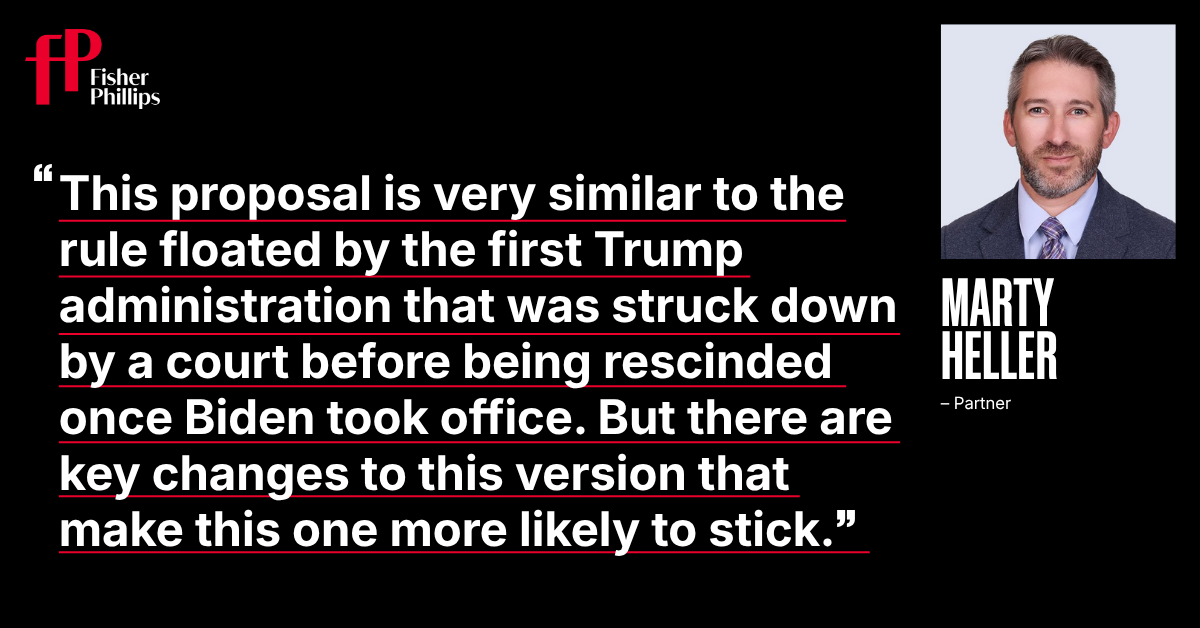
FP’s Heller says that while the “proposal is very similar to the rule floated by the first Trump administration that was struck down by a court before being rescinded once Biden took office,” there are “key changes to this version that make this one more likely to stick."
Important note: This proposal is not to be confused with the joint employer framework finalized by the National Labor Relations Board (NLRB) in February. While similar in approach, the NLRB rule applies in the context of collective bargaining rights and unfair labor practices under the National Labor Relations Act, whereas the DOL’s rule applies to wage and hour matters. Generally, the NLRB rule makes it more difficult for businesses to be held jointly liable for alleged labor law violations by staffing companies, contractors, franchisees, and other related organizations.
What’s Next?
If finalized, the rule will provide much needed clarity, factors, and examples of when entities can be found to be “joint employers” for purposes of the FLSA, FMLA and MSPA. But, even with more predictability around the DOL’s approach, employers should still ensure their contracts, policies, and procedures are reviewed by legal counsel.
The public will have 60 days to comment on the proposal. Then, the DOL will have to review the thousands of comments that are likely to be submitted on the rulemaking docket and prepare responses as part of the final rule. The agency may also make changes to the rule based on public input.
Will We See Legal Action to Block or Delay the Rule?
Employers might feel skittish about the prospects of a court delaying or blocking the rule at the eleventh hour, especially after the 2020 rule was sidelined by a court before it could take effect. This is especially concerning given the fact that federal courts no longer must defer to agencies’ interpretations of the law following the Supreme Court’s 2024 ruling in Loper Bright Enterprises v. Raimondo. That decision instructed federal judges to “exercise their independent judgment” when determining whether a federal agency has properly interpreted the law. With that precedent, it’s much easier for judges to toss out agency rules, creating a potential threat for the future of any federal rule.
However, a separate SCOTUS decision from 2025 significantly limited the ability of federal district court judges to issue nationwide injunctions – now coined “universal” injunctions – that have been used to block actions taken by federal regulatory agencies. Which means that any court that takes issue with this joint employer rule won’t necessarily be able to block it from taking effect across the country. We’ll track any litigation that emerges to challenge the proposed rule and provide updates as necessary.
3 Steps to Take Now
As we wait for the rulemaking process to unfold, there are a few proactive measures you can take to prepare your business for potential changes:
1. Consider submitting a public comment on the rule. If your business supports the changes proposed by the Trump administration, positive comments can support the DOL’s justification for the rulemaking. You may also want to identify provisions that are problematic for your business or will still lead to uncertainty. Reach out to our FP Gov Team for guidance and best practices.
2. Review your contracts, franchise agreements, and vendor agreements for potential joint employer liability if you haven’t conducted a review recently. Contact your FP legal counsel for assistance in identifying these potential risks.
3. Familiarize yourself with state and jurisdictional rules. As mentioned above, different district courts apply different joint employer tests. It’s unclear how deferential the courts will be towards any DOL joint employer rule following the SCOTUS precedent in Loper Bright. Some states, including California and New York, use their own joint employer tests that are broader than the proposed rule. Consult with legal counsel to better understand these location-specific rules and if they apply to your business.
Conclusion
Fisher Phillips will continue to monitor the DOL’s joint employer rulemaking process. Make sure you are subscribed to Fisher Phillips’ Insight System to get the most up-to-date information directly to your inbox. For further information, contact your Fisher Phillips attorney, the authors of this Insight, or any member of our Wage and Hour Practice Group.
Related People