

DOL Independent Contractor Proposal is Welcome News for Businesses: 4 Steps to Prepare
The US Department of Labor just released a highly anticipated proposal today that should soon modernize its approach to determining whether a worker is an independent contractor or employee under federal wage laws. The Trump administration’s February 26 proposal will make it easier for businesses to engage with independent contractors – including freelancers and gig workers – while providing clearer lines on what aspects of the working relationship can trigger employee status. If you’re having a bit of déjà vu, we are too. This marks the third regulation on independent contractor status since 2021, and you might be dizzy from the back-and-forth changes. Here’s everything you need to know about the DOL’s latest proposal and four steps you can take now to prepare.
Why Does it Matter?
The distinction between independent contractors and employees is significant. For example, workers who are considered independent contractors are in business for themselves and aren’t covered by minimum wage or overtime pay requirements that apply to employees under the Fair Labor Standards Act (FLSA).
But the line between employees and independent contractors isn’t always clear, which can lead to costly misclassification mistakes. For instance, if you classified workers as independent contractors and a court later says they are actually employees, you may be liable for unpaid minimum wage, overtime premiums, benefits, and taxes, as well as other penalties and attorneys’ fees.
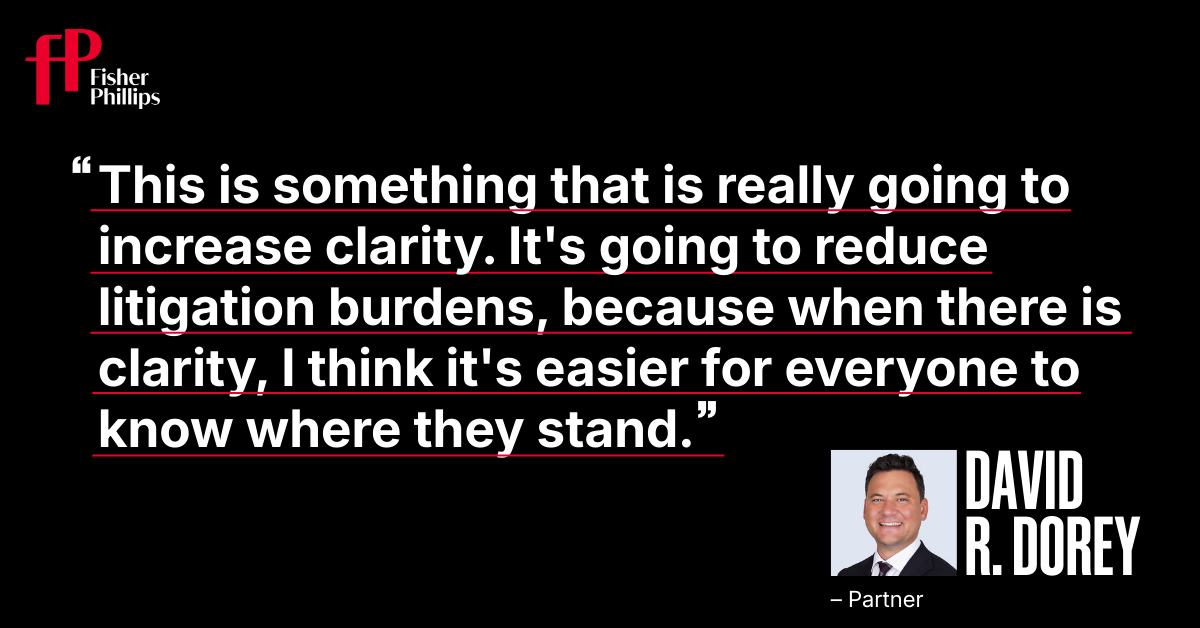
“This is something that is really going to increase clarity,” said David Dorey, a partner in FP's Washington, D.C., office and a key member of the firm's Government Relations team. “It's going to reduce litigation burdens, because when there is clarity, I think it's easier for everyone to know where they stand.”
The potential penalties for misclassification make it essential for businesses to regularly audit their practices and ensure compliance. The latest proposed rule from the Trump administration offers much-sought-after clarity for businesses that rely on independent contractors for their operations, as well as more flexibility.
What’s Being Proposed?
DOL’s Wage and Hour Division released a proposed rule on February 26 that would consider five factors when evaluating whether a worker is an employee or independent contractor in business for themselves. Similar to the rule released during the first Trump administration, the proposal evaluates the “economic realities” of the working relationship.
The proposal outlines two core factors, placing greater weight on:
- the individual’s control over the work; and
- their opportunity for profit or loss.
If a worker’s status isn’t clear based on those two core factors, the proposal instructs businesses to look to:
- the amount of skill required for the work;
- the degree of permanence of the working relationship between the individual and the potential employer; and
- whether the work is part of an integrated unit of production.
When evaluating the individual’s economic dependence on the potential employer, the proposal emphasizes that “the actual practice of the parties involved” is more relevant than what may be contractually possible.
What’s New?
While the WHD’s proposal largely mirrors the rule advanced by the Trump administration in 2021, there are some additions.
The proposal adds language to further clarify that when probing a workers’ economic dependence, one should consider “the dependence that a typical employee has on an employer for work, as opposed to an individual who has more of the nature and character of a business owner who has a separate business.” The DOL emphasizes that “economic dependence” shouldn’t focus on the amount of income the worker earns, or whether the worker has other sources of income.
So, the evaluation is essentially about work, not income.
The big takeaway: economic dependence is the ultimate inquiry when determining a worker’s status. It “ties all of the factors the department is using now together into a single question,” Dorey explained. “And those factors, at least the top two of them, control and profit or loss, if they point one way, would most likely answer the question in just about every case.”
How We Got Here
During the Biden administration, the DOL advanced a rule that generally made it harder for businesses to treat their workers as independent contractors under the FLSA.
The 2024 Biden rule set out a six-part non-exhaustive test to determine a worker’s status, considering issues like the investments by the worker and the business, the degree of permanence of the working relationship, among other factors. Under the Biden-era rule, the DOL could also consider “additional factors” beyond the ones listed – an ambiguity that sparked major concern among the business community.
Fast forward to the second Trump administration, which set out plans to revisit the contractor rule last year, citing five separate legal challenges against the Biden rule filed by industry groups, small businesses, and individual freelancers.
All five of those cases have been paused as the DOL works on its new contractor rule. The agency in May announced it would no longer be enforcing the old rule, despite it still being on the books.
The DOL said its new proposal aims to facilitate more accurate and predictable worker classification with an analysis that better reflects the modern economy.
What Are The Next Steps?
The new proposal will formally replace the Biden-era rule once finalized. The DOL will first publish the proposal in the Federal Register and seek public comment for a period of 60 days (which may be further extended if the agency believes it needs more time to sort through and address the feedback). While the agency may make minor modifications to the proposal, we don’t expect to see significant substantive movement. We’ll expect to see the final rule take effect sometime later in 2026.
Employers may be cautious about the chances of this rule staying in effect. After all, the last decade has seen multiples instances of federal courts yanking the rug out from under the workplace community at the last minute by issuing injunctions blocking rules from taking effect. That concern remains, but is mitigated here because the proposed rule is not novel—it is quite similar to the 2021 Rule—and because the current Administration has plenty of time to work through any litigation. So the odds are much greater that this rule will actually have lasting effect – which means you need to prepare now.
Don’t Forget State Rules Still Apply
Businesses should note that the DOL’s test applies only to the FLSA, FMLA, and MSPA, and many states have their own tests that are applied to state-level wage and hour claims. While some states, such as Arizona, have laws protecting the independent contractor relationship if certain criteria are met, other states have laws making it harder to establish.
For example, a growing number of states – including California, Illinois, New Jersey, and Massachusetts – apply a stringent “ABC test.” A worker is generally considered an employee under the ABC test unless the hiring entity establishes all three of these prongs:
- The worker is free from the control and direction of the hirer in connection with the performance of the work, both under the contract for the performance of such work and in fact;
- The worker performs work that is outside the usual course of the hiring entity’s business; and
- The worker is customarily engaged in an independently established trade, occupation, or business of the same nature as the work performed for the hiring entity.
The ABC test makes it much more difficult for many companies to treat workers as independent contractors, and more difficult for businesses to hire smaller, entrepreneurial businesses.
You should also recognize that, at the federal level, the National Labor Relations Board and other agencies may apply different tests than the DOL uses for FLSA cases.
4 Steps for Business to Prepare for New Rule
As noted above, the Trump administration’s proposed rule still needs to go through the formal notice and comment period, where the public will have an opportunity to share how the rule will impact their work or business. However, we do expect the DOL to prioritize the rule and finalize it as quickly as it can. Here are four key steps you can take to prepare:
1. Review your current work arrangements and consider how the changes will impact your business model if the rule is finalized.
2. Review state rules to ensure you’re still in compliance. Many states have stricter independent contractor standards than the federal level. You will still need to ensure your work arrangements comply with those rules, despite the more lenient federal proposal.
3. Update current policies and train hiring managers if needed. Be sure that managers discuss the project and worker classification with HR or inside counsel before seeking freelancers, gig workers, or other independent contractors.
4. Consult with legal counsel if you’re uncertain about how the new federal proposal could impact your operations. Your FP attorney can assist you in auditing your wage and hour practices and developing a plan of action in response to the new rule when it is finalized.
Conclusion
We will monitor these developments and provide updates as warranted, so make sure that you are subscribed to Fisher Phillips’ Insights to get the most up-to-date information direct to your inbox. If you have compliance questions, consult with your Fisher Phillips attorney, the authors of this Insight, or any member of our Wage and Hour Practice Group to assess and minimize potential risks.