

Colorado’s Impending AI Law Thrown Into More Doubt By Court Ruling: What Will Happen Before June 30 Effective Date?
A federal court just ordered Colorado not to enforce the impending AI law set to take effect on June 30 that otherwise would have upended the way employers use AI in the workplace. The April 27 ruling is just the latest roadblock that the long-delayed law has faced, coming off the heels of a March proposal to completely rewrite the bill and delay its effective date until 2027. The court order temporarily blocks the state from taking any enforcement action while protecting employers from any investigation or penalties for any alleged violations that take place until the court can more fully decide on whether the law should be permanently blocked. What do you need to know about Monday’s ruling and what should you do while we wait for a final resolution?
Quick Resource Center
- Colorado passed the nation’s first comprehensive AI antidiscrimination law in 2024, originally set to take effect February 1, 2026. The law aimed to impose sweeping obligations on both AI developers and the employers deploying those tools, including bias audits, risk impact assessments, and extensive disclosures.
- Almost immediately, the tech and business communities pushed back hard, arguing the requirements were unworkable and would stifle innovation.
- After failed attempts to revise the law during the 2025 legislative cycle, lawmakers pivoted and pushed the effective date to June 30, 2026.
- Governor Jared Polis convened a working group of technology industry representatives, consumer advocates, and business groups to find common ground.
- In March, the state working group released a sweeping proposed rewrite that would strip out the original law’s most burdensome requirements (including mandatory bias audits), replace them with a streamlined transparency-and-notice framework, and push the law’s effective date back to January 1, 2027.
Litigation Throws Another Monkeywrench at Law
Elon Musk’s xAI teamed up with the US Justice Department – which has its sights set on limiting the ability of states to regulate AI on their own – to file a lawsuit against Colorado’s pending AI law.
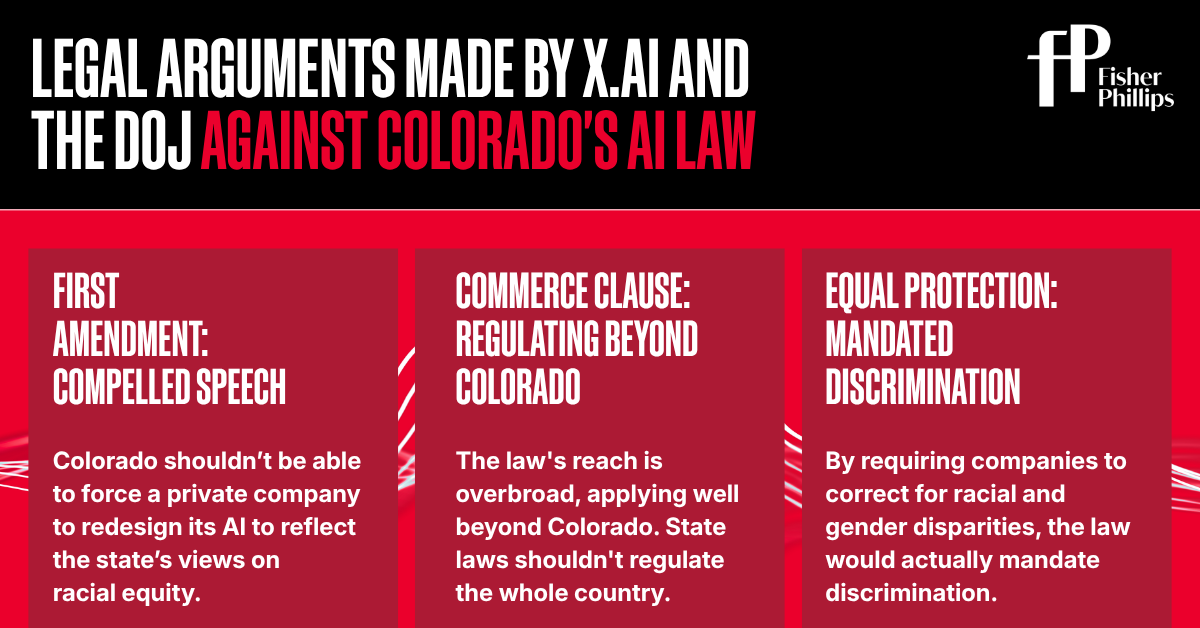
- xAI argued that Colorado’s law unconstitutionally forces private AI developers to embed the state’s preferred ideological views into its products. It contends that every editorial decision it makes in developing its AI products (like Grok) is protected speech under the First Amendment, and that the law would compel the company to redesign Grok to reflect Colorado’s “controversial, highly politicized viewpoint” on racial equity. The complaint also challenged the law on Commerce Clause grounds, arguing that it effectively regulates AI development outside the state because it applies anywhere a Colorado resident is affected by an AI system.
- The DOJ filed a separate complaint alleging Equal Protection violations, warning that “embedding AI with state-mandated discrimination is a recipe for disaster.” The government argued that the law effectively forces algorithm discrimination based on race, sex, and religion by requiring companies to monitor and correct for statistical disparities. Framing the stakes in national security terms, the filing warns that forcing American AI companies to “incorporate discriminatory ideology” into their models threatens US global competitiveness.
- Colorado’s Attorney General even weighed in, agreeing with the two plaintiffs that the court should put the law on ice for now, especially since there was a good chance that state lawmakers could soon make wholesale revisions to the law.
What Did the Court Say?
Without weighing in on the substantive arguments above, the court granted a temporary restraining order to block the state from enforcing or investigating alleged violations of the law. Any actions taken by companies on or before 14 days after the date the court issues a final ruling on the expected motion for a preliminary injunction will not be subject to the Colorado law.
We expect to see the opponents soon file a more thorough request to block the law altogether, regardless of whether state lawmakers amend the law. The court said xAI and the DOJ should file new motions within 28 days after lawmakers pass amended legislation or if the state AG issues final regulations implementing the law.
What’s Next?
The legislature wraps on May 13, so time is growing short for lawmakers to substantively revise the law before the June 30 effective date. But according to Bloomberg Law, bill co-sponsor Rep. Brianna Titone believes that the legislature will pass the rewrite before time runs out. We will keep an eye on the legislature and the litigation and provide updates as warranted.

What Should You Do?
While we play the waiting game, there are some common-sense approaches you should consider to best position your business.
- Audit your AI tools. Take stock of every AI-assisted tool involved in hiring, performance evaluation, compensation, or other employment decisions affecting Colorado workers. Understand what each tool does, how it influences decisions, and what data it uses.
- Conduct a bias audit. Just because Colorado might not require bias audits, they are still a good idea. Discrimination in employment decisions remains illegal under state and federal law, and we are seeing more discrimination lawsuits by applicants when employers use AI tools in the recruiting, screening, or interviewing process – regardless of whether the tool qualifies as an automatic decision-making tool (ADMT).
- Talk to your vendors. Ask your vendors now what they can provide: intended use cases, data categories, known limitations, and meaningful human review guidance. If they can’t answer these questions, that’s important information. Here are some other key questions to consider.
- Watch the legislature and the courts closely. The best way to stay up to speed is to ensure you are subscribed to the Fisher Phillips Insight system.
Conclusion
Make sure you are subscribed to Fisher Phillips’ Insight System to receive the most up-to-date information directly to your inbox. We will continue to monitor the situation and provide updates as they unfold. For more information, contact your Fisher Phillips attorney, the authors of this Insight, any attorney in our Denver office, or any attorney in our AI, Data, and Analytics Practice Group.
Related People