

5-Step Crisis Communications Plan for Professional Sports Organizations
Your sports organization operates under a constant spotlight, which works in your favor when that attention drives higher valuations, robust merchandise sales, and global brand recognition. But when a crisis hits, that same spotlight intensifies – and your window to respond is extremely narrow. The good news is that preparation makes all the difference, and there are steps you can take that will help you if a crisis hits. This Insight offers a practical, five-step crisis communications plan that your sports organization can put in place today.
Hypothetical Scenario: Damage Control
Consider this scenario: A major scandal naming your organization’s president breaks in the regional news. There are no criminal allegations, but the association alone is enough to generate significant pressure to act – from the media, fans, and those within your own organization.
In the first few minutes that follow, your ownership group and executive team are forced to confront a series of urgent questions simultaneously. What are the confirmed facts? What is already circulating on social media? What is the sentiment inside the organization? And most critically, what are your options? The pressure to remove the president is immediate and mounting, yet you know that a quick decision without a clear communications strategy can be just as damaging as the scandal itself.
What should you do?
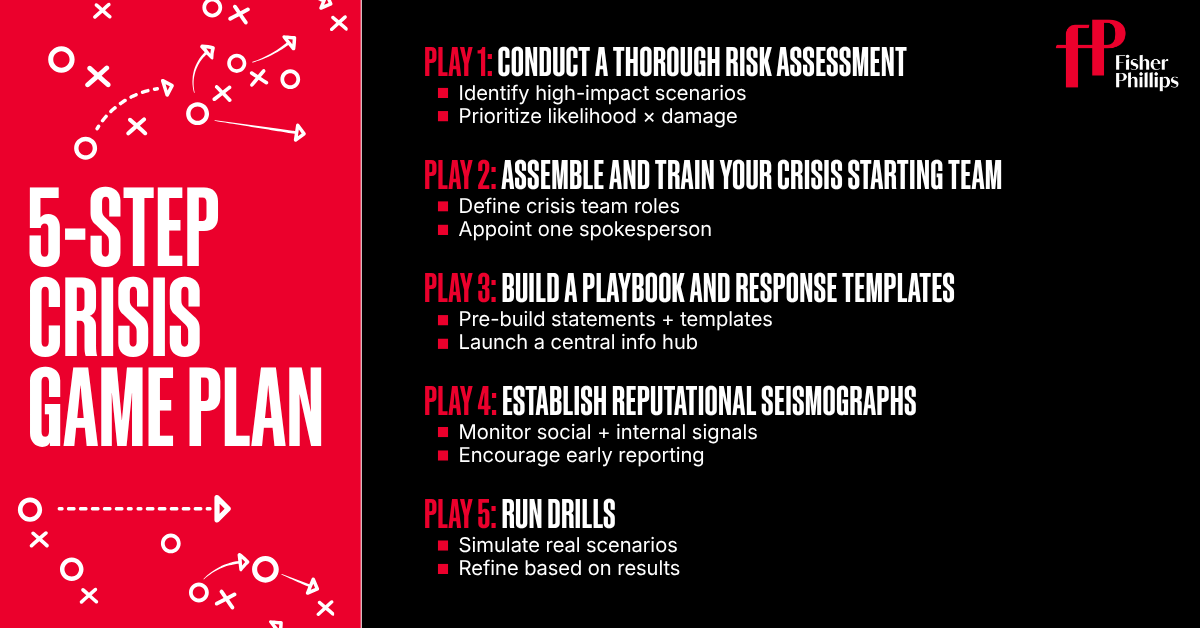
5-Step Crisis Communications Plan
This scenario demonstrates exactly why a proactive crisis communication plan can have immense value. Organizations that have thought through these scenarios in advance are far better positioned to respond and protect their reputation and operations. Here are five steps you should consider when forming your own crisis communications plan.
1. Conduct a Thorough Risk Assessment
Consider situations such as the following that could demand an immediate communications plan and response:
- League Penalties. The league determines that your organization tampered with another team’s athlete prior to the start of free agency, resulting in significant fines and the loss of draft picks.
- Investor Scandal. One of your largest investors becomes embroiled in a financial scandal, raising questions about your organization’s valuation and internal stability.
- Ownership Dispute. A disagreement among members of your ownership group regarding the direction of the team creates a leadership deadlock – and one owner has taken the dispute to the press.
- Data Breach. Your systems are compromised, and sensitive information belonging to your season ticketholders is exposed, creating both legal liability and reputational harm.
- Sale of the Organization. Your ownership team makes the decision to sell the team, and your organization is now navigating competing offers, league approval requirements, and intense public attention.
- Athlete or Executive Misconduct. A key contributor has received attention for the wrong reasons and everyone is looking to your organization to see what it will do.
When assessing risks, assess both the likelihood that the scenario will occur as well as the potential impact of the scenario. Focus your energy on preparing for the “high likelihood/high impact” scenarios first.
2. Assemble and Train Your Crisis Starting Team
When the heat is on, people need to know exactly what their role is. You don’t want to be debating who speaks to the press while a story is trending on social media.
- Designate a Crisis Management Team: This should include, at a minimum, your President, Owner, Legal Counsel, Head of PR, and General Manager. For certain high likelihood/high impact crises, you may want to think about who else should be on deck. For example, a player crisis will require more input from your coaching staff, while a technical crisis may require other subject matter experts in your organization.
- The One Voice: Appoint one primary spokesperson. In sports, consistency is key to preventing rumors.
- Media Training: Ensure your spokesperson is comfortable under the bright lights of aggressive questioning.
3. Build a Playbook and Response Templates
Speed is the currency of crisis management. Having pre-approved language allows you to respond in minutes rather than hours.
- The “Contingency Site”: Create a pre-built, unpublished section of your website containing safety FAQs, contact info, and placeholders for statements. Activate it only when needed. This allows you to immediately direct questions and rumors to a single, reputable source of information.
- Holding Statements: Draft “fill-in-the-blank” templates for various scenarios (e.g., “We are aware of the incident involving [Player Name] and are currently gathering more information...”).
- Contact Rosters: Maintain an active list of stakeholder, organizational, and media contacts who you should prioritize for communications, along with how to reach them on short notice.
4. Establish Reputational Seismographs
You can’t manage what you don’t know about. Most sports crises bubble up on social media or local fan forums long before they hit the national news.
- Social Listening: Use tools to monitor mentions of your team, players, and executives in real-time.
- Internal Reporting: Create a “no-fault” culture where staff can report potential issues (like a safety hazard in the stands) without fear of retribution.
- Radical Integrity: Commit to a culture of radical integrity. Make sure that when something goes wrong, your stakeholders can rely on the fact that they will hear it from you and that you will tell them what they need to know.
5. Run Drills
A plan on paper is just a theory until it’s tested. Your team practices plays; your organization should practice crises.
- Tabletop Exercises: Once a year, run a two-hour simulation. Throw a curveball halfway through (e.g., “The story just went viral on X, and a major sponsor is calling”) to see how the team pivots.
- Refine the Playbook: Study your film from these drills to update your contact lists and messaging strategies.
- Maintain Your Plan and Resources: As situations, personnel, and risk factors change, make sure you revisit and adjust your plan so that you are ready for those risks that stand to have the biggest impact on your organization.
Pro Tip: In almost any crisis, your audience will value authenticity over perfection. If a crisis hits, skip the “corporate-speak.” Be human, be transparent, and be fast. Taking the steps outlined above can help your organization respond rapidly to a dynamic environment on and off the field.
Conclusion
If your organization is ready to develop a proactive strategy, the attorneys in Fisher Phillips’ Reputation and Crisis Management Practice Group can help. You can reach out to the authors of this article, your Fisher Phillips attorney, or any attorney on our Sports Industry Team. Make sure you are subscribed to Fisher Phillips’ Insight System to receive the most up-to-date information.
Related People