

With layoffs trending upward in industries like manufacturing, business services, and transportation, it’s important to be aware of the legal requirements surrounding mass business closures or worker terminations. The Worker Adjustment and Retraining Notification (WARN) Act requires employers to provide advance notice to employees of certain plant closings and mass layoffs with limited exceptions. But the law has very specific requirements about the information you need to provide, when to provide it, and which employees you need to notify when engaging in major workforce reductions. Here’s everything that may surprise you when it comes to plant closures and large-scale terminations – and your 4-step plan to comply with the WARN Act.
Does WARN Apply to My Business?
The WARN Act can be triggered in several ways based on the number of impacted employees and under certain conditions. Generally, the law requires that during any 90-day period, private businesses with more than 100 full-time employees must provide 60 days of advance written notice when:
- a worksite closure will impact at least 50 people at a single site of employment;
- they plan to lay off at least 33% of their workforce at a single site of employment, so long as the layoffs will impact a minimum of 50 employees; or
- if planned layoffs will affect 500 or more employees at a single site of employment.
Figuring out if these scenarios apply to your business can be tricky and can require a bit of math, noted Matthew Korn, a partner in Fisher Phillips’ Columbia, SC office.
Workers who have been employed for fewer than six months and part-time employees aren’t counted towards these thresholds. An important caveat is that the law defines a “part-time” worker as an employee who (a) works less than 20 hours per week or (b) been employed for fewer than six of the 12 months preceding the date on which notice is required. So it’s important to keep this hourly threshold in mind, since it may differ from your company’s definition of “part-time.”
There are also certain exceptions to the 60-day notice requirement where employers can demonstrate that closings were caused by unforeseen business circumstances or a natural disaster (Read our comprehensive guide to responding to hurricanes and other disasters here). There is also a limited exception for “faltering companies” that are seeking capital, if disclosing the layoff would jeopardize their chances of securing funds needed to stay afloat. These exceptions are narrow and employers must still provide as much notice as possible to workers in these cases.
Employers should also recognize that at least 18 states, including California, New York, Delaware, Maryland, and Ohio, have enacted their own WARN laws that may be triggered based on different events or employee thresholds compared to the federal WARN Act. For example:
- In New York, employers must provide 90 days of advance notice for layoffs impacting 25 or more employees so long as they make up 33% of the workforce at a single site.
- In Maryland, state WARN requirements kick in when the layoff or closure affects at least 15 employees or 25% of the staff at a single worksite, whichever figure is greater.
Remote Employees
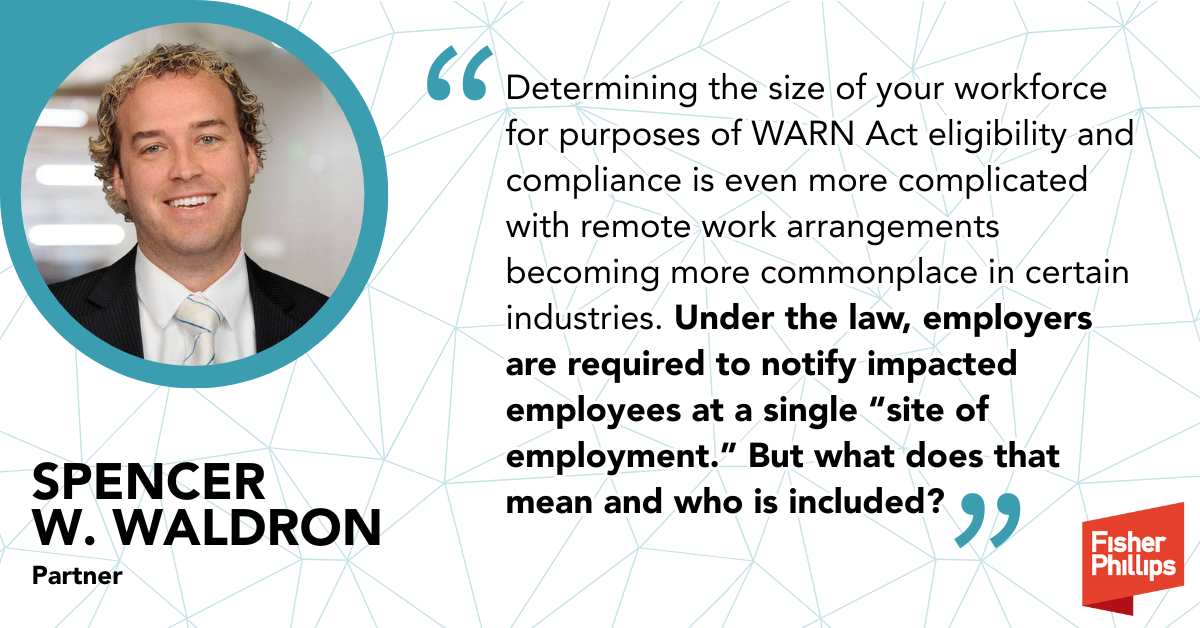
Determining the size of your workforce for purposes of WARN Act eligibility and compliance is even more complicated with remote work arrangements becoming more commonplace in certain industries.
Under the law, employers are required to notify impacted employees at a single “site of employment.” But what does that mean and who is included?
The law defines a single site of employment as: “separate buildings or areas within reasonable geographic proximity and share staff and equipment.” When it comes to workers who “primarily travel” or are “outstationed,” federal guidance says the site of employment can include a home base they are assigned to, where they report, or “from which work is assigned.”
Korn explained that WARN wasn’t intended to cover modern remote workers, and despite the major shift to remote work during the pandemic, the issue still hasn’t been ironed out by the courts.
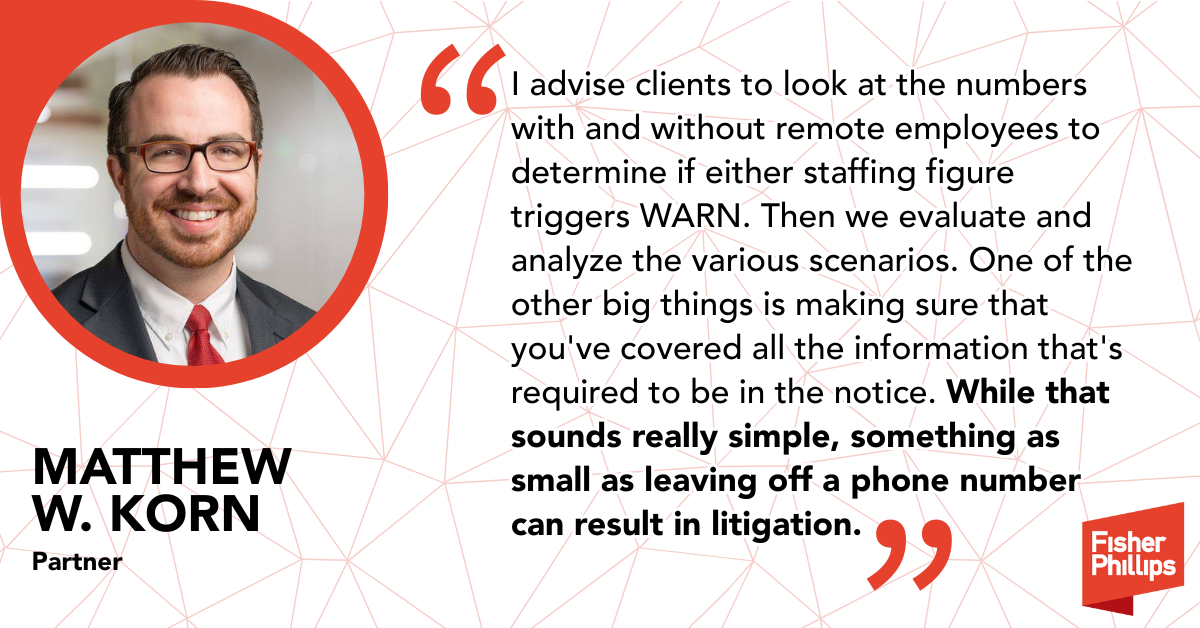
“I advise clients to look at the numbers with and without remote employees to determine if either staffing figure triggers WARN. Then we evaluate and analyze the various scenarios,” Korn said.
Notice Requirements
Another area of WARN that frequently trips up employers is the explicit details that must be included when providing written notification to employees of a layoff or closure.
“One of the other big things is making sure that you've covered all the information that's required to be in the notice,” said Korn. “And while that sounds really simple,” he added, “something as small as leaving off a phone number can result in litigation.”
Any federal WARN notice to affected employees must contain, at a minimum, the following information:
- A statement on whether the planned action is expected to be permanent or temporary, and if the entire plant is being closed;
- the expected date that the plant closing or mass layoff will commence, as well as the anticipated date of each employee’s layoff or termination (or a 14-day window when each employee’s layoff or termination will occur);
- an indication as to whether bumping rights (or a system that allows employees slated for layoff to claim or displace other positions, based on seniority status) exist; and
- the name and telephone number of a company official who can be reached for further information.
Some states require additional information in the notices.
Federal and local workforce entities also must receive advance notice of the closure or layoffs under these regulations. Federal WARN guidance states that employers should notify the “chief elected official of the local government” as well as the State Rapid Response Dislocated Worker Unit of the location, number of employees affected, and dates of a mass layoff, in addition to the businesses’ contact information.
Beyond providing the required paperwork, Korn emphasized that communication about the closure or layoff should go both ways: “If you're laying off 20% of your workforce. What are you saying to the rest of the 80%?” Reassuring your staff of the company’s business decision behind the cuts and demonstrating that staff exiting the company are being treated with respect is important, Korn said. It signals that they're going to be treated the same way if, unfortunately, layoffs happen again in the future.
4 Ways You Can Stay Ahead
While layoffs and natural disasters can be unexpected, there are several steps you can take to be prepared for the worst:
1. Review employee coverage and thresholds. Ensure your calculations account for employees who may have been at the company for less than six months or work less than 20 hours a week, and thus, aren’t counted toward federal WARN thresholds. Federal and state WARN requirements trigger based on the number of eligible employees affected by the layoff, so it’s important to understand the nuances of the applicable laws and consult with counsel as needed.
2. Check state laws where your employees operate. At least 15 states have their own WARN laws that may require earlier notification, require notice when notice is not required under federal WARN, or cover more employees. Consult with counsel about how the law’s definitions of “site of employment” may include or exclude employees based in other states.
3. Have counsel review your WARN notices. The law is very specific about what information must be included in WARN notifications provided to affected employees and government entities. Failure to include certain information could be considered failure to provide proper notice under the law.
4. Consider Fisher Phillips’ RIF/WARN Toolkit, which provides essential resources to help employers plan and properly carry out mass layoffs, including WARN notice templates.
Conclusion
If you’re contemplating layoffs or have employees in an area at high risk for natural disasters, your Fisher Phillips attorney is ready to help. You may reach out to authors of this Insight or any attorney in our Reductions in Force (RIFs) Practice Group. We will continue to monitor the latest developments related to this area and provide updates as warranted, so you should ensure you are subscribed to Fisher Phillips’ Insight System to gather the most up-to-date information directly to your inbox.
Related People