

A recent federal court ruling presents a cautionary tale for employers when handling employee disability-related requests. The US District Court for the District of Utah’s January 13 decision allows the employee to proceed with discrimination claims against a mountain resort for failing to provide a disability-related accommodation in employer-provided housing. The employee claimed that Flaming Gorge Resort violated federal and state law by refusing to allow his diabetes-alert dog to live in company-provided housing and subsequently firing him over the dispute. The court denied the resort’s request to toss out the lawsuit and gave the green light to the claims under both state and federal anti-discrimination law. The ruling underscores that not all disability accommodations apply to job functions. It also highlights the importance of engaging in an interactive dialogue with employees who request disability-related accommodations. Here’s everything you need to know about the ruling and what it means for your business.
Case Details
In O’Connor v. Collett’s Mountain Resorts, Inc., a former employee of Flaming Gorge Resort alleged his employer discriminated against him in violation of the Americans with Disabilities Act (ADA) and fair housing laws when it refused to allow his diabetes alert dog to live in company-provided employee housing. The employee has type 1 diabetes and relies on the alert dog to signal when his blood sugar spikes or drops. After being told that he would be unable to keep his dog in employee housing, the employee was fired.
According to the lawsuit, resort management said that the decision “was not related to his service animal but was because he was dishonest about the service animal, had argued about the denial of the service animal, and had said that he wanted to seek legal advice from an attorney regarding” the denial.
What the Court Found
The employee brought three claims under the ADA: failure to grant a reasonable accommodation, wrongful termination, and retaliation. In response, the resort argued that it didn’t violate the law because the employee requested a housing accommodation, not an accommodation needed to perform his job.
But the court determined that the employer-provided housing amounted to “a privilege of employment” because the housing is a benefit “provided by the employer specifically to employees – not to the general public.”
“While employees were not required to stay in the housing and still paid rent, the housing was only available to a specific class – employees – and had unique benefits for that class – namely, an affordable rate and a short commute,” the judge said. “And any discrimination in the housing is related to ‘some aspect of employment’ as the employer provided and managed the benefit.”
As the Collett’s Mountain Resorts, Inc. case made clear, disability accommodations under the ADA can be required to go beyond just providing assistance for an employee’s job duties.
Equal Employment Opportunity Commission (EEOC) guidance explains that employers must “provide reasonable accommodations so that employees with disabilities can enjoy the ‘benefits and privileges of employment’ equal to those enjoyed by similarly situated employees without disabilities.” Those benefits can include everything from training and employee assistance programs to access to cafeterias, gyms, and social functions.
Going Through the Process
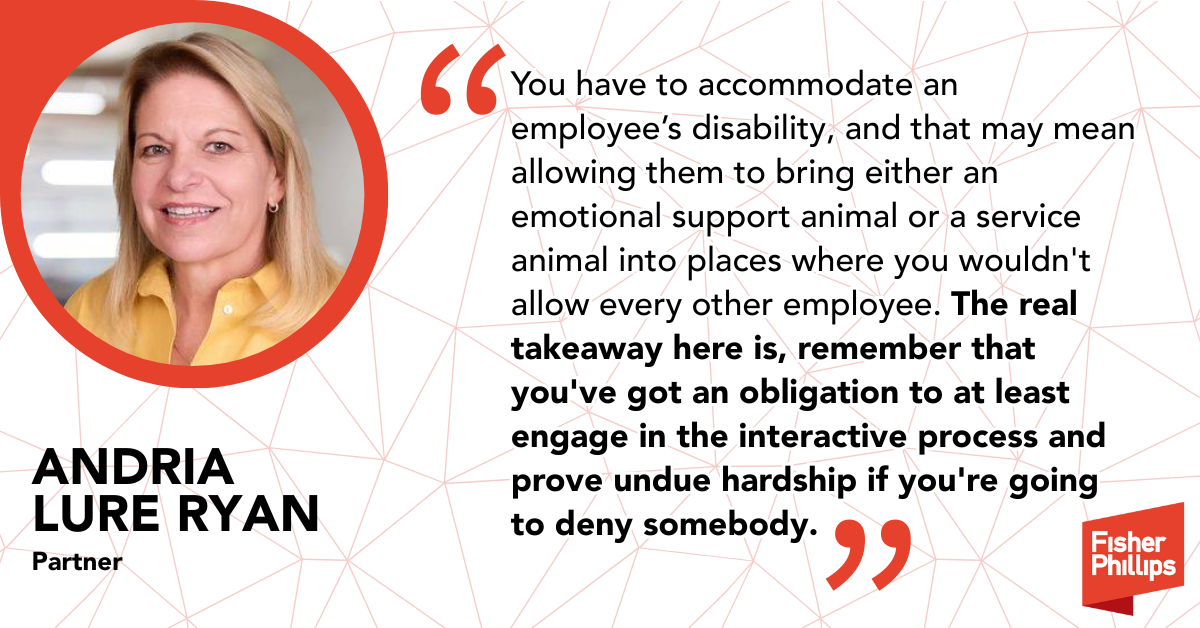
While it is common for hospitality and resort businesses to deal with service animal requests from guests, employers have different obligations with their employees under the ADA, said Andria Lure Ryan, Co-Chair of FP’s Hospitality Industry Group.
“You must engage in the interactive process to evaluate your obligation to accommodate an employee’s disability, and that may mean allow an emotional support animal or a service animal into places, such as employee housing, certain back of the house areas, or business offices, where you do not have the same obligation to guests,” Ryan explained. Employers will need to show undue hardship when denying an accommodation.
Engaging in good faith with an employee seeking an accommodation request is essential to ensure you’re complying with the ADA. Employees who make requests for reasonable accommodations don’t have to use any “magic word” or mention the ADA to start the process.
When it comes to accommodation requests under the ADA:
- Employees must request the accommodation. Employers don’t have to presume an accommodation is needed.
- You should respond to the accommodation request promptly. Delaying or dragging on the process can demonstrate a lack of good faith in complying with the ADA.
- Employers can request medical documentation to explain what accommodations may be needed and why.
- Even if you’re not required to comply with the request, work with the employee to explain why the accommodation may or may not be feasible and discuss alternatives.
- Contact legal counsel if you’re unsure about the nature of the request or accommodation requested.
“The real takeaway here is, remember that you've got an obligation to at least engage in the interactive process and prove undue hardship if you're going to deny an employee an accommodation,” Ryan said. “And presumably if your employee is acting in good faith and actually needs the service animal if, after the interactive process, you deny their request, you are likely terminating them or refusing to hire them because they can't come to work without it.”
|
Undue Hardship Businesses don’t have to provide accommodations to employees under the ADA if the request would create an “undue hardship.” EEOC guidance defines such hardship as “based on an individualized assessment of current circumstances that show that a specific reasonable accommodation would cause significant difficulty or expense.” This analysis should be done on a “case-by-case” basis and includes not only considering whether the request would be too costly, but also whether the accommodation would be disruptive, overly extensive, or alter the operation of the business. |
Conclusion
We’ll continue to monitor this case and provide updates as it develops. If you have questions, please subscribe to Fisher Phillips’ Insight System to get the most up-to-date information directly to your inbox or contact any attorney on our Employee Leaves and Accommodations or Hospitality teams.
Related People