
Our Workplace Safety thought leaders have pulled together their top predictions for the new year so that employers can get a head start to 2026. If you want more, register for our FP Workplace Law Forecast Webinar here.
We’ll See a Business-Friendly Enforcement Approach
New leadership will mean a new day for employers. Now that David Keeling is in place as the new head of OSHA, we predict the administration’s efforts to cooperative with employers will forge forward at a fast clip. Wayne Palmer has also been confirmed to lead MSHA, where we expect similar efforts to increase outreach to industry to continue. Some specific examples:
- DOL leadership launched a revamped Opinion Letter program last year, which is partially focused on issuing more letters of interpretation in response to requests about workplace safety regulations and policies.
- We predict OSHA will issue few, if any, press releases after an employer is cited for safety violations.
- We also expect fewer regulations to be proposed or promulgated, especially as DOL leadership looks to cut redundant or overburdensome rules.
- Thanks to reduced staffing at OSHA (and a White House request to lawmakers to cut roughly 12% of OSHA’s employees), we’ll see fewer inspections, especially programmed inspections. However, certain types of inspections will still occur, such as fatalities, hospitalizations, and amputations.
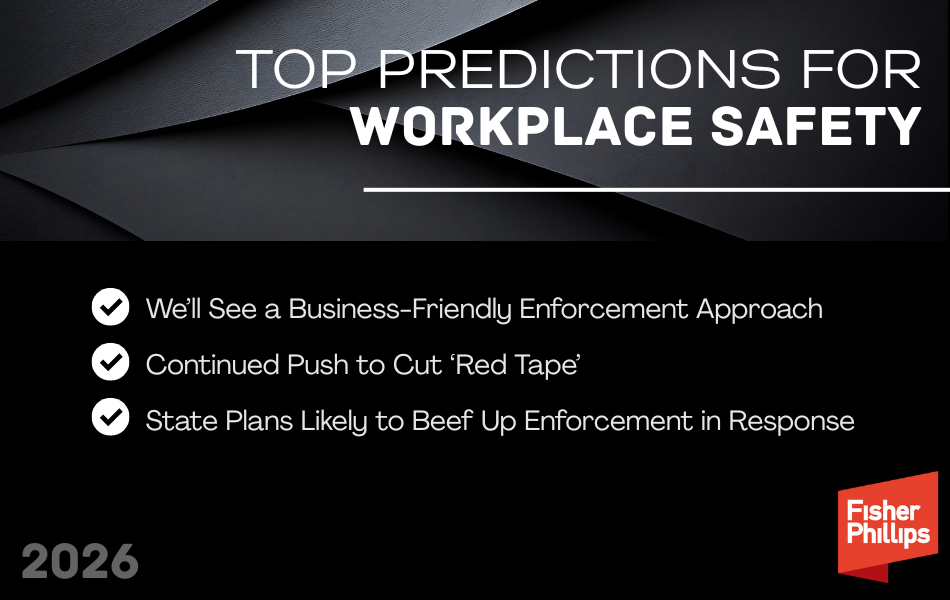
Continued Push to Cut ‘Red Tape’
We expect OSHA to move forward on the proposed deregulation efforts it announced this past year. For example, the agency proposed putting parameters around its general duty clause, which would restrict its own ability to regulate inherently risky work. If finalized, the proposal would change how the agency applies the “General Duty Clause” in the sports, entertainment, and other industries. It could shield entire industries from enforcement actions that threaten their core business models.
The DOL also wants to loosen medical evaluation requirements for filtering facepiece respirators (FFR) and loose-fitting powered air-purifying respirators (PAPR), as part of a proposed rulemaking. Currently, the medical evaluation requirement is a key component of the respiratory standard for all respirators.
The Trump administration proposed shuttering the Chemical Safety Hazard Investigation Board (CSB), suggesting the panel’s work was duplicative of other agencies. Funding hasn’t yet been finalized for the CSB for FY 2026.
We also expect federal OSHA to issue a heat regulation, however something far more performance-based and less prescriptive than what was proposed by the Biden administration. The agency received nearly 50,000 comments on its proposed limits on heat exposure in the workplace last year, with many employers expressing concern about the scope and one-size-fits-all nature of the rule. The agency will now have to work through those public comments and prepare responses before finalizing the rule.
State Plans Likely to Beef Up Enforcement in Response
With the anticipated changes at the federal level, we expect certain state OSHA plans will head in the opposite direction with more regulations and aggressive enforcement. We’ve already seen some of these efforts pick up under measures passed during the first year of Trump’s second term. For example, certain employers in Nevada had to start monitoring air quality and reducing employees’ exposure to wildfire smoke under a new state regulation that went into effect on January 1. Oregon also established workplace violence prevention requirements for certain healthcare entities, and Washington expanded safety standards for isolated employees (such as janitors, security guards, and room service attendants) in regulations that both went into effect January 1.
We also expect to see continued efforts by local prosecutors in certain jurisdictions pursing criminal investigations/prosecutions related to workplace deaths, even without federal OSHA making any referrals.
|
Want More?
|
Conclusion
We will continue to monitor developments related to all aspects of workplace safety law. Make sure you are subscribed to Fisher Phillips’ Insight System to get the most up-to-date information. If you have questions, contact your Fisher Phillips attorney, the authors of this Insight, or any member of our Workplace Safety Team.
Related People