

It’s estimated that upwards of 125 million people will watch next week’s Super Bowl matchup between the Seattle Seahawks and the New England Patriots, and it’s likely that your employees will be tuning in. Whether they’re die-hard football fans, or just watching for the commercials and halftime show, your employees will likely be excited in the days leading up to the big game (and may feel the after-effects the next day). That excitement can lead to employer headaches if you don’t spend a few minutes ahead of time planning for some inevitable events. Here are four key tips to help you prepare for these scenarios so you can win Super Bowl Sunday regardless of the outcome.
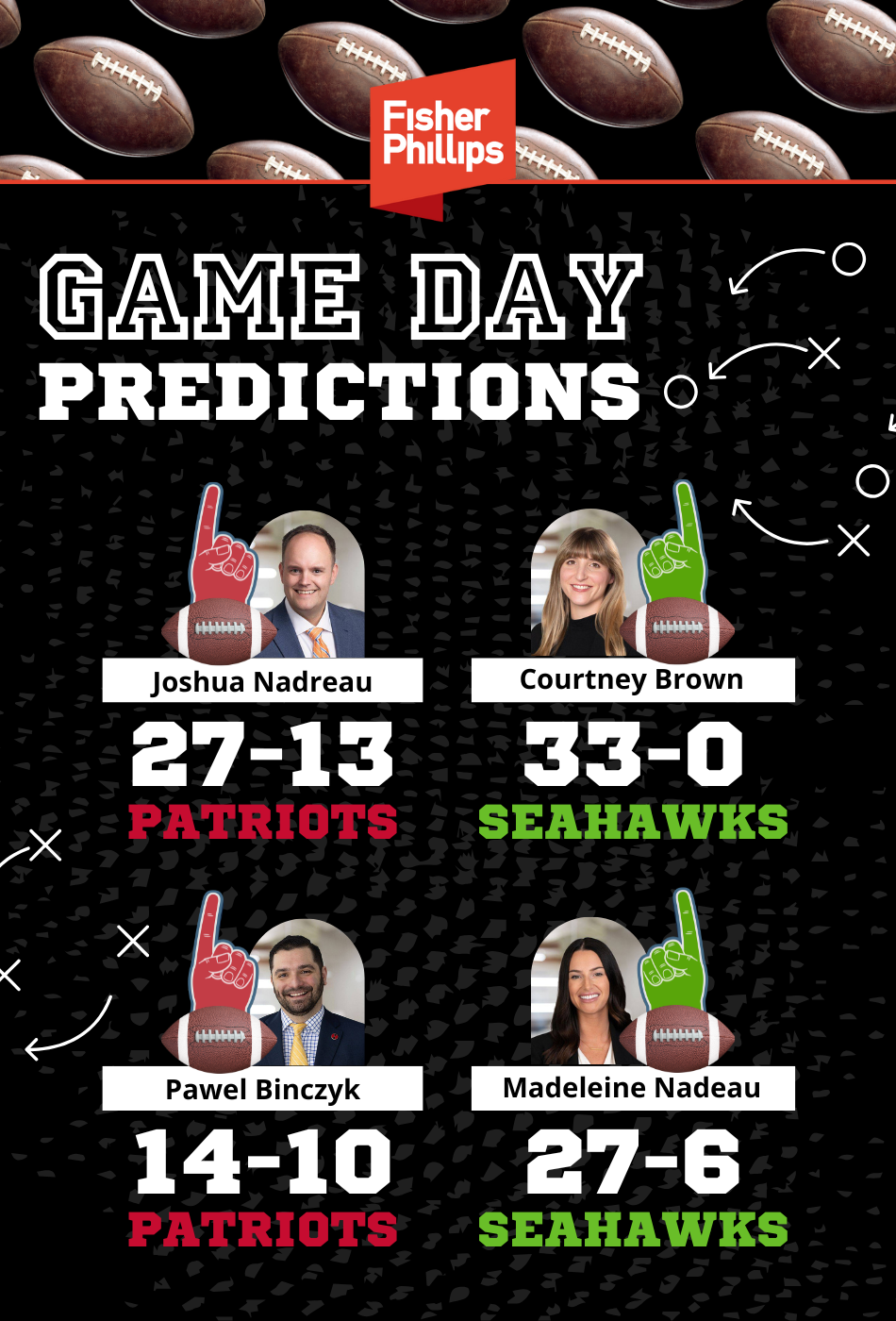
FP Author Predictions
|
🏈 Madeleine Nadeau: Seahawks 27, Patriots 6. The last time these two teams played in a Super Bowl after the 2015 season, we got one of the most unforgettable endings in NFL history – but this time the story gets a rewrite. The Seahawks control the game from start to finish, taking a steady lead into the fourth, when the Dark Side slams the door for good: Ernest Jones IV picks off a pass intended for Stefon Diggs in the end zone and takes it all the way for an all-time pick-six to seal it. 🏈 Josh Nadreau: Patriots 27, Seahawks 13. Uninhibited by snow and ice, Drake “Drake Maye” Maye shines a bright light on Seattle’s Dark Side, rushing for two touchdowns and passing for another. The Patriots’ defense adds one more for good measure while dominating wire to wire, making this old-fashioned New England winter a bit more bearable. 🏈 Courtney Brown: Seahawks 33, Patriots 0. Hot off the third-easiest regular-season schedule since 1978, Drake Maye is counting on Sam Darnold to “see ghosts" in this game. But no such luck. Late in the fourth, the Seahawks will line up on the 1-yard line and prepare to run the ball – no wait, it's a play action! Darnold throws the ball to JSN, who is bumped by Gonzales but still manages to come down with it in the end zone to cap the game. 🏈 Pawel Binczyk: Patriots 14, Seahawks 10. Drake will smile boyishly and scramble just enough to effectively game manage a come-from-behind defensive win. The Pats will seal it late in the fourth with a Christian Gonzalez end-zone interception on a Seattle goal-line throw that should have been a run (sound familiar?). The rest of the country will grumble at New England winning yet another Super Bowl but, on reflection, won't hate it as much as they thought they would. |
1. Protect Your Blind Side: Guard Against Productivity Pitfalls
While most employers jump to concerns about absenteeism and tardiness the morning after the Super Bowl, employees' anticipation in the days leading up to the game can create just as many productivity challenges.
For example, one study from Challenger, Gray & Christmas estimated that employees spend about 10 minutes a day on average in the days leading up to the Super Bowl discussing the game, managing betting pools, and researching stats about the participating teams and their players. For employees working on Super Bowl Sunday, the distractions can be even worse. According to a 2025 survey from the UK Workforce Institute, almost 18 million U.S. employees admitted that, although they would be working on game day, they still planned to watch at least some of the game. This is true even where employers have strict device policies prohibiting personal activity.
Game Plan: Apply productivity standards and associated policies consistently and fairly.
Rather than implementing strict Hail Mary procedures, you should rely on your already-established productivity expectations. Remember:
- It’s not uncommon or unexpected for employees to devote small amounts of time each day to personal matters, whether that be chatting with colleagues, placing an online order, or communicating with friends and family.
- As long as employees are completing their assignments in a timely and satisfactory fashion, every moment of the day does not need to be micromanaged.
- Especially for your salaried employees, it is important to remember that employees who find personal fulfillment outside of work are ultimately more engaged and productive at the office.
- You may need to adjust your approach to hourly employees in certain industries and positions depending on whether they must remain fully engaged while on the clock.
2. Replay Booth Review: Office Pools and Fantasy Leagues
As the day of the big game approaches, many workplaces find themselves heading back to the replay booth. “Super Bowl squares” reappear on the breakroom wall, fantasy league chatter fills Slack channels, and the ever-popular “just for fun” office pool is back in play. While these activities can be a great way to build camaraderie, a quick look at the tape can help confirm that everything lines up with the rules before kickoff.
Angle One: State Law Calls the Play
Following the Supreme Court’s 2018 decision striking down the federal ban on sports betting, the legality of workplace Super Bowl pools, fantasy leagues, and similar wagering is now governed primarily by state law. The result is a highly variable, state-by-state regulatory landscape. Many states permit some form of legalized sports betting, others allow only limited in-person wagering, and several continue to prohibit sports betting altogether. But even in states that broadly allow wagering, office pools and fantasy contests may be lawful only if they fit within narrow “social gambling” exceptions, such as requirements that no one profits from running the pool and that entry fees or prizes remain below specified thresholds.
Angle Two: Is That Pool Even Reviewable?
Traditional office pools often involve the core elements associated with gambling: consideration, chance, and a prize. Whether those activities are permissible depends not only on whether sports betting is legal in a particular state, but also on how the pool is structured. Conditions such as limits on entry fees, caps on winnings, prohibitions on organizers taking a cut, and restrictions on online or app-based wagering can determine whether a workplace pool qualifies for a lawful exception or crosses into prohibited activity.
Angle Three: The Multi-State and Remote Work Complication
For employers with remote or multistate workforces, ensuring you’re in compliance can be more complex. Sports betting laws generally apply based on where the employee is physically located, not where the company is headquartered. A single fantasy league or squares pool that includes participants working in multiple states may therefore be subject to multiple legal regimes at once. In addition, interstate or online betting activity can, in certain circumstances, implicate federal statutes governing wagering across state lines, even though federal involvement in this area is otherwise limited.
Angle Four: Risk Management and Best Practices
Given this patchwork of laws, the most prudent approach is to proceed cautiously. You may wish to limit participation to employees located in states where workplace pools or fantasy contests are clearly permitted, structure any activity to fit squarely within applicable social-gambling exceptions, and avoid interstate or online features that could trigger federal concerns. Clear guardrails are also important from an employee-relations standpoint. Participation should be genuinely voluntary, managers should avoid organizing or administering betting activities for their teams, and company systems and work time should not be used to run or manage pools. Finally, you might want to consider setting up your own company-run contests where you supply the prizes at no cost to your workers.
Final Call on Betting
A careful trip to the replay booth, including an ongoing review of applicable state laws, the structure of any office pools or fantasy leagues, and existing company policies, can help multi-state employers reduce legal risk while still allowing employees to enjoy the season. With the right advance review, the only calls under scrutiny on Monday morning should be the ones made on the field, not in the workplace.
3. Set Your Professionalism Game Plan to Avoid Workplace Fumbles This Year
While Super Bowl season is a great time for team bonding, it also presents a unique set of PR and HR challenges. Here is your executive guide to keeping the workplace professional and your brand’s reputation intact.
|
The "Third-Half" Liability: Off-Duty Conduct and Alcohol If your company hosts a watch party or if employees gather informally at a venue while wearing company-branded gear, your business may be legally and reputationally on the hook if things go south. The Risk: A viral video of an employee in a company polo engaging in a bar fight or public intoxication can cause immediate brand damage. In many jurisdictions, “social host liability” (or Dram Shop laws) can hold an employer responsible if an employee is over-served at a company-sanctioned event and later causes an accident. The Play: If hosting an event, use professional bartenders (who are trained to cut people off) rather than a self-serve cooler. Explicitly state in the invitation that workplace conduct and harassment policies remain in effect. Consider hiring transportation for employees if you will make alcohol available. Always ensure that there are leaders present who are not indulging and can intervene or de-escalate if a situation requires it. Offensive Line: Conduct and "Banter" Control Team rivalries can get heated and passion for a team can be used as a "pass" for behavior that wouldn't be tolerated elsewhere. What starts as friendly trash-talk can quickly spiral into conduct that violates workplace harassment or civility policies. The Risk: Excessive venting or aggressive behavior toward fans of the opposing team can create a hostile environment, particularly if it targets protected characteristics (e.g., using coded language or stereotypes about a player’s background to insult a coworker who supports that team). Internal “banter” that makes its way onto Slack or public channels can be screenshotted and used as evidence of a toxic or discriminatory workplace culture. The Play: Remind staff that while team jerseys might be permitted for the day, workplace conduct policies remain in full effect. Encourage competition to remain friendly and professional and make it clear that respect is non-negotiable, regardless of the score. Remind managers to model gracious winning and resilient losing. |
4. Attendance, Fatigue, and Safety: Enforcing the Rules Without Drawing a Flag
The Monday after the Super Bowl is often treated as an unofficial national sick day, but employers should resist the temptation to treat all absenteeism or reduced productivity as purely a discipline issue. Attendance challenges around the big game frequently intersect with state and federal leave, accommodation, and disability laws. Missteps can quickly turn routine enforcement into a legal fumble.
Absenteeism and Leave Law Compliance
Employees who call out or arrive late in the days immediately before or after the Super Bowl may cite illness, fatigue, or family-related obligations. Here’s a few reminders:
- While employers are entitled to enforce attendance policies, those policies must be applied consistently and in compliance with applicable laws, including the FMLA, state paid sick leave statutes, paid family and medical leave programs, and the ADA.
- A reported migraine, flu-like symptoms, or exacerbation of an underlying condition may trigger protected leave or accommodation obligations, even if management suspects the timing is football-related.
- Train managers to avoid dismissive comments (“You don’t look sick” or “Funny how everyone gets sick after the Super Bowl”) and instead route attendance issues through established leave-administration processes.
Disability and Accommodation Considerations
Fatigue, sleep disruption, and medication side effects can also implicate the ADA or state disability laws, particularly in safety-sensitive roles. Keep in mind:
- If an employee indicates that exhaustion or a medical condition is affecting their ability to work safely, you should engage in the interactive process rather than immediately defaulting to discipline.
- Temporary schedule adjustments, delayed start times, or reassignment away from hazardous tasks may be reasonable in some circumstances. The key is to focus on job-related concerns and safety, not speculation about the employee’s weekend activities.
Safety First – Especially in Safety-Sensitive Roles
For employers in manufacturing, transportation, healthcare, construction, and similar industries, post-Super Bowl fatigue can present real safety risks. Some things to consider:
- You may enforce fitness-for-duty standards and prohibit working while impaired or overly fatigued, so long as those standards are applied uniformly and are tied to legitimate safety concerns.
- Reminding employees ahead of time that safety policies remain in full effect – and that employees are expected to report to work rested and able to perform their duties safely – can help reduce risk without singling anyone out.
Balancing Flexibility With Consistent Enforcement
Many employers choose to offer limited flexibility around the Super Bowl, such as pre-approved PTO, shift swaps, remote work where feasible, or adjusted start times. These approaches can reduce unplanned absences and morale issues, but they should be structured and communicated clearly. Managers should avoid ad-hoc exceptions or “wink-and-nod” approvals that later become evidence of inconsistent enforcement. Whatever approach you take, the safest play is consistency: apply attendance rules, leave policies, and discipline standards the same way you would any other time of year.
Conclusion
By keeping the above game plan in mind, employers are sure to emerge victorious regardless of the outcome of the game. We will continue to monitor developments related to all aspects of workplace law, so make sure you are subscribed to Fisher Phillips’ Insight system to get the most up-to-date information. If you have questions, contact your Fisher Phillips attorney, the authors of this Insight, or any member of our Sports Industry Practice Group.
Related People




Regional Managing Partner and Vice Chair, Labor Relations Group
emailSend Email
phone617.722.0044