

Employers have a month to prepare for the FY 2027 H-1B cap lottery to open – and you should be aware of upcoming deadlines and significant changes this year. The H-1B visa program allows US employers to hire highly skilled foreign professionals. But with a limited number of visas and high demand, early preparation is key. Here’s a quick overview of this year’s H-1B visa lottery process and practical steps employers can take to navigate the process smoothly.
What is the H-1B Visa Cap Lottery?
- Each year, US Citizenship and Immigration Services (USCIS) allocates a limited number of H-1B visas through a cap lottery process. The H-1B program allows businesses to temporarily hire foreign workers in certain highly skilled, specialized occupations that require at least a bachelor’s degree or its equivalent in a field related to the duties of the position.
- Examples of H-1B specialty occupations include architecture, computer science, engineering, construction project management, mathematics, physical sciences, social sciences, medicine and health, education, business specialties, accounting, law, theology, and the arts. H-1B visas are highly sought after in tech, healthcare, higher education, finance, and engineering.
- There are 65,000 slots available for "regular" H-1B registrations, with an additional 20,000 slots allocated to individuals with a US master's degree or higher.
- To apply for a particular year, employers must submit an electronic registration for each candidate they sponsor. If the number of registrations exceeds the quota, USCIS will conduct a random lottery process to determine which registrations will advance to the next stage. Over the past 15 years, the lottery has been necessary due to high demand by US employers.
- For selected candidates, employers will be required to submit detailed individual nonimmigrant applications.
- The lottery system is intended to ensure a fair allocation of visas when demand exceeds supply. The visas are valid for up to six years, subject to employer sponsorship and regulatory requirements.
When Will the H-1B Cap Lottery Take Place in 2026?
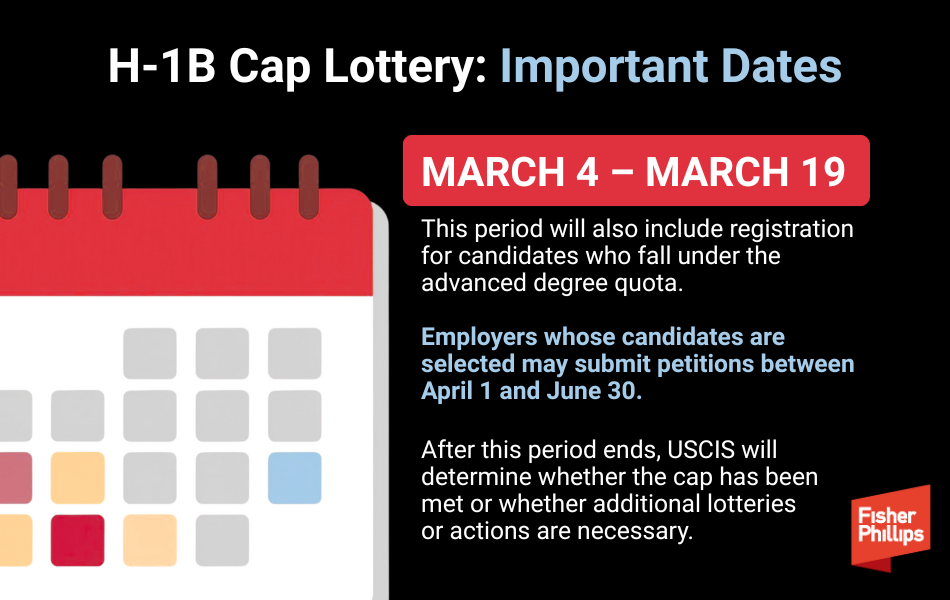
- March 4–March 19. This period will also include registration for candidates who fall under the advanced degree quota.
- Employers whose candidates are selected may submit petitions between April 1 and June 30.
- After this period ends, USCIS will determine whether the cap has been met or whether additional lotteries or actions are necessary.
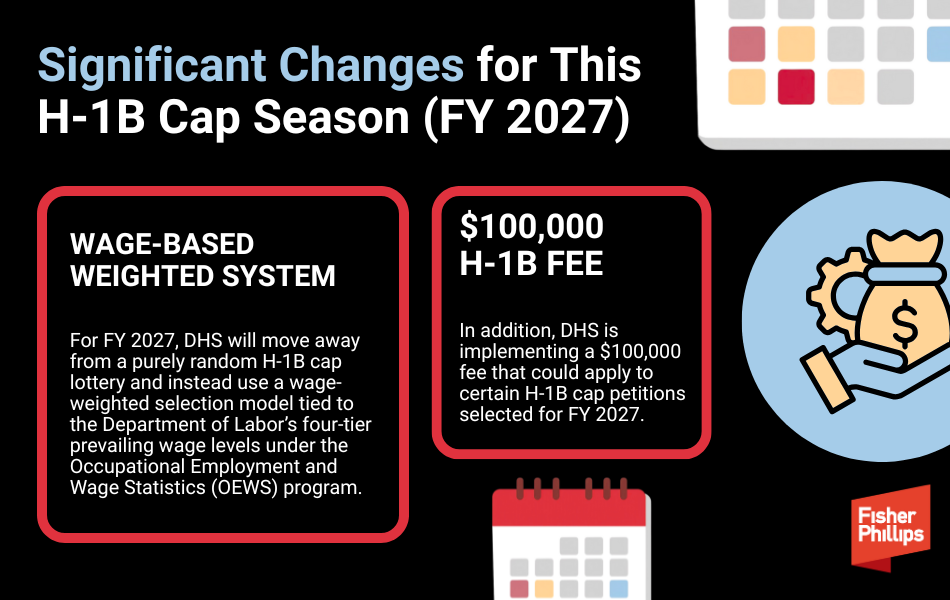
Significant Changes for This H-1B Cap Season (FY 2027)
USCIS has announced two significant changes for employers to navigate:
1. Wage-Based Weighted System: For FY 2027, DHS will move away from a purely random H-1B cap lottery and instead use a wage-weighted selection model tied to the Department of Labor’s four-tier prevailing wage levels under the Occupational Employment and Wage Statistics (OEWS) program. Under this approach, employers will need to identify the OEWS wage level that corresponds to the offered salary for the relevant occupation and work location at the time of registration. Higher wage levels will receive more “entries” in the selection pool: Level IV registrations will be entered four times, Level III three times, Level II two times, and Level I once. When a role involves multiple worksites, the lowest applicable OEWS level among the locations will control.
2. $100,000 H-1B Fee: In addition, DHS is implementing a $100,000 fee that could apply to certain H-1B cap petitions selected for FY 2027. This fee generally applies when an H-1B petition is filed for consular notification, or when the case is only approvable for consular processing rather than as a change of status in the United States. As a result, the fee is most likely to arise when the beneficiary is outside the United States at the time of filing, or when the beneficiary is in the United States but cannot obtain an approvable change of status (for example, due to a status maintenance issue), unless an exception applies.
What to Do Now
- Work with legal counsel: It is critical to work with your immigration attorney to evaluate how these changes may affect you and your employees. Counsel can help you streamline the registration process, stay up to date on changes, and ensure compliance with USCIS requirements.
- Educate stakeholders: Ensure your internal teams, such as HR and managers, understand the lottery process, timelines, and areas of responsibilities to prevent delays and improve coordination.
- Prepare alternatives: Not being selected in the H-1B lottery can be a setback, but it doesn’t mean there are no other options. Employers can consider a variety of short-term, long-term, and lesser-known alternatives to ensure they can continue to employ foreign national workers.
Conclusion
Fisher Phillips will continue to monitor this situation and will provide additional updates as new information becomes available from USCIS. In the meantime, we encourage you to sign up for Fisher Phillips’ Insight System to receive the latest updates. If you have further questions, please contact your Fisher Phillips attorney, the authors of this insight, or any attorney in our Immigration Practice Group.
Related People