

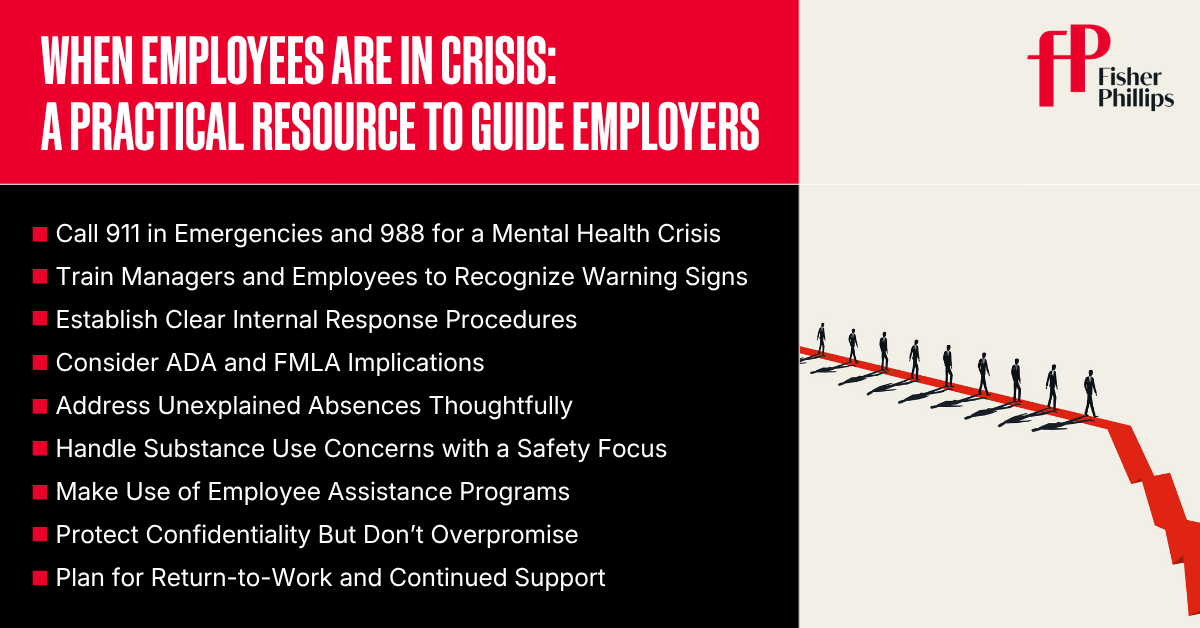
When Employees Are in Crisis: A Practical Resource to Guide Employers
When an employee stops showing up to the office, talks about wanting to give up, or appears impaired during work hours, managers and HR staff might feel unsure how to respond. But you can be supportive while also addressing legal obligations, safety, and business needs through a bit of planning, training, and resources. While employers are generally not mental health professionals, you can play a critical role in identifying warning signs and connecting employees with the support they need. Here are eight practical steps to help your managers and HR department respond in real time to serious and sensitive situations, as well as the key legal points to keep in mind.
Call for Help Immediately in Emergencies
- First and foremost, you should call 911 in critical situations, such as when an employee expresses intent to self-harm imminently.
- You should also consider directing employees to 988, the National Suicide and Crisis Lifeline.
- When you have a specific concern about an employee’s safety, you may also consider requesting a welfare check through local authorities in accordance with your company’s policies and legal guidance.
1. Train Managers and Employees to Recognize Warning Signs
Managers and co-workers are often the first to notice changes in an employee’s behavior. Watch for frequent absences, poor performance, detachment, or comments that suggest they feel hopeless or are thinking about self-harm.
Action Items
- Provide managers with a reference guide that includes check-in language, such as: “I’ve noticed you seem overwhelmed lately. How are you doing?” The National Alliance on Mental Illness (NAMI) says the key is being understanding and non-judgmental.
- Emphasize that employees and managers alike should follow the organization’s crisis and workplace violence prevention protocols rather than attempt to manage the situation themselves. They should raise concerns with their manager or HR as soon as they see a potential issue.
- Remind managers and HR that they should respect employee privacy and should not ask for a specific diagnosis, details of treatment, or other unnecessary medical information.
2. Establish Clear Internal Response Procedures
Developing a clear internal process for handling a crisis at work – and ensuring employees are familiar with it – can help ensure a consistent and safe response.
Additionally, we recommend developing a workplace violence prevention plan with procedures for responding when an employee’s conduct poses a safety risk to others. Note that:
- California requires that virtually all employers have workplace violence prevention plans, which include procedures for alerting employees of the presence, location, and nature of workplace violence emergencies.
- Otherwise, employers are expected to maintain a hazard-free workplace under the Occupational Safety and Health Act’s General Duty Clause.
- When it comes to enforcement, OSHA agencies typically look at whether an employer knew or should have known of a serious risk and failed to act. Yet employers need to balance their OSHA obligations with confidentiality concerns under disability discrimination and privacy laws.
- This underscores the benefit of engaging legal counsel early to mitigate risks in difficult situations with complex compliance considerations.
Action Items
You may want to create written procedures that outline:
- Who employees should contact internally when a crisis arises.
- When emergency services should be called.
- When crisis resources such as the 988 Suicide and Crisis Lifeline may be appropriate.
- When to call legal counsel.
You should train managers on these procedures periodically, so the appropriate protocols remain fresh in their minds if a situation arises.
3. Consider ADA and FMLA Implications
When you’re managing employee mental health, you’ll need to consider potential implications under the Americans with Disabilities Act (ADA), the Family and Medical Leave Act (FMLA), and similar state laws. Key considerations include:
- Employees with mental health conditions may be entitled to a reasonable accommodation, such as leave time, additional breaks, or a modified schedule. You should engage in a back-and-forth “interactive” dialogue to identify potential reasonable accommodations.
- Certain mental health conditions may also qualify as a serious health condition under the FMLA, particularly if they involve inpatient care or ongoing medical treatment.
- Recognize that additional laws and resources may come into play, such as state leave and disability-related laws and short-term disability.
Action Items
- When an employee’s crisis affects attendance or performance, HR should evaluate whether leave or other workplace accommodation is required.
- Ensure managers know to contact HR when an employee references difficulty performing their job because of a health condition.
- When requesting medical information to support leave or accommodation, limit requests to functional limitations and anticipated restrictions, consistent with applicable federal and state law.
4. Address Unexplained Absences Thoughtfully
Unexcused no-shows and prolonged absences are often legitimate grounds for terminating employment, but they may also signal a crisis.
- Employers should maintain consistent attendance policies while allowing HR to evaluate whether to excuse such absences based on legal protections or company policy as applied.
- Employers commonly have policies that require employees to give reasonable notice regarding absences – and they may consider a three-day “no show” a voluntary separation (unless state laws require longer notice). While this is generally a permissible policy, it should also allow HR to evaluate whether FMLA leave, ADA accommodations, or other leave rights apply.
Action Items:
- Create a fair and consistent process for handling no-shows in a way that balances operational needs, legal protections, and potential health conditions.
- Work with experienced legal counsel to create balanced policies and procedures in this area.
5. Handle Substance Use Concerns with a Safety Focus
Substance use disorder may intersect with mental health conditions, and in some cases, may qualify as a disability under the ADA and equivalent state law. At the same time, employers must maintain safe workplaces and are not required to allow an employee to be impaired on the job. Therefore, substance abuse policies should distinguish between:
- Active impairment while working or on work premises
- An underlying substance use disorder
- Lawful use of prescribed medication
- Participation in treatment or recovery programs
Action Items
- You should train managers to focus on observable workplace behaviors (such as unsafe equipment operation or clear signs of impairment) rather than speculating about a medical condition.
- Managers and supervisors should know when to halt unsafe activities immediately – and know who to contact in HR or on your legal team to guide them through the process from there. Safety comes first, but it’s also important to avoid assumptions.
- Employers may also consider recovery-supportive approaches, such as allowing time off for treatment or using return-to-work agreements where appropriate, as well as legally compliant drug testing protocols.
6. Make Use of Employee Assistance Programs
Employee Assistance Programs (EAPs) can provide confidential counseling and referrals to outside services, among other resources. An effective EAP can be the foundation of an employer’s workplace mental health support system.
Action Items:
- Promote the EAP as a voluntary and confidential resource for employees and their families.
- Clearly communicate protections and limitations.
- Consult legal counsel before requiring EAP participation as part of a return-to-work agreement, since mandatory participation may raise concerns under various employment laws.
7. Protect Confidentiality But Don’t Overpromise
Confidentiality requirements apply to employee medical information, including mental health conditions. Additionally, employers should store medical information separately from personnel files.
However, to the extent an employee seeks confidentiality in raising concerns about their own or a co-worker’s condition, you don’t want to promise complete confidentiality. You may need to share critical information with appropriate internal leaders and outside resources or emergency service providers on a need-to-know basis.
Action Items
Ensure your policies and practices:
- Prohibit disclosure of an employee’s health condition to co-workers with no need to know.
- Share only necessary information, such as adjustments to tasks, assignments, and duties – or temporary coverage arrangements.
- Curb workplace gossip and maintain employee privacy.
8. Plan for Return-to-Work and Continued Support
Employees returning from mental-health-related leave often need additional support as they adjust to being back at work.
Action Items
- Review your return-to-work procedures and consider addressing fitness-for-duty certifications, modified schedules, and other accommodations when appropriate.
- Schedule check-ins during the first few weeks back to review expectations and provide support.
👉 For more tips on mental health awareness in the workplace, read our complete guide here.
Conclusion
Your FP attorney can help you prepare for and respond to these challenging situations. If you have questions, please contact the authors of this Insight or your Fisher Phillips attorney. Make sure you are subscribed to Fisher Phillips’ Insight System to gather the most up-to-date information directly to your inbox.
Related People