

Unions Reach Decades-High Approval Rating: 6 Steps for Employers in Current Labor Environment
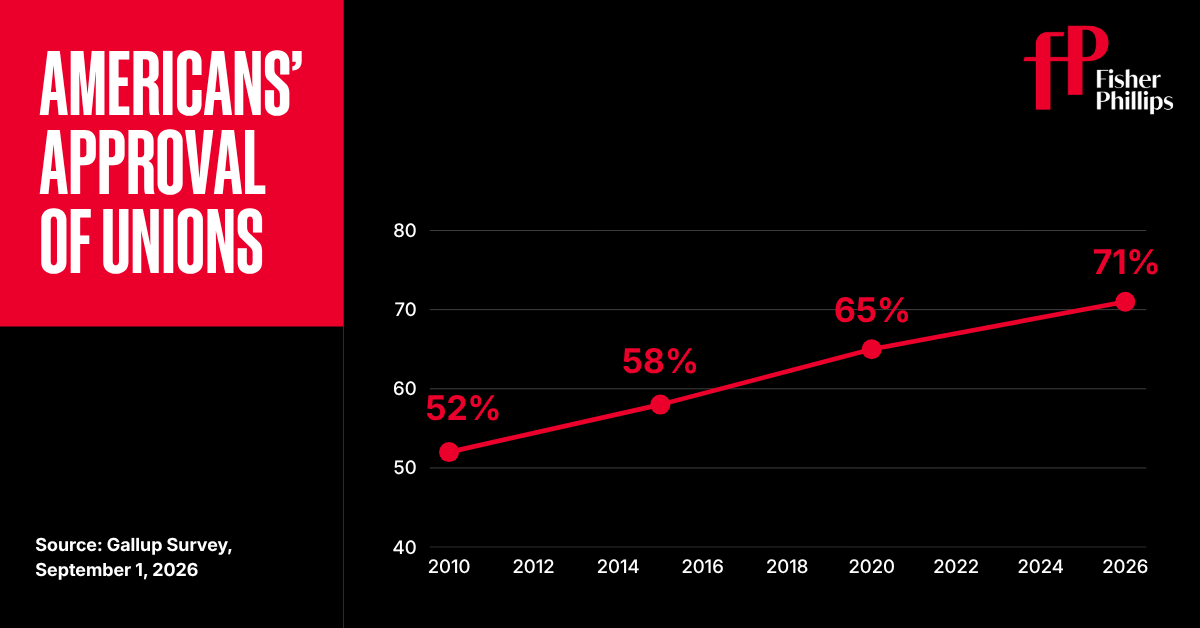
A survey released last week showed that 71% of Americans approve of labor unions, the highest reading tracked since the 1950s. But union membership has been moving in the opposite direction for decades, and today just 5.9% of private sector workers carry a union card. That doesn’t mean that employers should ignore matters, however, as unions have been getting more strategic in their approach to organizing. Here’s a deeper dive into what these contrasting figures mean for your operations, why unions remain relevant for employers, and six steps you can take in today’s labor environment.
New Polling Shows Massive Support
The 71% approval figure from the September 1 Gallup survey continues a recent trend over the past two decades showing a surge in support. In fact, approval has not been higher since 1959, when it reached 73%.
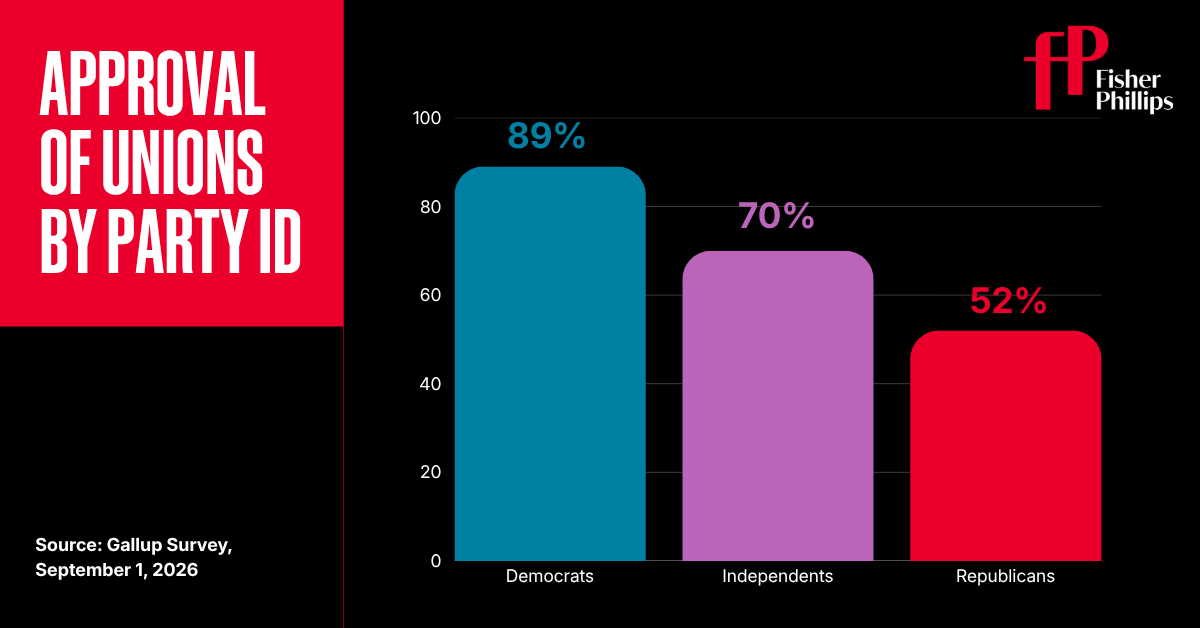
🗳️ Majorities Across All 3 Political Groups Now Approve of Unions
This is only the second time in the past quarter century that a majority of Republicans has approved of labor unions.
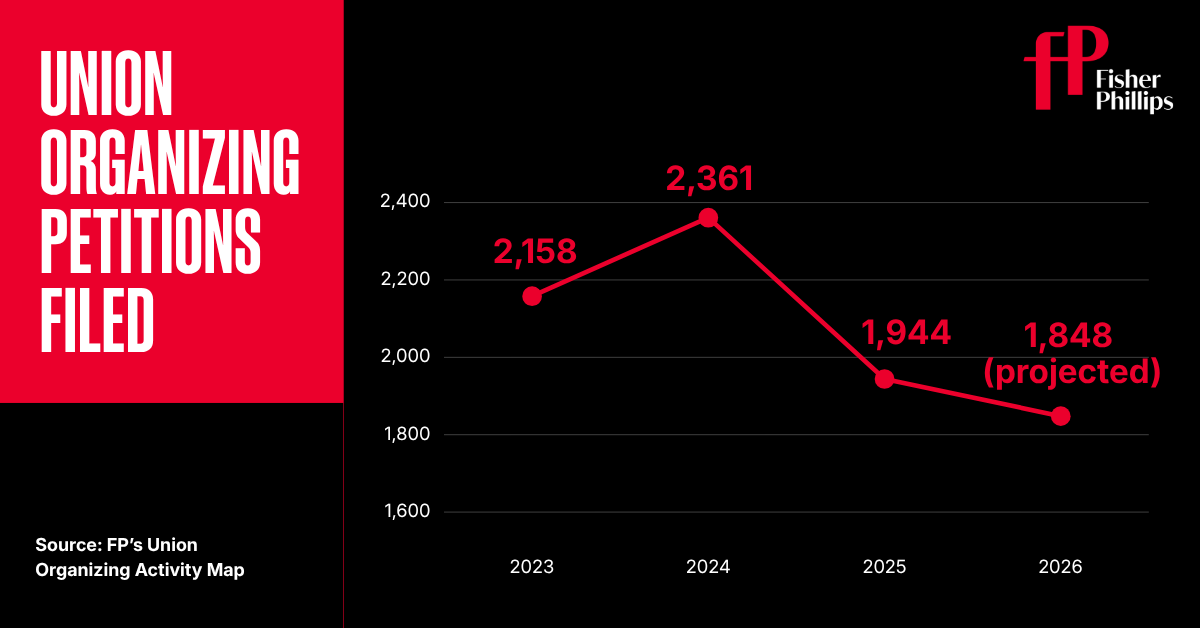
FP Union Organizing Activity Map Shows Decline
But while support hasn’t been higher in almost 70 years, that has not translated to increased union organizing activity. In fact, FP’s Union Organizing Activity Map shows that filings have been falling. If the current pace holds, 2026 will finish about 22% below the 2024 peak and will be the lowest of the four years we have tracked.
Record-Low Union Membership
This dwindling union activity has led to record-low numbers. Federal data released in February shows that only 14.7 million wage and salary workers, or 10% of the workforce, belonged to a union in 2025. The membership rate has been cut in half since 1983, the first year of comparable data, when the rate was 20.1%.
The private sector shows the sharpest decline. Just 5.9% of private sector workers were union members in 2025, unchanged from the year before and the lowest rate on record. Public sector membership stood at 32.9%, more than five times the private sector rate.
Unions Have Adopted a More Strategic Targeted Approach
But all of this data doesn’t mean that employers can ignore the situation when it comes to potential union organizing drives. Our Labor Relations Team has identified the following trends that demonstrate that labor has taken a more strategic approach when it comes to targeting employers:
- Unions continue to seek out smaller operations that may not have a robust employee relations strategy and thus may not be as prepared for organizing activity.
- Organizing drives have been leveraging the favorable Biden-era legal standard on micro-units, allowing unions to carve out small, fragmented bargaining units that are easier to organize. Interestingly, this issue was not identified by the NLRB’s General Counsel as a specific legal standard she wants the Board to overturn when she published her wishlist Memo a few weeks ago.
- Unions are targeting less traditional industries when it comes to organizing drives. For example, The Committee of Interns and Residents (CIR-SEIU) now claims to represent 40,000 resident physicians, up from roughly 17,000 a few years ago. The App Drivers Union (SEIU 32BJ/IAM) now covers more than 70,000 rideshare drivers. The United Videogame Workers-CWA Local 9433 is a new industry-wide game industry union including contractors, freelancers, and indie developers. Also, food service, hospitality, and retail remains a consistent target, since union density remains very low (just 1.8% in food services and drinking places) and campaigns can proceed one location at a time rather than across an entire company.
- Unions have identified less common geographic locales for organizing so they can make a splash in unexpected areas. As one example, unions added 166,000 members across 13 Southern states in 2025, with Georgia registering by far the largest gain at 62,000 more union members than in 2024, and Florida, Louisiana, Texas, and Virginia seeing smaller increases.
- Finally, younger workers represent a relatively untapped and enthusiastic market for unions. The Gallup survey found that 77% of adults aged 18 to 34 approve of unions, the highest of any age group. But government data shows that workers aged 16 to 34 had the lowest union membership rate of any age group in 2025, at just 7.2%. Unions are hoping to turn that enthusiasm into card-carrying members in the near future.
💡 What’s Driving the Support?
Our Labor Relations attorneys see the same handful of workplace conditions behind most organizing activity:
- Compensation that has not kept pace with cost-of-living pressure
- Scheduling that feels unpredictable or arbitrary
- Lack of transparency with operational changes and day-to-day decision-making
- No meaningful channel for input on decisions that affect daily work
- Inconsistent treatment from frontline supervisors
6 Steps for Employers
The most effective response to this environment is to address the conditions at your workplace that could otherwise draw union support.
1. Train your frontline supervisors. Supervisors generate most of the conditions that shape how employees feel about their employer, and most of the legal exposure as well. Train them on how to handle complaints, apply policies consistently, solve small issues quickly, escalate issues they cannot resolve, and how to respond if union activity occurs at your workplace.
2. Audit compensation, benefits, and scheduling. Review your practices against the relevant market, and review them internally for consistency, explainability, and legality. Work with your FP labor counsel to conduct the audits to gain the benefit of the attorney-client privilege.
3. Build feedback mechanisms – but you must act on them. Engagement surveys, skip-level meetings, open-door policies, and other feedback mechanisms are great tools, but they only work if employees see things changing as a result.
4. Communicate lawfully and consistently. Supervisors need to understand what they can and cannot say. Two rules deserve particular emphasis. First, do not interrogate employees about union sympathies or their coworkers’ activities. Second, do not improve wages, benefits, or working conditions in response to organizing activity. These are among the most common sources of unfair labor practice findings, and they can result in an election being set aside even when the employer wins the vote.
5. Review handbooks and work rules for legal compliance. Section 7 of the NLRA protects employees who engage in concerted activity about the terms and conditions of their employment, whether or not a union is involved. Solicitation and distribution rules, social media policies, confidentiality provisions, and non-disparagement language are all frequent sources of challenge. Have your FP labor counsel review this language, especially given how much this legal standard has recently shifted (and is expected to again soon shift).
6. Build your response plan before you need it. Under the National Labor Relations Board’s current Cemex standard, an employer that receives a demand for recognition based on a claimed card majority generally must either recognize the union or promptly file its own election petition – or risk a bargaining order without any employee vote. That standard’s long-term future is uncertain given recent changes at the Board, but remains the law today. Know now who makes that decision at your organization, who gets called, and how quickly you can reach your FP labor counsel.
Conclusion
We will continue to monitor developments in this area and provide updates as warranted. Make sure you are subscribed to Fisher Phillips’ Insight System to get the most up-to-date information direct to your inbox. If you have questions about union organizing activity or your employee relations practices, contact your Fisher Phillips attorney, the author of this Insight, or any attorney in our Labor Relations Practice Group or Government Relations Practice Group.
Related People

Regional Managing Partner and Labor Relations Group Co-Chair
emailSend Email
phone813.769.7513



Regional Managing Partner and Vice Chair, Labor Relations Group
emailSend Email
phone617.722.0044