

Sexual Harassment Claim Lets Worker Avoid Arbitration on Entire Case: What Employers Need to Know After Latest Federal Appeals Court Ruling
A former employee can pursue all her claims in court against a Dallas-based law firm, not just her sexual harassment claim, even though she signed a pre-dispute arbitration agreement. The 2nd US Circuit Court of Appeals confirmed yesterday that a federal law aiming to protect sexual harassment and assault victims allows employees with such claims to bypass arbitration for the entire lawsuit. This is the latest of several court rulings that reached similar conclusions. Here's what employers nationwide need to know about the ruling and three steps you should consider taking now.
Refresher on the Federal Law at Issue
A federal law seeking to end forced arbitration of sexual harassment and sexual assault disputes allows the person alleging the misconduct to take their claim to court even if they signed a pre-dispute arbitration agreement. The Ending Forced Arbitration of Sexual Assault and Sexual Harassment Act (EFAA), which was signed into law in 2022, amended the Federal Arbitration Act (FAA) and broadly defines a “sexual harassment dispute” as “a dispute relating to conduct that is alleged to constitute sexual harassment under applicable Federal, Tribal, or State law.” For a detailed summary of the law, read our comprehensive FAQs here.
Even though the EFAA clearly covers valid workplace sexual harassment claims, questions remained when a worker brought a harassment claim alongside other claims that would otherwise be arbitrable. So, the issue in this case was whether the employee could bypass arbitration for the whole lawsuit or just the harassment piece.
Courts have increasingly said the EFAA covers the whole lawsuit, and the federal appeals court in Diaz-Roa v. Hermes Law agreed. While the case involved a Dallas-based law firm, the litigation occurred in the 2nd Circuit, which covers New York, Connecticut, and Vermont.
What Happened in the Case
The plaintiff was the Director of Innovation at a law firm and also helped create and manage a computerized litigation management company with the firm’s owner. She was steadily promoted, ultimately to Chief Operating Officer of that company, and given stock options, which fully vested after three years of employment at a value of about $1 million, according to the complaint.
She claims that she was fired “for cause” after attempting to exercise her stock options despite having positive performance reviews. She also asserts that she was subject to sexual harassment during her tenure by the firm’s owner, who allegedly encouraged her to flirt with clients and remarked on her appearance.
She filed a lawsuit with a federal district court in New York (where she lived and worked remotely for some of her employment) asserting state-law sexual harassment claims, as well as breach of contract and other non-harassment claims related to the stock options. The law firm and its owner moved to compel arbitration, dismiss the case, and/or transfer the case to the Northern District of Texas. The court denied the motion to compel arbitration or transfer the case, and while it dismissed some of her claims, the ones that remained were a mix of sexual-harassment and other claims.
The district court held that the EFAA allowed the employee to invalidate the arbitration agreement she signed with the law firm for all the claims in her lawsuit, including the surviving non-harassment claim. The law firm appealed and sought to compel arbitration for that claim.
How the Federal Appeals Court Ruled
The defendants argue that the term “case” under the EFAA refers to an individual claim, not the whole lawsuit, so the non-harassment claim should be severed and compelled to arbitration.
The 2nd Circuit rejected this argument and upheld the district court’s ruling denying the motion to compel arbitration of any of the remaining claims. “The Supreme Court and this Court frequently use the term ‘case’ to refer to a lawsuit as a whole, and the term ‘claim’ to refer to a specific cause of action within that lawsuit,” the appeals court said. “Moreover, the EFAA’s drafters used the word ‘claim’ instead of ‘case’ elsewhere in the EFAA.”
The 2nd Circuit noted that its interpretation of the EFAA is consistent with the 6th Circuit and the 9th Circuit, which have also considered this issue. And a California appeals court also read the EFAA this way.
Where is the Line Drawn?
Notably, a federal district court in New York made clear in a 2023 ruling that a worker cannot tack on an implausibly pled sexual harassment claim in order to avoid arbitration of other claims. The judge in that case held that, without surviving sexual harassment claims, the EFAA was not implicated with respect to arbitration of the remaining non-sexual harassment claims.
What Does This Means for Employers?
Now that several courts at the federal and state level have interpreted the EFAA in the same way, plaintiffs asserting a sexual harassment claim are more likely to avoid arbitration of all claims brought in that same lawsuit. And this is true even if the “crux” of the sexual harassment claim occurred before the EFAA’s effective date, so long as the “last act” of the alleged wrongful conduct occurred on or after March 3, 2022.
This poses significant challenges for employers, who often rely on mandatory arbitration agreements to streamline dispute resolution and minimize litigation costs with respect to wage and hour claims.
What Should Employers Consider Doing Now?
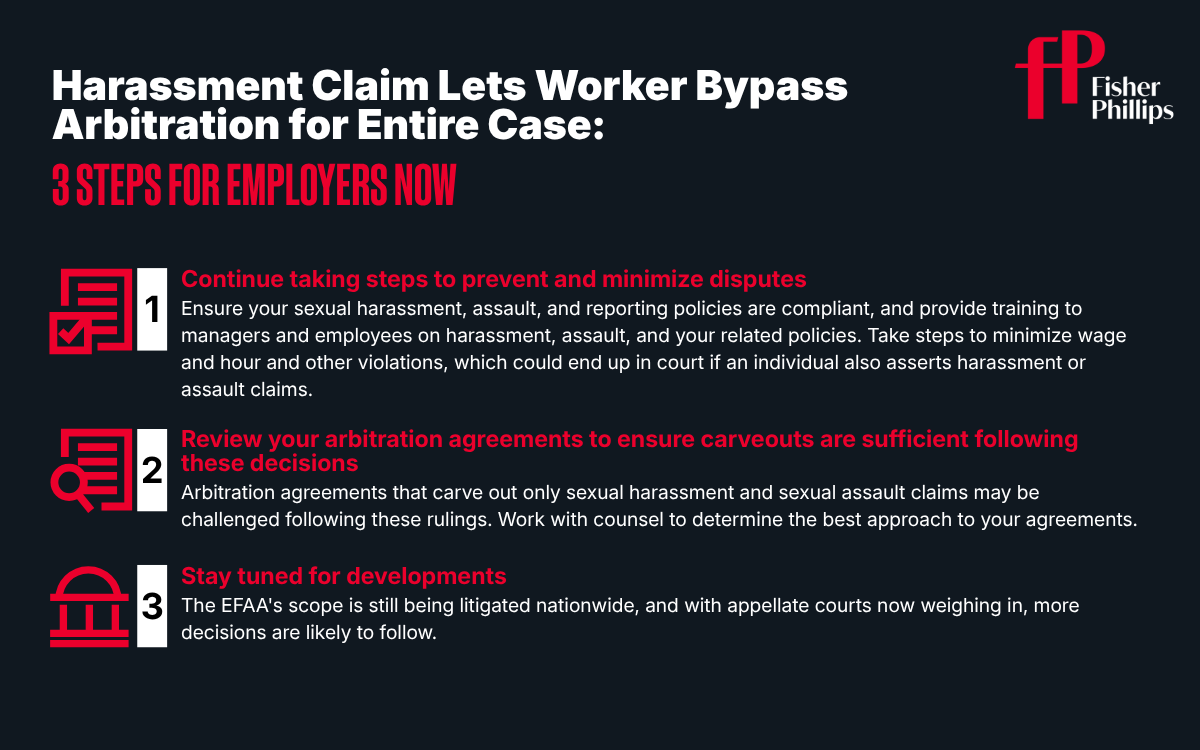
- Continue taking steps to prevent and minimize disputes. Ensure your harassment, assault, and reporting policies are compliant, and provide training to managers and employees on harassment, assault, and your related policies. Take steps to minimize wage and hour and other violations, which could end up in court if an individual also asserts sexual harassment or assault claims.
- Review your arbitration agreements to ensure carveouts are sufficient following these decisions. Arbitration agreements that carve out only sexual harassment and sexual assault claims may be challenged following these rulings. Work with counsel to determine the best approach to your agreements.
- Stay tuned for developments. The EFAA's scope is still being litigated nationwide, and with appellate courts now weighing in, more decisions are likely to follow.
Conclusion
We will continue to monitor developments that impact the workplace and provide updates as warranted, so make sure you subscribe to Fisher Phillips’ Insight System to get the most up-to-date information. If you have questions, please contact your Fisher Phillips attorney or the authors of this Insight.
Related People



Regional Managing Partner, Co-Chair of Sports Industry Team
emailSend Email
phone214.220.8304