

Retailers Are Feeling the Pinch of the Penny Shortage: 7 Steps to Take as States Offer Guidance
The federal government’s decision to end penny production last year has caused confusion and compliance risks for retailers. How should you handle cash transactions? Can you round down without violating consumer protection laws? Can you round up without taking a major hit to your bottom line? While Congress has yet to weigh in, many states are offering solutions, giving retailers some guidance as pennies are phased out of circulation. Here’s what you need to know and seven steps you should consider taking now.
Quick Overview
The US Treasury stopped producing pennies in 2025 because it cost almost four cents to make one penny coin. Indeed, the penny has cost more to make than it’s worth for the last two decades. Existing pennies will continue to be circulated and accepted as legal tender, but it’s getting harder for employees who handle cash transactions to provide exact change.
Rounding Issues
Can retailers just round to the nearest nickel? That’s the ultimate goal, but doing so currently presents some potential business and compliance risks:
- Cash customers may be upset if your policy is to always round up the price, which could impact your brand image and reputation. But always rounding down the total price could result in significant losses over time.
- Rounding to the nearest nickel means transactions would sometimes be rounded down (for example, $9.96 would be $9.95) and sometimes be rounded up ($9.98 would be $10). In theory, this “symmetrical rounding” would balance out over time, but some laws require retailers to treat all customers equally.
- Specifically, some states and cities have laws requiring businesses to treat cash customers the same as those paying by other means, like credit cards. Therefore, rounding these transactions differently could cause compliance problems.
- Under the Supplemental Nutrition Assistance Program (SNAP), authorized grocers and retailers must offer eligible food at the same price and on the same terms to EBT customers as all other customers, so rounding policies that produce a different cash price could put your authorization at risk.
States Take Action
The National Retail Federation, National Restaurant Association, and other advocacy groups are calling on Congress to pass the Common Cents Act (H.R.3074), which would set a nationwide standard requiring cash transactions to be rounded up or down to the nearest five cents. The bill, however, has stalled in Congress.
Meanwhile, many states are taking matters into their own hands. Here are a few recent examples:
Washington’s Governor just signed HB 2334 on March 23 allowing symmetrical rounding. Specifically, the total price or change due for any in-person cash transaction may be rounded to the nearest five-cent increment as follows:
- If the final digit of a cash transaction ends in one cent, two cents, six cents, or seven cents, the final digit may be rounded down to the nearest amount divisible by five cents;
- If the final digit of a cash transaction ends in three cents, four cents, eight cents, or nine cents, the final digit may be rounded up to the nearest amount divisible by five cents; or
- If the final digit of a cash transaction ends in zero cents or five cents, the final digit may not be rounded up or down.
The Washington law also gives customers the option to pay the original price if they have exact change – and outlines how taxes should be calculated and handled in light of the rounding rules.
Indiana had initially sought to require rounding, but a law finalized in March makes it optional. Businesses can choose whether to always round up or down or use symmetrical rounding for cash purchases. The rounding is done after tax is added on, but the full state tax is still owed on the unrounded number regardless of which method the business chooses.
A patchwork of state laws could be emerging. About two dozen states are considering similar legislation, according to AP News, with some aiming to require and others allowing optional rounding. Additional states are offering guidance in the absence of legislation.
Although state rules may be helpful, each location has its own nuances, so compliance for multistate operations could be challenging, particularly without federal legislation.
What Should Retailers Do Now?
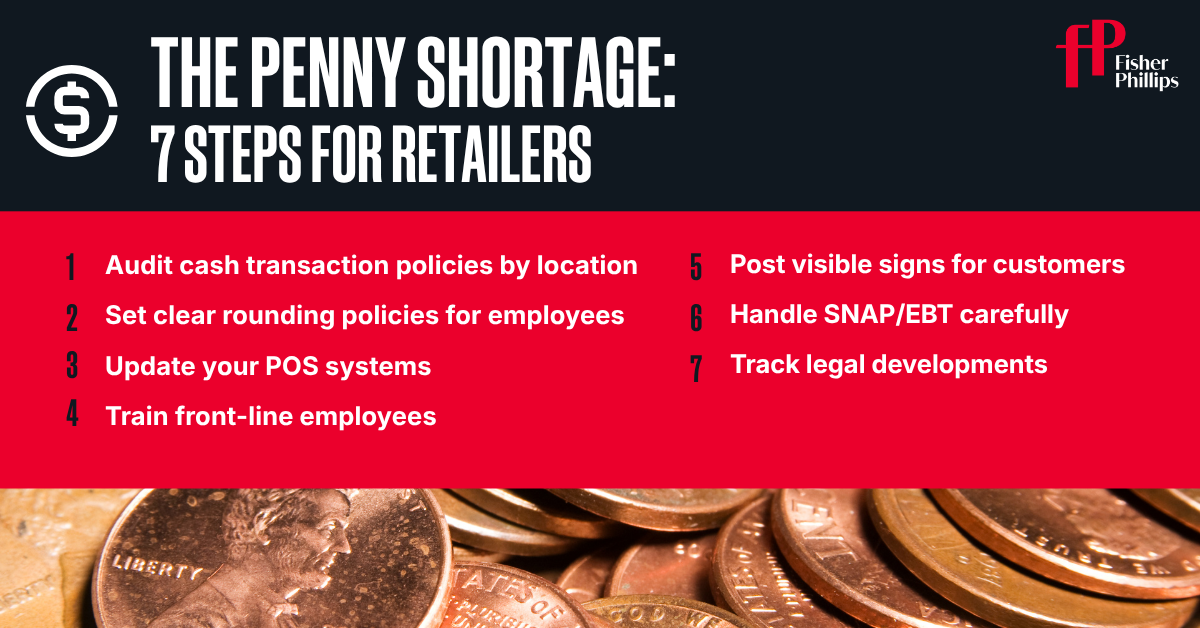
Consider taking these seven steps as the penny shortage expands and a patchwork of state laws and guidelines emerges:
1. Audit cash transaction policies by location. Review your cash practices against state and local rules. While most state-level guidance is flexible, a one-size-fits-all policy can create risks if it ignores location-specific requirements.
2. Set clear rounding policies for employees. Decide how you want to approach rounding, create written policies that account for location-based nuances, and apply them consistently. Be sure to handle taxes and fees appropriately.
3. Update your POS systems. Check with your vendor on rounding functionality. Automating this process can reduce errors and ensure proper documentation for receipts and audits.
4. Train front-line employees. Be sure your employees who handle cash transactions and front-line supervisors understand the policy, how rounding works, and how to handle customer questions.
5. Post visible signs for customers. As a best practice, consider disclosing your rounding method through simple signage at entrances and registers.
6. Handle SNAP/EBT carefully. Your attorney can help you navigate challenging compliance questions regarding SNAP benefits and EBT transactions.
7. Track legal developments. This area is evolving, so it’s a good idea to monitor changes at the federal and state level and be ready to make adjustments as needed.
Conclusion
Make sure you are subscribed to Fisher Phillips’ Insight System to get the most up-to-date information. For further information, contact your Fisher Phillips attorney, the authors of this Insight, or any attorney on our Retail Industry Team.
Related People