

New EU Equal Pay Rules Are Coming Soon: A 7-Step Plan for Employers
If you have operations in the EU, your disclosure obligations may be changing this month. The European Union Pay Equity Directive also brings new reporting requirements that you may need to put together soon, depending on your headcount. Although the Directive sets EU-wide minimum requirements, each EU member state must implement those requirements through local law, and implementation is already developing unevenly across the region. Here’s what you need to know about the upcoming June 7 deadline, what to expect next, and your seven-step compliance plan.
Quick Overview
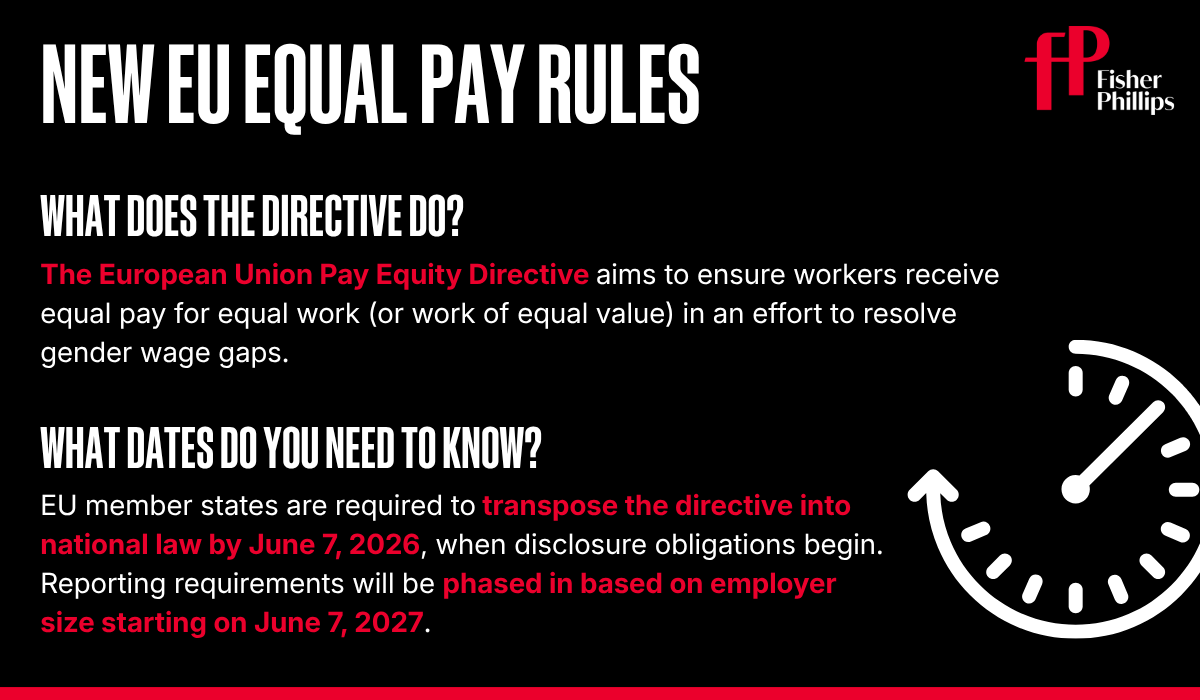
- The European Union Pay Equity Directive was adopted in Spring 2023 and came into force on June 7, 2023. EU member states are required to transpose it into national law by June 7, 2026. The primary purpose is to ensure workers receive equal pay for equal work (or work of equal value) in an effort to resolve gender wage gaps.
- Guiding principles focus on increasing transparency in pay-setting and pay progression and improving employer accountability through reporting, access to pay information, and stronger enforcement.
What's Changing?
Changes are coming in three forms:
- Immediate disclosure obligations
- Reporting requirements
- Enforcement
Because the Directive will be implemented through local laws, the timing and mechanics may vary by country.
Immediate Disclosure Obligations
Beginning with this year’s June 7 transposition deadline, all EU employers, regardless of size, must comply with the following obligations:
- Provide applicants with information on the starting salary or pay range before the first interview, and refrain from asking about pay history
- Ensure job vacancy notices and job titles are gender neutral
- Make pay criteria, including criteria for pay progression, accessible to all workers – those criteria should be objective and gender neutral
- Respond to employee requests for individual pay information and average pay levels, broken down by gender, within two months
Reporting Requirements
Employers meeting certain headcount thresholds must report gender pay gap data to the relevant public authority and to their workers. The Directive establishes a phased schedule based on employer size:
- Companies with 250 or more employees: first report due by June 7, 2027, and then annually
- Companies with 150–249 employees: first report due by June 7, 2027, and then every three years
- Companies with 100–149 employees: first report due by June 7, 2031, and then every three years
- Companies with fewer than 100 employees: reporting is permissive, not mandatory, though EU member states may individually require compliance at the national level
In practice, implementation is already developing unevenly. For example, Poland has implemented selected recruitment-stage requirements, while draft legislation is still pending for other parts of the Directive. By contrast, the Netherlands is expected to implement the Directive after the June 2026 deadline, with pay gap reporting likely to begin later.
What Must Be Reported? Each gender pay gap report must include the following metrics:
- Median gender pay gap in base pay
- Mean (average) gender pay gap in base pay
- Median and mean gender pay gap in variable pay components, such as bonuses, commissions, and allowances
- Proportion of female and male workers receiving variable pay components
- Proportion of female and male workers in each quartile pay band
- Gender pay gap between workers by category, broken down by ordinary basic wage or salary and work performed
The 5% Threshold and Joint Pay Assessments: When a report reveals a gender pay gap of more than 5% in any category of workers that cannot be justified by objective, gender-neutral criteria – and the employer does not remedy the unjustified difference within six months after submitting the report – the employer must carry out a joint pay assessment in cooperation with worker representatives. This assessment must identify the root causes of the disparity and establish corrective measures with concrete timelines. Failure to act on an unjustified gap of more than 5% constitutes a compliance violation and may trigger enforcement proceedings under applicable national implementing law.
Reporting Format and Transparency: Reports must be submitted to a designated national monitoring body and shared with employees and their representatives. The European Commission will establish a common template for reporting to ensure consistency across member states. Certain employer-level gender pay-gap information will be made publicly accessible, meaning investors, job seekers, regulators, and the press will be able to review an employer’s gender pay gap figures. This may create significant reputational and legal exposure for noncompliance. Employers should also confirm whether each country will use an existing reporting process or introduce a new platform, template, or submission procedure.
Enforcement
Member states must establish penalties that are effective, proportionate, and dissuasive, including fines. Critically, when an employer has failed its transparency or reporting obligations, the burden of proof in discrimination claims shifts to the employer to demonstrate that no pay discrimination occurred.
Your 7-Step Compliance Plan
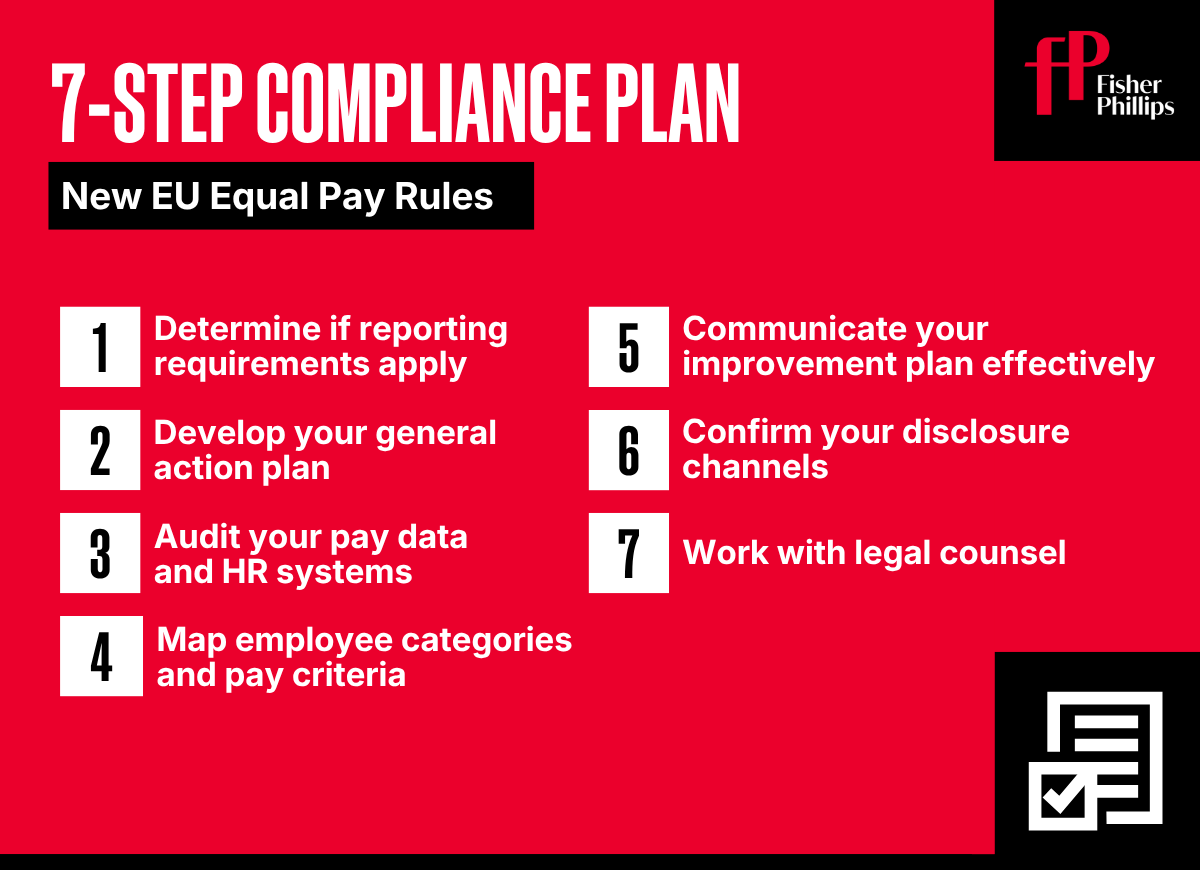
1. Determine if reporting requirements apply. Review your EU headcount against the thresholds above. If your employee population is near the 100-employee threshold in any jurisdiction, consult an attorney to determine when obligations are triggered under the applicable national implementing law.
2. Develop your general action plan. Focus on compliance and remediation. Employers subject to reporting obligations should be prepared to explain pay differences based on objective, gender-neutral criteria and take corrective action where unjustified gaps are identified.
3. Audit your pay data and HR systems. Run a preliminary analysis of your gender pay data ahead of your reporting window. Ensure your HR systems capture workforce data sortable by full-time, part-time, or fixed-term status, and that your payroll system captures base wages, bonuses, and allowances as required for reporting.
4. Map employee categories and pay criteria. Ensure your records clearly identify employee categories, roles, compensation components, and objective pay criteria, so you can accurately prepare pay transparency disclosures and assess whether employees are performing the same work or work of equal value.
5. Communicate your improvement plan effectively. In addition to disclosing gender pay gap data, you should be prepared to communicate the objective criteria used to explain pay differences and any corrective measures taken where unjustified gaps are identified. Your legal, HR, and communications teams should work together to produce an honest, constructive, and compliant report.
6. Confirm your disclosure channels. Disclosures should appear on your company website or a designated government platform. Employers should confirm the applicable national reporting channel, submission format, and communication process for employees and employee representatives in each country where you operate.
7. Work with legal counsel. Reach out to your attorney to help you navigate new workplace laws and create a compliance plan.
Conclusion
We will continue to monitor developments and provide the most up-to-date information as member states advance the Directive. Make sure you are subscribed to Fisher Phillips’ Insight System to receive the latest news directly to your inbox. If you have questions about how these changes impact your organization, please contact your Fisher Phillips attorney, the authors of this Insight, or any attorney in our International Practice Group.
Related People

Gustavo José Villaça Borin Gavião De Almeida
Visiting Legal Professional
emailSend Email
phone484.581.2494