

Many Restaurant Chains Must Comply with California's New Allergen Disclosure Law: Here’s Your 8-Step Plan
If you operate a restaurant chain with 20 or more locations, including at least one in California, you’ll likely be covered by a new state law requiring you to disclose certain allergen information on your menus. Here’s what you need to know about the new law that takes effect July 1 and the eight steps you should consider taking now to comply.
Disclosing the Top 9 Major Allergens
California's SB 68 applies to any food facility with 20 or more locations – doing business under the same name and substantially the same menu items – with at least one of those facilities located in California.
The new law covers the nine major allergens recognized by the FDA: milk, eggs, fish, crustacean shellfish, tree nuts, peanuts, wheat, soybeans, and sesame. You'll need to provide a disclosure for each standard menu item that includes any of these ingredients. Importantly, the disclosure has to appear on all physical and digital menus, including app menus, website menus, menu boards, and ordering kiosks.
The law gives you two possible disclosure formats for onsite guests:
- list allergens directly on the menu next to each item; or
- use a QR code or digital link, but only if you also provide a written alternative for guests who can’t access the digital version, such as an allergen chart, grid, or booklet – or a separate allergen-specific menu.
Here are a few nuances you should note in California as you create your compliance plan:
- Digital menu disclosures include online ordering platforms and should be enabled for visually impaired guests.
- The law covers allergens as ingredients but does not require cross-contact warnings (about other ingredients used in the same facility, for example), though we do recommend including a disclaimer as a precaution.
- The standard is what the restaurant “knows or reasonably should know” about its menu items, which gives some protection against circumstances outside your control, but also creates a potential factual question that a jury would need to decide during litigation.
- SB 68 will impact franchisors and franchisees that are part of a system doing business in California.
- The law will be enforced by the California Department of Public Health, but guest lawsuits are also a significant practical risk.
- Regardless of regulations, liability risk increases once a guest has put you on notice of an allergy.
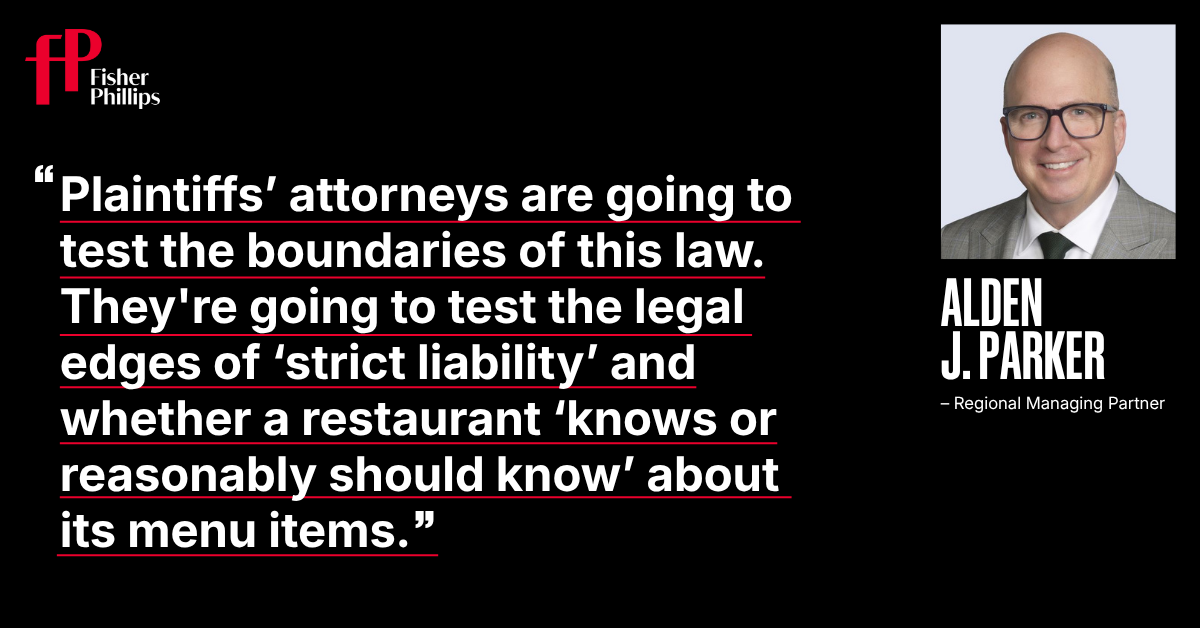
“Plaintiffs’ attorneys are going to test the boundaries of this law,” says Alden Parker, Managing Partner of FP’s Sacramento office and Hospitality Industry Group Co-Chair. “They're going to test the legal edges of ‘strict liability’ and whether a restaurant ‘knows or reasonably should know’ about its menu items.”
More States Join the Trend
California isn't the only state seeking to require allergen disclosures on menus. New York lawmakers finalized similar legislation last year. But instead of applying to all menus, it will apply to all prepackaged food that is prepared and sold on a food establishment’s premises. Food establishments in New York will need to begin labelling such products by November 2026.
Lawmakers in Maryland, Michigan, and New Jersey, are also working on similar proposals that would extend allergen disclosure requirements to all restaurants, though the details vary a bit under each proposal. Notably, if passed, Maryland’s law would carry significant penalties, including civil penalties up to $5,000 per day and misdemeanor criminal charges.
Practical Tip: If you operate in multiple states, you’ll want to track each applicable bill to account for nuances as you build your compliance plan.
Your 8-Step California Compliance Plan
If you operate a restaurant chain that’s covered by SB 68, you should consider taking the following eight steps ahead of the July 1 effective date:
1. Document every menu item’s ingredients and allergen content. Go through your full menu, list every ingredient in each item, and identify which ones contain any of the nine major allergens.
2. Coordinate with your suppliers to obtain and maintain current ingredient specifications.
3. Decide on your disclosure format and update all menus accordingly. Whether you decide to list allergens directly on the menu next to each item or use a QR code, make sure every physical and digital menu complies. If you use the QR code option, be sure to have a written backup ready for guests who can’t access the digital copy.
4. Consider adding a cross-contact disclaimer to menus. SB 68 doesn't require it, but including a disclaimer about potential cross-contact is a practical step that can help limit liability when a guest raises a concern.
5. Train your staff on the allergen disclosure system. Your team should know how to direct guests to relevant information and what to do when a guest has questions or raises an allergy concern.
6. Build a process for tracking menu changes and supplier updates so your allergen data stays current.
7. Keep clear records of allergen data and any menu changes. Proper recordkeeping can demonstrate your compliance commitment and help reduce liability risk. Develop a system record when servers ask guests about allergies, as well as the responses.
8. Consult with counsel on the best compliance strategy, particularly if you have multistate or global operations with varying allergen disclosure requirements.
Conclusion
We will continue to monitor developments impacting employers in the Hospitality Industry. Make sure you are subscribed to Fisher Phillips’ Insight System to get the most up-to-date information. If you have questions, contact your Fisher Phillips attorney, the authors of this Insight, or any member on our Hospitality Industry Team.
Related People
