

Feds Target Tech Sector Immigration Practices: 5 Ways to Safeguard Your Hiring Process
The federal government is ramping up enforcement against tech companies that allegedly hire foreign nationals using temporary work visas, when qualified U.S. workers may be available. In a recently filed lawsuit against a U.S. data analytics and AI firm, the Department of Justice Civil Rights Division claimed the company did not properly consider job applications from U.S. candidates, and instead reserved certain jobs for foreign workers holding temporary employment status such as H-1B, and being sponsored for U.S. Lawful Permanent Residence (or, “green card”) status via the employment-based PERM Labor Certification process. The lawsuit marks another big step in the administration’s broader immigration enforcement plan, making it more important than ever for employers to strengthen compliance efforts and practices. Here’s what tech sector employers need to know about the uptick in enforcement, and five steps you should consider taking now.
What is the Process of Sponsoring an Employment-Based Green Card?
Under U.S. immigration law, an employer may sponsor a non-U.S. worker a green card, provided the employer can demonstrate that it attempted to recruit for the position but was unable to identify any ready, willing, qualified, and available U.S. workers to fill the role. The process by which an employer establishes this is called PERM Labor Certification, which involves a series of advertising and recruitment efforts conducted under the supervision of the U.S. Department of Labor.
This is a common pathway for H-1B workers, to acquire longer-term status in the U.S. If the employer successfully demonstrates through Labor Certification that no qualified U.S. workers are available for the position, the employer and H-1B employee may then proceed to the next stages of the employment-based green card process, toward lawful permanent residence.
What Happened?
The DOJ’s April 28 complaint alleges that Cloudera violated Department of Labor rules and other law related to the U.S. permanent residence process, by creating a discriminatory hiring process that earmarked desirable positions within the company, for candidates with temporary work authorization. In short, the DOJ has alleged that the employer’s recruitment efforts were deliberately ineffective. Among the allegations, the DOJ has stated that Cloudera gave an intentionally erroneous email address to U.S. workers to use in submitting their applications and then claimed it could not find qualified U.S. workers to fill the roles.
In addition to the heightened scrutiny presently being directed toward the PERM Labor Certification process, U.S. authorities are simultaneously expanding enforcement, compliance, and audit initiatives associated with employment-based immigration more broadly, particularly in the H-1B nonimmigrant category. Recent changes to the annual H-1B cap selection process now place increased emphasis on offered salary levels in determining lottery selection outcomes, while parallel federal rulemaking efforts are underway that would significantly increase required prevailing wage levels for H-1B workers nationwide. At the same time, federal agencies have launched a new coordinated enforcement initiatives designed to increase interagency collaboration in detecting and penalizing alleged fraud and abuse in the H-1B category.
Combined with substantial new government filing fees and an overall shift toward heightened compliance expectations, these developments have caused the H-1B category to become an area of significant operational, financial, and strategic focus for U.S. employers that rely on professional foreign national talent.
Takeaway From the Pending Litigation
The allegations against Cloudera have not yet been proven, and the case is still pending before the Office of the Chief Administrative Hearing Officer, which is a specialized adjudicative office within the DOJ that hears and decides certain immigration-related employment disputes and employer enforcement cases. But the lawsuit shows that the Trump administration is serious about immigration enforcement for tech sector employers and the private equity firms that back them.
As many private equity firms specialize primarily or heavily in technology companies, including software, SaaS, cybersecurity, AI, fintech, semiconductors, cloud infrastructure, and health tech, it is important for tech-enabled businesses – and related institutional investors – to take note. “Private equity needs to look at all the companies in their portfolios that have employees on H-1B visas, and understand the stage is being set to seriously challenge and restrict the H-1B program,” FP Partner Brian Coughlin said in an interview with The Wall Street Journal.
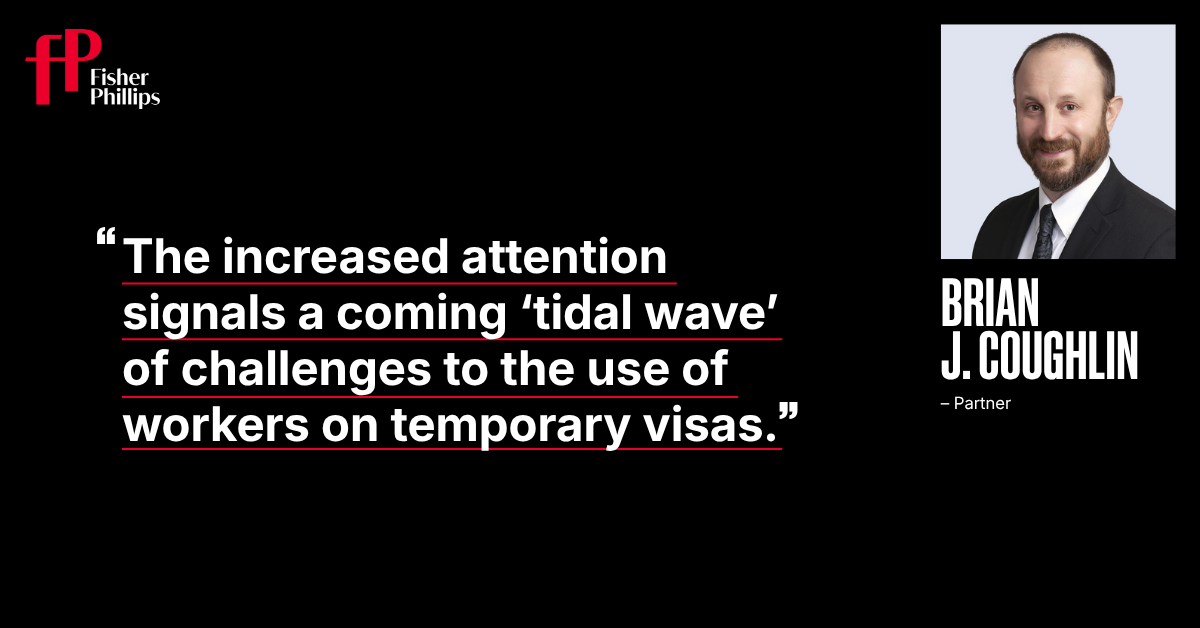
“The increased attention signals a coming ‘tidal wave’ of challenges to the use of workers on temporary visas for which private-equity firms need to be prepared,” he told the WSJ.
The Bigger Picture
The H-1B visa program is a cornerstone for U.S. technology companies seeking to fill professional, specialty occupation roles. Employers that rely on the H-1B visa program to bring in high skilled and specialty talent are facing stricter scrutiny and heightened enforcement under a Department of Labor effort dubbed “Project Firewall,” which was announced last September. You can read more about it here.
Through this initiative, the DOL has been working with other government agencies including the Equal Employment Opportunity Commission and the Justice Department to ensure compliance. They are coordinating investigations into employers, using the unique regulatory regime of each associate agency.
Job postings, hiring patterns, and other business practices related to H-1B staff are being closely scrutinized by these agencies. Employers found in violation of program requirements could face significant civil penalties which can cost thousands of dollars per infraction, and even disbarment from participating in visa programs.
So, we expect to see more lawsuits like the one against Cloudera. Tech sector employers can also expect more compliance investigations, on-site visits, and reviews of job postings for companies that participate in the H-1B program. Employer records are expected to be closely scrutinized, and strict penalties will be imposed on violators, making it essential to be proactive and consider taking the five steps below.
5 Steps Tech Employers Can Take Now
1. Review Your Recruiting and Hiring Process. Review job postings, screening practices, and recruiting and interviewing procedures for compliance with DOL rules and INA requirements.
2. Keep Accurate Records. Maintain clear, accurate, and up-to-date files, as required by DOL regulations. Proper documentation of recruitment efforts, hiring decisions, wage records, and visa-related filings can minimize the risk of penalties or negative findings during an investigation.
3. Closely Monitor Regulatory Developments. Stay informed about immigration enforcement trends, agency guidance, and policy changes that may impact your compliance plan.
4. Train HR and Hiring Managers. Regular training can help HR staff and hiring managers stay up to date on evolving immigration-related directives. Training can also ensure consistent practices to reduce potential discrimination and fix errors before they become an issue.
5. Regularly Reach Out to Legal Counsel. Increased scrutiny of H-1B and PERM participation make it critical to regularly work with immigration counsel to audit practices, develop a robust compliance strategy, and maintain privilege of the audit.
Conclusion
For support, feel free to reach out to your Fisher Phillips attorney, the authors of this Insight, or another member of our Immigration Practice Group or Technology Industry Team. We’ll continue to monitor developments impacting the tech sector and the H-1B program and will provide updates as warranted. Make sure you are signed up for Fisher Phillips’ Insight System to receive the latest news directly in your inbox.
Related People