

Employers May Soon Face a Hard Deadline on First Union Contracts: What You Need to Know about Faster Labor Contracts Act
A bipartisan bill that would impose strict federal timelines and mandatory binding arbitration on first union contract negotiations is now on a fast track to becoming law. The Faster Labor Contracts Act, which would amend the National Labor Relations Act for the first time in over 50 years and cause a sea change in the country’s established labor dynamic that has stood the test of time for almost a century, just cleared a major procedural hurdle and could reach the House floor in early June. And the way things are shaping up, there’s a real chance this bill could pass Congress and get signed into law in the near future. Here’s what’s happening and what employers need to do while we wait.
How We Got Here
The NLRA currently imposes no timeline for reaching a first contract, allowing employers to negotiate for months, or even years, in order to hammer out a fair deal. But opponents of the status quo point to data showing workers are forced to wait an average of 458 days before obtaining a first union contract.
H.R. 5408, also known as the Faster Labor Contracts Act, was introduced in the House last year by Rep. Donald Norcross (D-N.J.). On May 20, the U.S. House reached the 218 signatures needed on a discharge petition that would advance the bill a floor vote in the coming weeks.
What the Bill Actually Does
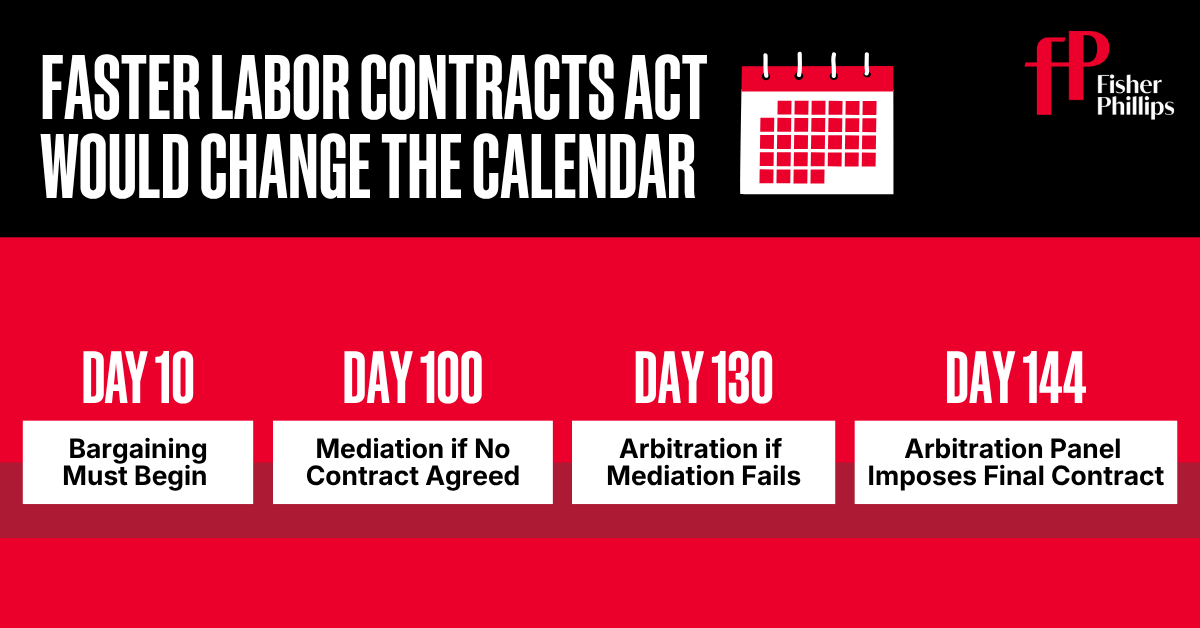
The legislation would amend the National Labor Relations Act to impose a compressed, federally mandated timeline on first-contract negotiations in the private sector. Under this framework, following union certification:
- Day 10: The employer is required to begin bargaining
- Day 100: Federal mediation is triggered if no agreement has been reached
- Day 130: Binding interest arbitration is initiated if mediation fails
- Day 144: An arbitration panel is seated to impose a final contract
This represents a maximum bargaining period of 120 days – 90 days of bargaining followed by 30 days of mediation – before either party can invoke mandatory arbitration. To put that window into context: one researcher found that fewer than 10% of first contracts have historically been achieved within 120 days.
If the parties cannot agree on a neutral third arbitrator, the Federal Mediation and Conciliation Service would step in to designate one. The arbitration panel’s decision would be binding for two years. The panel must weigh factors such as the employer’s financial status and employee living costs.
A Bipartisan Bill With an Unusual Coalition
The legislation has attracted support from an unlikely mix of lawmakers.
- The Senate version was introduced by Sen. Josh Hawley (R-Mo.) and Sen. Bernie Moreno (R-Ohio), and Sen. Roger Marshall (R-Kan.) joined as cosponsor last month.
- Both Hawley and Marshall sit on the Senate HELP Committee, which gives the Senate path additional significance.
- They were joined by Democratic Senators Cory Booker (D-N.J.), Gary Peters (D-Mich.), and Jeff Merkley (D-Ore.).
- In the House, the bill crossed the 218-signature threshold when Republicans Don Bacon (R-Neb.), Riley Moore (R-W.V.), and Nick LaLota (R-N.Y.) added their signatures.
What Comes Next
Under House rules, the bill must now complete two layover periods before a floor vote can be scheduled. Under that timeline, a House floor vote is expected in early June, and is widely expected to pass given the bipartisan coalition that signed the discharge petition.
The Senate picture is less certain, but our Government Relations Team notes there is a meaningful possibility that the White House could issue a Statement of Administration Policy (SAP) in support of the legislation given President Trump’s efforts to appeal to working class voters. If that happens, it could provide political cover for additional Republican senators to get on board, potentially enabling the bill to clear the upper chamber.
What This Means for Employers
If it passes, this bill would fundamentally change the first-contract bargaining dynamic. Today, the law requires good-faith bargaining but sets no deadline. Under the Faster Labor Contracts Act, employers could find the terms of their first union contract decided not by their own negotiating team, but by a panel of government-appointed arbitrators operating under a compressed timeline with limited context about your business, finances, or workforce.
Critics note there is no guarantee the bill will actually speed up the process. While it limits negotiations, the arbitration timeline itself is unlimited. Bringing uninformed arbitrators up to speed on a workplace’s risks and finances could take months or longer, while decisions made without that context could be disastrous for the business and union members alike.
The bill also strips employers of the traditional negotiating dynamic in which employees ultimately vote on whether to ratify a contract. Under binding arbitration, the terms are imposed without a ratification vote.
What Should You Do?
It is hard to underscore just how big of a change this law would bring about. But the bill is quickly gaining momentum, and employers shouldn’t wait for it to cross the finish line before taking action. Here’s what we recommend:
1. Contact your representatives. The most effective action you can take right now is to make your voice heard. Reach out to your U.S. Senators and House members to express your concerns. Our FP Gov Team can help facilitate that engagement.
2. Assess your union exposure. Take stock of which of your facilities or workforces could be subject to an organizing campaign. If a union were certified tomorrow, would you be prepared to bargain effectively within a 90-day window?
3. Evaluate your bargaining readiness. Understand where your compensation and benefits stand relative to the market. If arbitration became a possibility, an arbitrator would evaluate your financials and employee living costs. You’ll want to enter that process in a strong position, not scrambling to gather data.
4. Strengthen your employee relations proactively. The best defense against a compressed bargaining timeline is a workforce that doesn’t feel the need to organize in the first place. Review your wages, benefits, communication practices, and management culture now.
5. Audit your first-contract bargaining strategy. If you already have unions in some locations, work with labor counsel to understand how this law would change your approach to any upcoming initial agreements.
Conclusion
We will continue to monitor developments and provide updates as Congress acts. Make sure you are subscribed to Fisher Phillips’ Insight System to get the most up-to-date information direct to your inbox. If you have questions, contact your Fisher Phillips attorney, the authors of this Insight, or any member of our Labor Relations Practice Group or Government Relations Team.
Related People

Regional Managing Partner and Labor Relations Group Co-Chair
emailSend Email
phone813.769.7513



Regional Managing Partner and Vice Chair, Labor Relations Group
emailSend Email
phone617.722.0044