

Top 5 Employer Mistakes to Avoid During the Summer Season
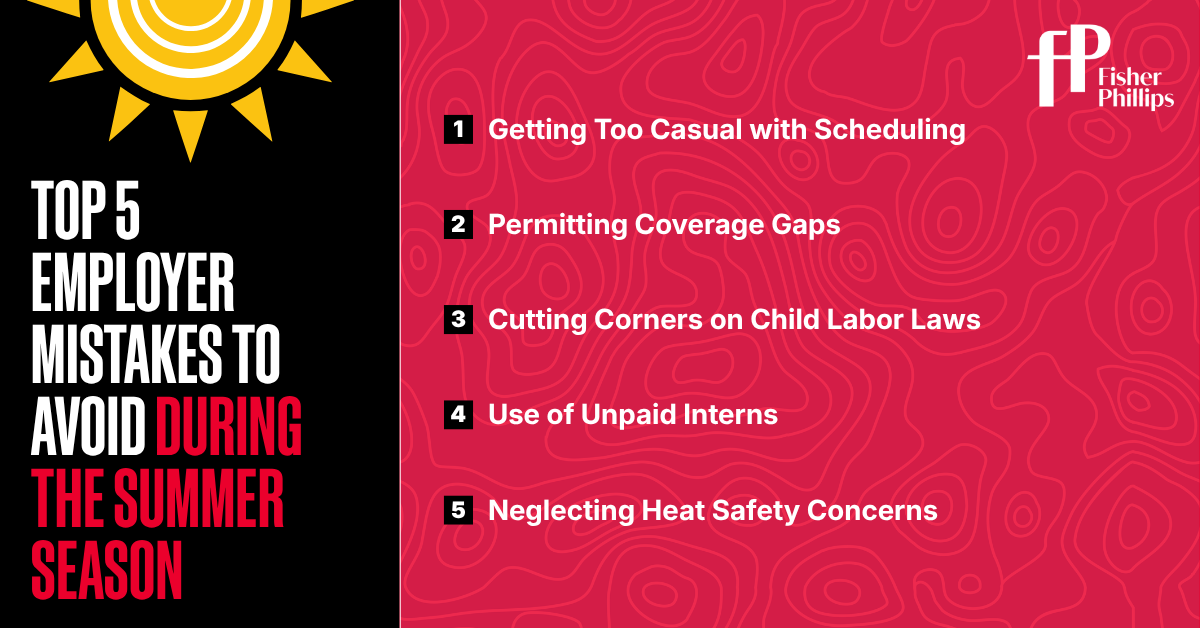
Longer days, lighter moods, and packed vacation calendars can make summer feel like a natural time to loosen the reins in the workplace. On the other hand, summer is one of the busiest and most operationally complex times of the year for certain industries, such as hospitality, retail, and attractions. The sun-soaked season intensifies compliance challenges and exposes businesses to risks related to wage and hour rules, workplace safety, and more. Below are the top five mistakes employers make during the summer, plus steps you can take to avoid them.
1. Getting Too Casual with Scheduling
Summer often brings a wave of informal scheduling practices that can be great for morale but risky for workplace compliance. When managers are quick to approve non-exempt employees’ requests for last-minute schedule changes, “Summer Fridays,” shift swaps, early outs, and flexibility, it can lead to issues under the Fair Labor Standards Act and state wage and hour laws.
Here are just a few potential risks regarding non-exempt employees:
- Difficulty tracking hours and meeting recordkeeping requirements
- Increased overtime obligations and failures to properly calculate OT (especially in states with daily OT laws)
- Violations of predictive scheduling laws in some states and cities
- Exposure to “off the clock” work claims. This can arise, for example, if an employee is permitted to “make up” missed work time by working through an unpaid meal break, or if employees feel required to attend unpaid summer picnics, team building exercises, lunch-and-learns, and other similar events.
In addition, if the warmer months are a slower time for your business, reduced office hours and compressed workweeks can be a huge hit with employees (who doesn’t love a Summer Friday?) – but doing so can be a potential compliance issue if non-exempt employees are still working full hours without getting paid for it, or if the salaries of exempt employees are reduced during the summer months.
Practical Pointers
- Require your managers to approve non-exempt employees’ schedule changes, shift swaps, or early departures through a well-documented and consistent process, and reinforce that all hours worked must be recorded.
- Be clear with non-exempt employees as to whether attendance at special events is mandatory or voluntary, and avoid any pressure to attend unpaid special events.
- Avoid reducing exempt employees’ salaries based on short-term schedule changes, especially if reduced or relaxed office hours are encouraged by the company. In addition, remember that the FLSA may apply to seasonal and part-time employees – workers you might utilize much more during busy summer seasons – regardless of how many hours they work per week or high turnover rates.
2. Permitting Coverage Gaps
Approving employees’ overlapping time-off requests can be great for company culture on the front end, but it can become a net negative if those approvals later result in coverage gaps. Understaffing brings a greater likelihood of employee mistakes, burnout, and employment law violations. Here are examples of the risks that arise when fewer employees are forced to cover the same or an even higher volume of work:
- Meal and rest breaks are delayed or skipped. While the FLSA does not require a meal period or rest break, at least 20 states have laws that do, and failure to provide timely and uninterrupted breaks can add up to significant penalties.
- Managers scramble to fill gaps by asking employees to work longer hours or report to work on scheduled off days. Doing so may implicate child labor laws when minors are involved (more on this below), as well as state or local “predictive scheduling” and “fair workweek” laws that require certain employers to give employees advance notice of their schedules and pay additional compensation for last-minute scheduling changes.
- Restaurants, hotels, and other hospitality businesses that take a “tip credit” toward their minimum wage obligations should be cautious about asking tipped workers to perform non-tip-producing side work to make up for coverage gaps. This is true even for seasonal tipped workers, who still must be properly onboarded and paid in accordance with ever-changing “tip credit” rules. Learn more by checking out our tip credit tips ahead of Summer 2026.
Practical Pointers
- Identify high-volume days/weeks and communicate in advance if certain dates will have limited PTO availability.
- Establish guidelines for how many employees can be off at the same time by role, department, or location, especially during known peak periods, and how determinations will be made as to which employees will be required to work.
- When coverage is tight, be extra careful to monitor hours and consider workplace law implications before adjusting schedules or job duties.
- Ensure your policies are fair and applied consistently to promote positive employee morale and avoid potential discrimination claims.
3. Cutting Corners on Child Labor
Summer is peak season for hiring teenagers. As applications from high school students pile in, managers are eager to plug coverage gaps with available workers, especially in the hospitality, retail, and attractions industries. However, employers should not cut corners when it comes to child labor laws.
Both the FLSA and state laws restrict the hours when minors can work, the type of work they can perform, and the equipment they can operate. Most states impose documentation requirements as well, such as work permits, age certificates, and notices regarding the dates when employment of a minor began, and when it stopped.
Practical Pointers
- Carefully consider child labor law restrictions before hiring, scheduling, or asking a minor to stay longer hours when you’re short-staffed. Even inadvertent violations can result in significant penalties.
- If a minor is participating in a formal apprenticeship program, be sure to obtain and save all documents demonstrating participation in the program. Some child labor law requirements are loosened for minors who are participating in an official apprenticeship program, but the burden will be on the employer to document the minor’s enrollment in the program.
- If you are hiring teens this summer, check out our six-step guide to help your business comply with child labor rules.
4. Use of Unpaid Interns
Some employers wrongly assume that an internship may be unpaid so long as it provides the intern a beneficial learning opportunity. However, the US Department of Labor applies a multi-factor test to determine whether an intern or student must be treated as an employee for purposes of the FLSA. This test looks at which party is the “primary beneficiary” of the relationship and weighs various factors, none of which is determinative on its own.
Practical Pointers
- Before even posting an unpaid internship opportunity, carefully determine what the role will entail and work with counsel to evaluate whether the intern must be treated as an employee for FLSA and other workplace law purposes.
- This is especially true if the intern will be performing work that displaces the work of paid employees.
5. Neglecting Heat Safety Concerns
Failing to adjust workplace safety practices when temperatures rise is a common but dangerous mistake. Heat-related risks may be most associated with certain industries, such as agriculture and construction, but they can impact a much broader workforce. Consider, for example, retail employees retrieving carts from the parking lot, or restaurant staff working on outdoor patios when it is 95 degrees outside, or minors overseeing “kiddie land” rides at an amusement park during the dog days of summer.
Although there’s currently no federal rule that sets specific heat stress mitigation requirements or a threshold for when protections should be implemented, employers have a general duty to provide a safe workplace that’s free from known hazards. The Occupational Safety and Health Administration has tools to crack down on employers who don’t take heat risks seriously. It’s also important to be familiar with the rules in the jurisdiction you’re operating in, as at least seven states have their own heat stress rules. Also remember that breaks of 20 minutes or less are compensable time, even if they are taken more frequently due to heat conditions.
Practical Pointers
- Employers should act now before temperatures rise, particularly in industries involving outdoor work, that require heavy or bulky equipment, or where workers are performing strenuous tasks.
- For more, check out our six practical tips for heat safety in the workplace.
Conclusion
Whether summer is your peak season or a slower time for your business, you cannot afford to take shortcuts or get too lax when it comes to workplace law compliance. If you have any questions, reach out to your Fisher Phillips attorney, the authors of this Insight, any attorney in our Wage and Hour Practice Group or our Workplace Safety Practice Group, or any attorney on our Hospitality Industry Team or our Retail Industry Team.
We will continue to monitor all aspects of labor and employment law and provide updates as warranted, so make sure you are subscribed to Fisher Phillips’ Insight System to get the most up-to-date information.
Related People