

5 Ways Employers Can Avoid a Red Card this World Cup
The 2026 FIFA World Cup kicks off June 11 and runs through July 19, making it the largest, longest, and most historic tournament in the competition’s history. For the first time ever, the event will feature 48 nations hosted across the US, Mexico, and Canada, and is bound to spark passion for billions around the world. For employers, that passion could translate into a workday disruption unlike anything a domestic sporting event has ever produced. Employers will be faced with five weeks of absenteeism challenges, harassment risks, wage and hour pressure, and discrimination exposure. This Insight will break down the five biggest mistakes employers could make during this World Cup, and what to do about each one.
Additional Resources
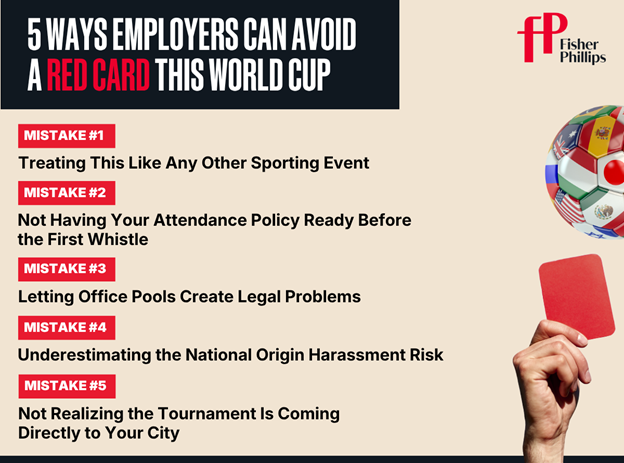
Mistake #1: Treating This Like Any Other Sporting Event
The World Cup will feature five weeks of games running during core business hours, meaning employees will be checking scores, streaming matches, and in some cases simply not showing up to work. The legal risk isn’t necessarily the distraction itself, but if your managers inconsistently enforce your policies.
What Should You Do As An Employer? Communicate productivity and device policy expectations proactively and ensure every manager understands that consistency is non-negotiable. At the same time, you can consider leaning into the moment. Designated viewing areas for games, company sponsored watch parties, and flexible scheduling around key match days can turn a potential productivity drain into a genuine morale opportunity, provided they are managed equitably.
Mistake #2: Not Having Your Attendance Policy Ready Before the First Whistle
Employers can expect a wave of half-day requests, last-minute callouts, and fatigued employees throughout the tournament. Some matches have kickoffs as late as midnight Eastern Time, meaning your employees may be up into the wee hours. But remember that a call-out citing illness or exhaustion may trigger FMLA, state paid sick leave, or ADA considerations regardless of the real reason. Dismissive comments like “Funny how you always get sick when there’s a big game” are the kind of remarks that end up in litigation.
What Should You Do As An Employer? Train managers on what not to say and how to route attendance issues through proper leave channels. You may also want to offer flexible scheduling or pre-approved PTO around key match days to reduce unplanned absences before they happen. These proactive decisions can be a signal to your employees that you care about their well-being and boost morale, and at the same time help mitigate your business from undue operational impacts.
Mistake #3: Letting Office Pools Create Legal Problems
The World Cup is the largest wagering event in the world, and that energy will land in your workplace whether you plan for it or not. The barriers to placing a bet have never been lower, as employees can wager on any match outcome through a growing number of sports betting apps and prediction market platforms. That accessibility means workplace betting activity is likely to be more widespread and harder to monitor than in previous years. This is almost entirely a state law question, and the landscape varies widely. Even where betting is broadly legal, workplace pools may only be lawful under narrow social gambling exceptions. For multistate and remote workforces, a single bracket pool with participants in multiple states could be subject to several different legal regimes simultaneously.
What Should You Do As An Employer? The lowest risk option that still captures the fun is a company-sponsored free pool where the employer supplies the prizes and your workers don’t have to wager any money to win. If you have an existing gambling policy, remind employees that it will remain in effect and be enforced consistently during the World Cup.
Mistake #4: Underestimating the National Origin Harassment Risk
With 48 nations represented, employees may wear their nation’s jerseys, display flags, and engage in rivalries tied directly to their cultural and national identities. National origin is a protected class under Title VII of the Civil Rights Act and friendly trash talk can cross a legal line quickly if it incorporates stereotypes, derogatory language, or targets an employee in a way that makes them feel singled out based on where they are from. Employers also face risk if they inconsistently approve or deny time off or apply discipline in ways that disadvantage employees from certain national backgrounds. These decisions can give rise to discrimination claims even without discriminatory intent.
What Should You Do As An Employer? Ensure your conduct and harassment policies are up to date and remind employees that those policies are in full effect throughout the tournament. “It’s just sports” is not a defense and discriminatory jokes can lead to a hostile work environment. Train managers to recognize the line between friendly competition and protected-class targeting, and make clear that complaints will be taken seriously. On the time off and discipline side, establish a clear, neutral, and objective policy for handling requests before the competition begins and document every decision. If you discipline an employee for absenteeism, make sure you are applying the same standard regardless of which country’s match they stayed up to watch. Inconsistency in either direction is where discrimination claims take root.
Mistake #5: Not Realizing the Tournament Is Coming Directly to Your City
Everything above applies to every US employer. But if your business operates in one of the 16 host cities, including Dallas, Houston, Atlanta, Los Angeles, Miami, Boston, Philadelphia, Seattle, San Francisco, Kansas City, or the New York/New Jersey area, you face an additional and more urgent set of concerns. Hospitality, food service, retail, and transportation employers will need to scale up staffing rapidly, and that speed is precisely when wage and hour violations emerge: misclassified contingent workers, missed meal breaks, and overtime errors. Businesses near fan zones also need to review security protocols and crowd management plans that may never have applied to their locations before.
What Should You Do As An Employer? Host city employers should treat preparation as a separate workstream. Review contingent worker classification and overtime compliance now, update safety protocols before matches begin in your city, and consult our comprehensive host-city checklist for a full rundown of location-specific considerations.
Conclusion
If you have questions, contact your Fisher Phillips attorney, the author of this Insight, or any member of our Sports Industry team. Make sure you sign up for our Fisher Phillips Insight Service to ensure you receive direct and timely updates.
Related People

Regional Managing Partner, Co-Chair of Sports Industry Team
emailSend Email
phone214.220.8304