

5 Things Your School Needs to Know About the PowerSchool Naviance Wiretapping Settlement
A popular digital ed-tech platform recently paid $17.25M to settle a class action lawsuit filed by Chicago’s Board of Education that alleged it illegally tracked confidential student information through third-party analytics software – a practice commonly referred to as “digital wiretapping.” Although PowerSchool’s Naviance system is purported to be used by more than 13,000 public and private schools – representing a student population of approximately 10 million nationwide – many educators were surprised to learn of the February settlement, and some are just now hearing about it for the first time. This Insight answers the five most common questions your school has about this development.
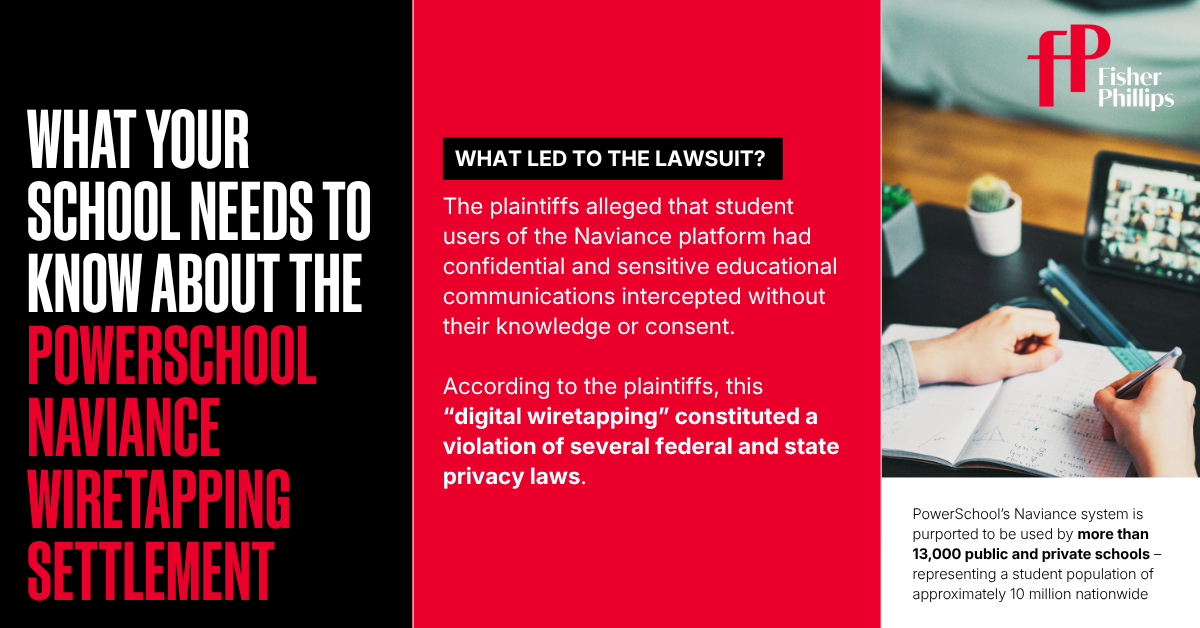
What led to the class action lawsuit against Naviance?
In their suit, the plaintiffs alleged that student users of the Naviance platform had confidential and sensitive educational communications intercepted without their knowledge or consent. According to the plaintiffs, this “digital wiretapping” constituted a violation of several federal and state privacy laws, including the Electronic Communications Privacy Act, the California Invasion of Privacy Act, and the Illinois Eavesdropping Act.
While digital wiretapping suits are becoming increasingly common (as you can see on FP’s Digital Wiretapping Litigation Map), the lawsuit was even more notable given the enhanced protections that are afforded to minors and students when it comes to data privacy.
This is not to say that there is any merit to these allegations or that a clear and well-established violation of the law occurred. Indeed, many courts have rejected these types of claims for a variety of reasons, reasoning that wiretapping laws predating the Internet should not apply to digital tracking and analytics tools, or that other privacy laws preempt the field when it comes to sharing data through website cookies and pixels, or that data about a user’s digital activity isn’t confidential enough to establish harm. That said, many courts have reached the opposite conclusions, leaving businesses like PowerSchool under pressure to settle such claims to avoid an adverse ruling that could be an existential threat to their businesses due the potential for staggering statutory penalties.
What are the terms of the settlement?
As part of the settlement, the defendants set aside $17.25M to pay approved claims that are submitted by members of the settlement class. Members of the class who file a timely and valid claim are eligible to receive a one-time, pro-rated cash payment from the deal. The amount of any payment will depend on the total number of valid claims filed.
It’s important to note that, in the settlement, the defendants denied fault but agreed to settle to avoid protracted litigation. The agreement explicitly sates that the defendant’s decision to settle the case should not be “deemed or construed to be an admission or concession of liability or wrongdoing.”
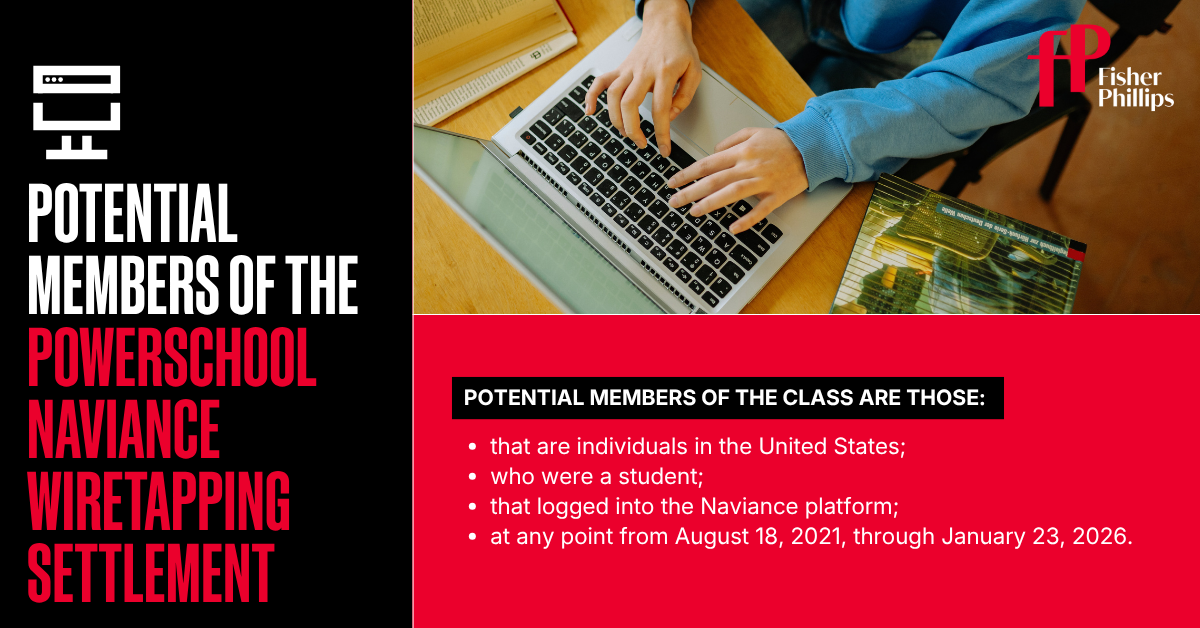
How do potential members of the class know if they have a valid claim?
Potential members of the class are those:
- that are individuals in the United States;
- who were a student;
- that logged into the Naviance platform;
- at any point from August 18, 2021, through January 23, 2026.
More information can be obtained by visiting the settlement website or by calling the settlement administrator at (833) 447-8852. The form to submit a claim can be found here and must be submitted by July 27, 2026. If you still have questions as to whether you qualify as a member of the settlement class, you should speak with a legal professional.

Are schools or other educational institutions that used the Naviance platform obligated to advise potential class members that they may have a claim?
No. The job of notifying potential claimants is that of the settlement administrator and plaintiffs’ counsel. Educators, administrators, and staff members of educational institutions that used Naviance during the period in question have no affirmative requirement to convey news of the settlement to students that may have a claim.
However, nothing bars you from doing so, either. We suggest that you reach out to the attorneys in our Fisher Phillips' Education Practice Group if you have any questions and to discuss if it makes sense to proactively or reactively communicate with your students / alumnus on this settlement. Our team can help you prepare any communications that you elect to send.
What should schools or other educational institutions do if they receive questions from parents or the community?
Parents of affected students or members of the community at large may reach out to your institution with questions about this settlement. We strongly recommend having a prepared reactive statement (which our team can help you prepare) ready to go. You should avoid providing any legal advice, either way, as to whether they should file a claim. Instead, you should direct them to the resources (like the settlement website and telephone hotline), where they can obtain more information and/or encourage them to confer with an attorney on how best to proceed.
Again, if you have specific questions on how to develop your approach, you should reach out to the attorneys in our Fisher Phillips' Education Practice Group.
Conclusion
Fisher Phillips will continue to monitor developments and provide updates as warranted, so make sure you are subscribed to Fisher Phillips’ Insight System to get the most up-to-date information direct to your inbox. If you have questions, please contact your Fisher Phillips attorney, the authors of this Insight, or any member of our Education Practice Group or our Digital Wiretapping Litigation Team.
Related People