
Our International thought leaders have pulled together their top predictions for the new year so that employers can get a head start to 2026. If you want more, register for our FP Workplace Law Forecast Webinar here.
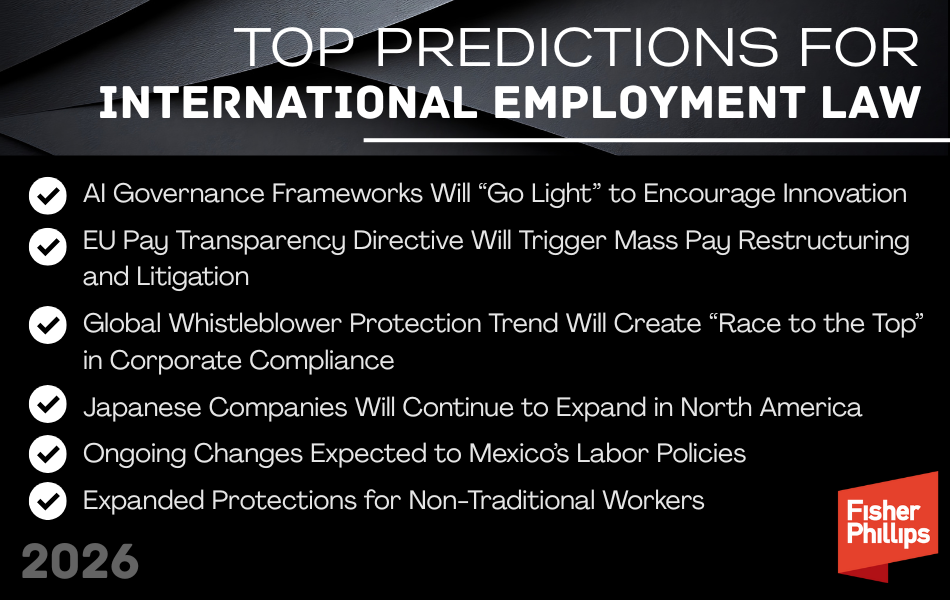
AI Governance Frameworks Will “Go Light” to Encourage Innovation
Despite the fact that 2025 saw stricter AI regulations, the new global trend in 2026 will focus on advancement and voluntary guidelines rather than mandatory guardrails. Notably in the Asia-Pacific (APAC) region, Japan, Singapore, India, and Australia are making moves that encourage AI use and attract investment while also addressing safety and transparency. In fact, we predict the stringent EU AI Act will not become a global model and most jurisdictions will diverge rather than align.
EU Pay Transparency Directive Will Trigger Mass Pay Restructuring and Litigation
Companies with 100+ employees must report gender pay gaps and disclose salary ranges in job postings by June 2026. A significant portion of EU companies will face pay equity challenges using “work of equal value” assessments – a complex methodology most have never implemented – triggering widespread audits and litigation by 2027.
Global Whistleblower Protection Trend Will Create “Race to the Top” in Corporate Compliance
Global whistleblower claims will substantially increase as employees test strengthened protections – Japan now criminalizes whistleblower retaliation, EU has boosted protections, and Singapore, China, and India introduced enhanced frameworks. Multinationals will increasingly adopt the strictest standards globally to avoid compliance fragmentation. Meanwhile, ESG investors will demand whistleblower protection audits as governance metrics.
Japanese Companies Will Continue to Expand in North America
As companies accelerate US expansion – due to favorable policy shifts, rising demand for domestic supply chains, and shifting population – you’ll need to carefully evaluate if a potential landing site makes strategic, operational, and financial sense. You can review our site selection checklist here, but if you’re unsure about where to start, check out why many Japanese companies are heading to Texas. Regardless of where you land, your leadership teams will need to understand the nuances of US workplace law.
Ongoing Changes Expected to Mexico’s Labor Policies
- Workweek Reduction Will Be Implemented. We anticipate that the long-discussed reform to reduce the weekly work schedule from 48 to 40 hours will move forward and receive political approval, with gradual implementation beginning in 2026.
- Renegotiation of the USMCA/T-MEC. The United States-Mexico-Canada Agreement (USMCA), known as “T-MEC” in Mexico, has played a key role in Mexico’s labor reform by including strong labor provisions and compliance obligations since 2020. As the joint review of the USMCA approaches, we expect labor issues to be central to the renegotiation.
- Continued Pressure to Raise Compensation. Significant annual increases to the minimum wage will likely continue, impacting internal pay structures and collective bargaining negotiations.
Expanded Protections for Non-Traditional Workers
Multinational businesses should prepare for upcoming regulatory changes related to non-traditional workers, including freelancers and gig workers. For example:
- EU member states will need to adopt a new directive before the end of 2026 that seeks to curb worker misclassification, ensure algorithm transparency, and enhance working conditions and data protection for individuals engaged in platform work, including freelance, on-demand, and gig work.
- The first-ever law protecting freelancers and independent contractors in Japan came into effect in 2024. The law already requires businesses that do work in the country to review their workplace practices and adjust as necessary, and we expect regulations to be expanded and refined in 2026.
- Companies doing business in Mexico should also expect the government to advance and strengthen regulations for digital platform workers in the year ahead.
|
Want More?
|
Conclusion
We will continue to monitor developments related to all aspects of international employment law. Make sure you are subscribed to Fisher Phillips’ Insight System to get the most up-to-date information. If you have questions, contact your Fisher Phillips attorney, the authors of this Insight, or any member of our International Practice Group.
Related People